How to Choose Media Outlets That Build Real Brand Trust
The right media outlets do more than publish your announcement. They help buyers, partners, investors, and AI systems understand why your brand deserves attention and trust.

Get featured on 500+ media outlets
Guaranteed placement, no PR experience needed.
Choosing media outlets is not just a PR logistics decision. It is a trust decision.
A placement in the wrong publication can look random, feel promotional, and disappear without changing how people perceive your brand. A placement in the right publication can become third-party proof that supports sales conversations, investor updates, hiring, partnerships, search visibility, and long-term reputation.
The challenge is that “more coverage” does not always mean “more trust.” A list of 500 media outlets may sound impressive, but the real question is whether those outlets are credible, relevant, visible, and aligned with the audience you need to influence.
Here is how to choose media outlets that build real brand trust, not just a longer logo strip.
Why media outlet selection matters for brand trust
People rarely trust a brand because the brand says it is trustworthy. They trust it because consistent signals from other sources make the claim believable.
Media coverage is one of those signals. When your company appears in a known business publication, a respected trade journal, a relevant local outlet, or a credible industry news site, the outlet lends context to your story. It tells readers, prospects, and partners that your announcement was worth publishing in a place they already recognize or respect.
But that transfer of credibility only works when the outlet makes sense. If a cybersecurity startup is published only on generic lifestyle sites, the coverage may create links, but it will not do much to convince security buyers. If a regional healthcare provider ignores local media and only chases broad national syndication, it may miss the publications its patients actually read.
Trust is built through fit. The best media outlets for your brand are the ones your target audience would expect to see you in, the ones with enough editorial credibility to validate your story, and the ones that remain discoverable after launch day.
Start by defining the trust outcome you want
Before building a media list, decide what kind of trust you are trying to earn. A founder looking for investor confidence needs different media signals than a local service business trying to reassure customers. A B2B SaaS company selling to enterprise buyers needs different proof than a consumer brand launching a new product line.
For most brands, media trust falls into four categories.
Customer trust comes from appearing where potential buyers already research solutions, compare options, or discover credible companies. These outlets may include industry blogs, product review publications, local media, or business news sites.
Investor and partner trust comes from outlets that signal momentum, legitimacy, market relevance, and operational seriousness. Business, finance, startup, and industry-specific publications often matter here.
Search and AI visibility trust comes from coverage that creates authoritative references across the web. Search engines and AI systems depend on credible public information to understand entities, topics, and relationships. If this is a priority, outlet quality and link integrity matter. MediaBoost has also covered how high quality backlinks can strengthen brand visibility when they come from credible sources.
Internal trust matters too. Media placements can support sales decks, hiring pages, email campaigns, investor newsletters, and partnership outreach. In that context, the right publication is one your stakeholders immediately recognize as relevant.
A strong media strategy usually serves more than one of these outcomes, but one should lead. That priority will help you separate useful media outlets from vanity placements.
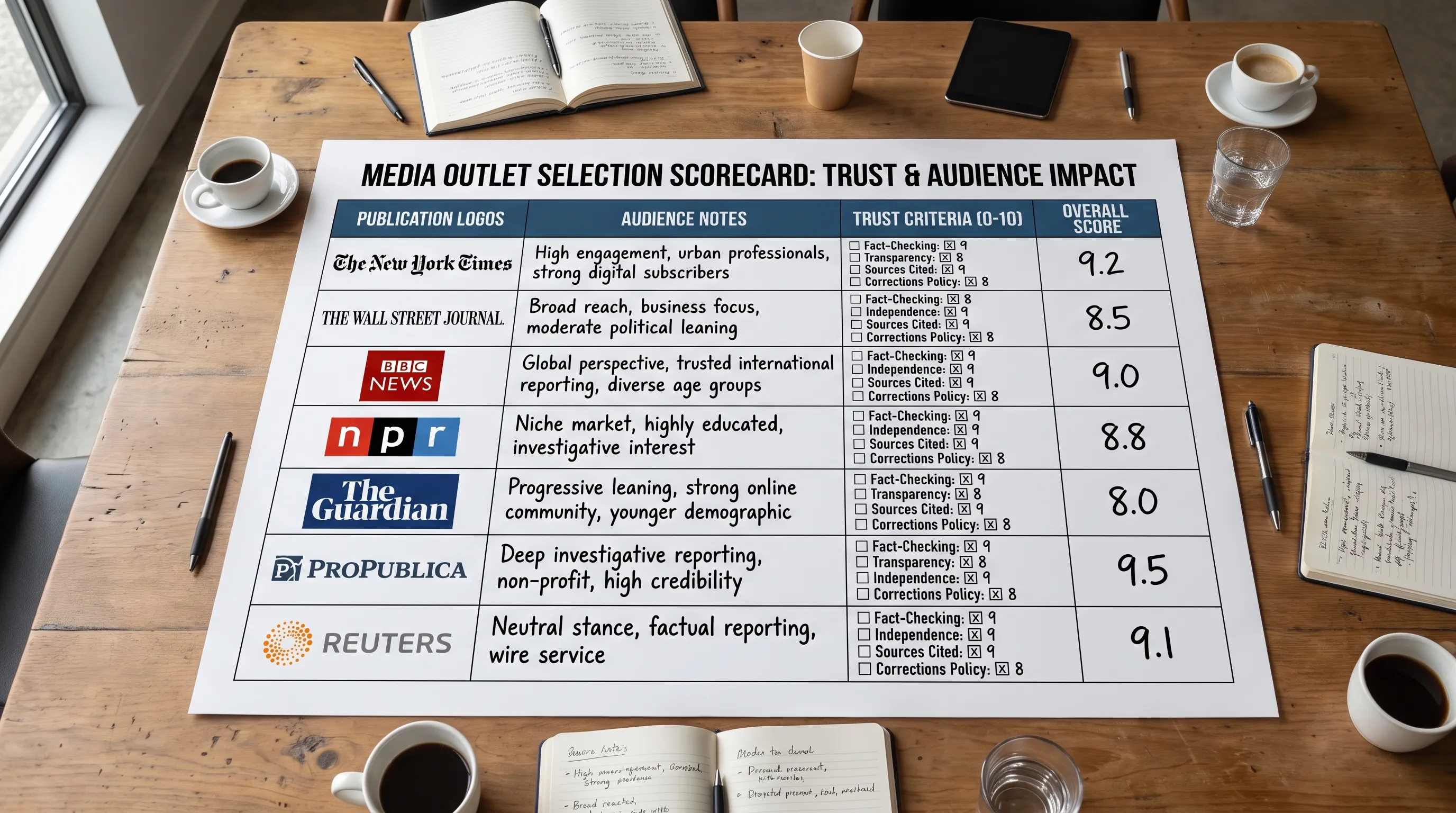
The trust-building media outlet scorecard
Not every outlet needs to be famous. Some of the most valuable publications are niche, technical, regional, or industry-specific. The key is to evaluate each outlet against the right criteria.
| Evaluation factor | What to look for | Why it builds trust | Red flag |
|---|---|---|---|
| Audience fit | Readers match your buyers, investors, partners, or community | Coverage reaches people whose opinion matters | The outlet publishes every category with no clear audience |
| Editorial credibility | Clear authorship, sourcing, editorial standards, and quality control | Readers feel the publication has judgment | Anonymous content, thin articles, or obvious content farms |
| Topical authority | Regular coverage of your industry, market, or business model | Your story appears in a relevant context | Your announcement looks unrelated to surrounding content |
| Discoverability | Pages are indexed, searchable, and easy to reference later | Coverage keeps working after launch day | Articles are hard to find or disappear quickly |
| Brand environment | Clean layout, reasonable ads, reputable neighboring content | Your brand appears in a professional setting | Spammy ads, misleading headlines, or low-quality content |
| Proof value | Recognizable name, strong niche reputation, or useful link equity | Placement can support sales, SEO, and reputation | The outlet cannot provide live links or reporting |
This scorecard helps you avoid the common mistake of ranking media outlets only by name recognition. A recognizable mainstream outlet can be powerful, but a respected niche publication may create more trust with the specific audience you are trying to influence.
Match media outlets to the people you need to convince
A trustworthy media list starts with the buyer, reader, or stakeholder, not the outlet database.
If your product is technical, industry outlets often carry more persuasive weight than broad consumer sites. If your brand serves a city or region, local media can create immediate familiarity. If your announcement involves funding, market expansion, leadership, or financial milestones, business and finance outlets may be the right trust signal.
The Reuters Institute Digital News Report has consistently shown that trust in news varies significantly by market, source, and audience behavior. That means your media choices should reflect where your specific audience places attention and credibility, not just which publications have the largest reach.
| Brand goal | Strong outlet fit | Why it works |
|---|---|---|
| Launch a B2B product | Trade publications, business outlets, technology media | Buyers see your company in a professional context |
| Build local credibility | City, regional, and community news outlets | Local audiences recognize the publication and relevance |
| Support fundraising or partnerships | Finance, startup, business, and industry outlets | Stakeholders see momentum and market seriousness |
| Improve search presence | Indexed publications with live links and topic relevance | Coverage creates durable public references |
| Establish expert authority | Niche journals, analyst-style publications, and vertical media | Your expertise is framed for a knowledgeable audience |
The best strategy is often a mix. One recognizable business publication may help with broad legitimacy, while several niche outlets help with audience-specific persuasion.
Look beyond the logo and inspect the placement type
A media outlet’s name matters, but the placement format matters too. There is a difference between an editorial feature, a contributed article, a sponsored post, a syndicated press release, and a short announcement.
None of these formats is automatically bad. Each serves a different purpose. Editorial coverage can be highly persuasive because it involves independent judgment. A press release can be useful because it provides controlled, accurate information at scale. Sponsored or guaranteed placements can be effective when transparency, quality, and relevance are handled properly.
The trust issue appears when brands use the wrong format for the wrong goal. If you need independent validation, a basic press release may not be enough. If you need fast, accurate distribution of a funding announcement or launch update, a press release network may be exactly the right tool.
If you are weighing predictable placement against traditional pitching, MediaBoost’s guide on whether guaranteed media coverage is a smart move for small businesses explains the tradeoffs in more detail.
The practical rule is simple: choose the format that matches the promise you want the coverage to make. Do not present a syndicated announcement as investigative journalism. Do not rely on a niche editorial mention when you need broad public distribution. Trust grows when the format is clear, relevant, and honest.
Red flags that a media outlet may not build trust
Some outlets create the appearance of coverage without much reputational value. Before including a publication in your strategy, check for warning signs.
- The site has no clear editorial standards, ownership information, or contact details.
- Most articles look generic, duplicated, or written only for search traffic.
- The outlet publishes unrelated topics with no clear audience or editorial focus.
- Ads, pop-ups, or misleading widgets dominate the reading experience.
- Pages are not indexed or are difficult to find after publication.
- The outlet does not provide live links, proof reports, or stable URLs.
- The publication’s surrounding content could harm your brand by association.
A single red flag does not always disqualify an outlet, but several together should make you cautious. Brand trust is not built in isolation. Your story is judged partly by the company it keeps.
Balance reach, relevance, and credibility
Many brands struggle with the same question: should they prioritize premium outlets or broad distribution?
The answer depends on the announcement and the audience. Premium outlets are useful when recognition and authority matter most. Niche outlets are useful when relevance and expertise matter most. Broad distribution is useful when you need scale, search coverage, and a larger public footprint.
For example, a startup announcing a seed round may want business and startup publications for investor credibility, industry outlets for buyer relevance, and wider syndication to make the announcement easier to discover. A local healthcare brand may prioritize regional media first, then add broader health or business outlets only if the story has wider relevance.
This is why a strong media plan should not be built around one metric, such as domain authority, audience size, or outlet count. Those metrics can help, but they do not replace judgment. The right question is: “Will this placement make the people we care about more likely to believe us?”
Make the announcement worthy of the outlet
Even the best media outlets cannot build trust if the story itself feels thin. Publication quality and message quality work together.
A trust-building announcement should be specific. Instead of saying your company is “revolutionizing the industry,” explain what changed, who it helps, and why it matters now. Include concrete details such as launch dates, product capabilities, market expansion, funding milestones, customer impact, research findings, or leadership experience.
Quotes should add perspective, not repeat the headline. A founder quote that explains the customer problem, the market shift, or the company’s strategic direction creates more credibility than a generic celebration.
Accuracy matters too. Exaggerated claims can weaken the value of even strong placements. If you mention performance results, customer numbers, awards, partnerships, or rankings, make sure they are verifiable. If the placement is sponsored or distributed through a press release service, keep the format transparent.
Google’s guidance on creating helpful, reliable content emphasizes people-first information, expertise, and trust. The same principle applies to PR. Media coverage works best when the content is genuinely useful to the reader.
Build a media outlet mix instead of a one-off list
Real brand trust usually comes from repeated, coherent signals over time. One placement can create a proof point. A thoughtful mix of media outlets can create a reputation.
A balanced media mix may include:
| Outlet type | Best use | Trust contribution |
|---|---|---|
| Recognizable business or finance outlets | Funding, growth, partnerships, executive announcements | Broad legitimacy and stakeholder confidence |
| Industry and trade publications | Product launches, expert commentary, technical updates | Relevance and category authority |
| Local or regional media | Community news, local expansion, hiring, events | Familiarity and geographic trust |
| Search-visible syndication outlets | Press releases, official announcements, public proof | Discoverability and durable references |
The mix should evolve as your company grows. Early-stage brands may need credibility signals that help prospects take them seriously. Growth-stage brands may need broader coverage that supports category leadership. Established brands may need media outlets that reinforce expertise, transparency, and market relevance.
Measure whether outlets are actually building trust
Trust is not as easy to measure as clicks, but it leaves evidence. After a campaign, review more than the number of placements.
Look at whether sales teams use the coverage in outreach. Check whether prospects mention the article during calls. Monitor branded search activity, referral traffic, indexed links, and conversions assisted by media pages. Track whether partners, investors, or customers engage with the coverage when you share it.
A proof report is especially useful because it turns placements into assets your team can reference. Live links, outlet names, publication dates, and page URLs make it easier to use coverage in sales decks, investor updates, website trust sections, and SEO reporting.
For SEO and AI visibility, focus on the quality and consistency of public references. Coverage across relevant, trusted media outlets helps create a clearer digital footprint for your brand. That footprint can support both human trust and machine understanding over time.
Frequently Asked Questions
What makes a media outlet trustworthy for a brand? A trustworthy media outlet has a relevant audience, credible editorial standards, clear publication practices, stable live pages, and a brand environment that makes your company look legitimate. The outlet does not need to be globally famous if it is respected by the audience you want to influence.
Are big-name media outlets always better than niche outlets? No. Big-name outlets can create broad recognition, but niche outlets often create stronger trust with specific buyers, investors, or industry peers. The best choice depends on your goal, audience, and announcement.
How many media outlets should a press release target? There is no universal number. A focused campaign may need a small group of highly relevant outlets, while a broad announcement may benefit from wider distribution. Quality, relevance, and proof value matter more than outlet count alone.
Can guaranteed media placements build real trust? Yes, if the outlets are credible, the story is relevant, the placement format is transparent, and the campaign includes live links or proof reports. Guaranteed placement is most effective when it supports a clear PR goal rather than replacing brand strategy.
Should I choose media outlets for SEO or credibility? Ideally, both. Strong media outlets can support credibility with human readers while also creating authoritative public references for search engines. Avoid choosing outlets only because of a metric if the audience or brand environment is a poor fit.
Choose media outlets that make your brand easier to believe
The right media outlets do more than publish your announcement. They create proof that your brand is active, relevant, credible, and worth paying attention to.
MediaBoost helps brands distribute press releases across 500+ trusted publications with done-for-you submissions, editorial review, guaranteed live backlinks, and proof reports. Packages can be tailored by industry and completed quickly, often within 48 hours.
If you want coverage that supports brand trust, SEO, and visibility in AI search results, explore MediaBoost’s press release distribution services and build a media presence your audience can verify.