What Is Online Authority Beyond Domain Scores?
A high domain score cannot tell customers whether your business deserves their trust. Learn how expertise, reputation and independent evidence work together, plus practical ways to measure credibility without chasing a single metric.
Get featured on 500+ media outlets
Guaranteed placement, no PR experience needed.
Online authority is the credibility a person, business or website earns around a particular subject through demonstrable expertise, useful information and recognition from others. It influences whether people trust your advice, cite your work or consider buying from you. A domain score can describe part of your backlink profile, but it cannot establish that you deserve that trust.
For a business investing in content, SEO or press coverage, that distinction changes what is worth building and measuring.
Four concepts that should not be confused
Expertise, reputation, authority and SEO metrics overlap, but they answer different questions.
| Concept | Question it answers | Evidence to examine |
|---|---|---|
| Expertise | Can this person or business do the work? | Relevant experience, documented methods and accurate explanations |
| Brand reputation | What do people believe about this business? | Customer feedback, complaint handling and consistency over time |
| Topical authority | Is this a dependable source on this subject? | Useful coverage, original contributions and relevant independent references |
| Third-party domain score | How does this tool assess the website’s link strength? | The provider’s model, backlink data and comparison set |
A respected specialist might have a modest website with few backlinks. A heavily linked website might publish weak advice outside its actual competence. Neither case is unusual enough to justify treating these concepts as interchangeable.
Authority is also contextual. Being a credible source on commercial accounting does not make a company qualified to advise on medical treatment.
Why is online authority different from a domain score?
Moz’s Domain Authority and Ahrefs’ Domain Rating are proprietary metrics. They use different models to summarize aspects of a website’s link profile. They are not Google-issued credibility ratings, and Google does not use those third-party scores as ranking metrics.
These tools remain useful for competitive research. A score can help you identify an established competitor or investigate a change in link strength. It cannot verify an author’s qualifications, the accuracy of a claim or the quality of customer support.
Google’s guidance on helpful, reliable, people-first content encourages publishers to consider experience, expertise, authoritativeness and trustworthiness. The same guidance explains that E-E-A-T is not a specific ranking factor. It is a framework for assessing qualities that Google’s systems seek to recognize through multiple signals.
Use domain metrics as diagnostic tools, not certificates. Our guide to building domain authority for better SEO results covers their practical role in benchmarking. The broader task is to make your competence understandable and verifiable.
Make expertise visible through evidence
Online authority becomes more credible when readers can inspect the basis for your claims. “We understand your industry” is less useful than a clear explanation of a difficult industry problem, supported by a real example.
Start with identifiable authors and relevant experience. A biography should explain why someone is qualified to address the topic, without inflating their credentials. Where qualifications matter, make them verifiable. Where direct experience matters more, show the work.
Useful evidence might include an original analysis with a stated methodology, a case study with customer permission or a product comparison that explains its testing conditions. Include limitations so readers understand where the findings apply.
Specificity matters for service businesses too. A traveler considering local help and travel assistance in Japan through Japan Hand needs to understand what help is available, which locations are covered and how booking works. Those practical details help someone assess suitability more directly than a generic claim of being a leading travel resource.
Website usability supports this process. Clear navigation, readable service descriptions and accessible contact information make evidence easier to find. They do not prove expertise by themselves, but confusing pages can prevent genuine expertise from being recognized.
Separate independent recognition from paid distribution
Online authority is stronger when recognition comes from sources with relevant knowledge and a genuine reason to mention you. A professional association citing your research or a journalist independently requesting your analysis offers a different kind of evidence from a syndicated announcement.
Press release distribution has a legitimate role. It can make a launch, partnership or research finding accessible across publication websites and give interested readers a public reference. However, a published release is not automatically an editorial endorsement, and repeated copies do not represent separate investigations of your claims.
Describe placements accurately. “Our announcement was distributed to these publications” is different from “these publications recommend us.” Likewise, a publication logo should not imply an endorsement that never occurred.
Paid links require care. Google’s spam policies on link spam address links created primarily to manipulate rankings, including optimized anchor text in distributed press releases. Advertising and sponsorship links should be appropriately qualified, typically with rel="sponsored" or rel="nofollow".
When comparing a backlink service, examine relevance, placement context and transparency rather than buying a domain score. A guaranteed live link does not guarantee indexing, ranking improvements or inclusion in an AI-generated answer.
Measure online authority with several kinds of evidence
A useful measurement system separates visibility, credibility and business outcomes. Otherwise, a large increase in published URLs can look like progress even when nobody relevant notices them.
Choose indicators that match your current objective:
| Indicator | What it can help you understand | What it does not prove |
|---|---|---|
| Relevant independent mentions | Whether knowledgeable sources recognize your work | That every mention is positive or influential |
| Branded search activity | Whether more people may be seeking your business by name | Why interest changed or whether trust increased |
| Qualified referral visits | Whether external coverage reaches potential customers | That every visit will become a sale |
| Citations of original work | Whether others find your contribution useful enough to reference | That your methods or conclusions are necessarily correct |
| Inquiry quality and customer feedback | Whether prospects understand your expertise and customers value the result | That content or PR alone caused the outcome |
Record a baseline before publishing or distributing an announcement. Review patterns over a period appropriate to your sales cycle rather than declaring success from a single week’s movement.
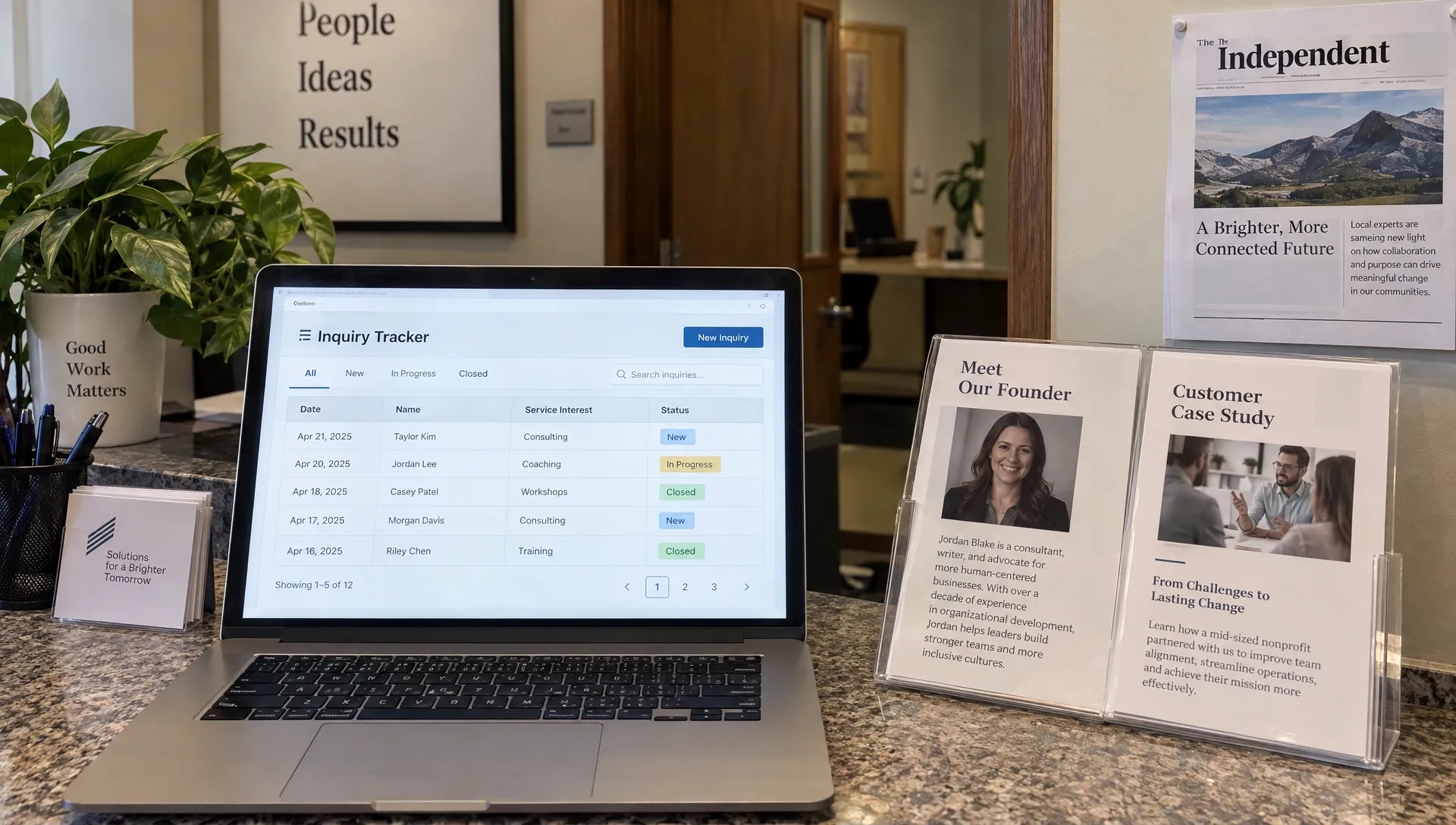
Add qualitative evidence. Ask prospects where they first heard about you and what helped them decide to make contact. Their answers can reveal credibility signals that analytics miss.
For AI search, record which queries you tested, the platform and the date. An isolated mention is an observation, not proof of durable visibility. Generated answers vary, and neither media coverage nor structured content guarantees inclusion.
A practical starting plan for small teams
Building online authority does not require publishing every day or appearing on every social platform. A solo expert or small business can begin with one narrow subject and a small collection of convincing evidence.
Choose a problem you can credibly own
Select a recurring customer question that you can answer from direct experience. A bookkeeping firm might explain how to prepare records for a particular type of business rather than trying to cover every finance topic.
Review your existing material first. Sales conversations, support questions and completed projects often reveal useful subjects without requiring a new research budget. Protect confidential information and get permission before identifying customers.
Publish one substantial proof asset
Create something readers can inspect and use: a worked example, an original dataset, a decision guide or a detailed process explanation. State who produced it, how it was developed and where its limits lie.
Then make the surrounding trust information consistent. Your author biography, service pages and business profiles should agree on names, experience and scope. A clear correction process is more credible than pretending mistakes never happen.
Share it with a relevant audience
Send the resource to a small number of industry contacts who would genuinely benefit from it. Contribute useful answers in professional communities and offer relevant commentary when journalists or event organizers need it.
Use social channels to explain the findings and invite informed discussion, not merely to repeat promotional headlines. Distribution should help the right people discover the evidence. It cannot substitute for having evidence worth sharing.
Check credibility before you publish or trust a claim
Online authority should survive a basic verification exercise. Whether you are assessing your own website or another source, ask who is responsible for the information, what supports it and whether independent evidence agrees.
Watch for credentials that cannot be verified, case studies with no meaningful details and claims that become broader each time they are repeated. A testimonial about friendly service does not establish technical expertise. A famous customer logo does not explain what work was delivered.
Also distinguish disagreement from unreliability. A credible author can reach a different conclusion while showing their methods and acknowledging uncertainty. An unreliable source may offer certainty without evidence.
Keep commercial incentives visible. Disclose relevant sponsorships, affiliate relationships and paid placements. Buying reviews, inventing customer results or presenting promotional coverage as independent validation can undermine the credibility your marketing is supposed to build.
Frequently asked questions
Can a small website be authoritative? Yes. A specialist website can earn trust through relevant experience, accurate information and independent recognition without having a high domain score. Its authority may be narrow, which is often appropriate for its audience.
Does online authority improve search rankings? Credible content, relevant links and a positive reputation can support search performance, but there is no universal authority score that guarantees rankings. Query relevance, competition and technical accessibility also matter.
Do social followers prove expertise? No. Followers indicate audience size, not necessarily competence or trust. More useful evidence includes substantive discussion, relevant professional recognition and people applying or citing the work.
How long does building credibility take? There is no dependable universal timeline. Making qualifications and contact details clearer can help immediately, while earning repeat recommendations and independent recognition requires sustained work. Measure both early improvements and longer-term patterns.
Give your next announcement evidence worth sharing
Before investing in distribution, identify the claim your announcement makes and the evidence that supports it. A clear launch, documented finding or specific business milestone gives readers something concrete to evaluate.
MediaBoost offers press release distribution across a network of 500+ outlets, with editorial review, done-for-you submissions and proof reports. Use distribution to make a substantiated announcement easier to discover, then assess the coverage alongside relevant visits, inquiries and independent recognition. Treat placement as one contribution to credibility, not a replacement for it.