How to Compare a Backlink Service Without Chasing Metrics
Authority scores can help, but they do not tell you whether a link is useful or safe. This guide shows how to compare providers by relevance, proof, risk control and reporting quality.

Get featured on 500+ media outlets
Guaranteed placement, no PR experience needed.
Choosing a backlink service is easy if you only sort vendors by Domain Rating, Domain Authority or the number of promised placements. Choosing well is harder, because a link that looks powerful in a dashboard can still be irrelevant, ignored by readers or risky for your brand. The better comparison starts with a different question: what evidence proves this provider can earn links that make sense for your market, your message and your long-term search profile?
Metrics still matter. They can flag obviously weak domains and help you compare scale. But they should be treated as a screening layer, not the buying criteria. A useful process compares editorial context, topical fit, transparency, reporting and risk controls before you look at the scoreboard.
What a backlink service should prove beyond authority scores
Most third-party authority scores estimate link strength using proprietary formulas. Google does not use Domain Rating or Domain Authority as ranking signals, even if those tools can be useful for analysis. The gap matters because a vendor can market a high score without proving that the placement is editorially relevant, visible to real readers or aligned with your search goals.
A backlink service that sells only metrics is asking you to trust a proxy instead of the actual asset. A strong link should be judged by where it appears, why it appears there, what surrounds it, which page it points to and whether the relationship would make sense to a human reviewer.
Google Search Central's spam policies also make the risk side clear: links intended primarily to manipulate rankings can create problems. That does not mean all link building is risky. It means your comparison process should reward quality signals that are hard to fake and penalize shortcuts that leave a footprint.
Start with the outcome, not the metric
Before comparing providers, define what the links need to do. A founder raising investor awareness may value recognizable media placements and social proof. A SaaS team may want topical authority around a category page. An ecommerce brand may need credibility signals that support both search visibility and conversion. These are different outcomes, so they should not be judged by one universal score.
The right backlink service should be able to connect its placement strategy to your business goal. If the goal is brand credibility, ask how the publication mix supports trust. If the goal is SEO, ask how placements fit the topic cluster, target pages and anchor text profile. If the goal is visibility in AI search results, ask whether the placements create clear, verifiable mentions across trusted sources.
This shift keeps the conversation practical. You are no longer asking who has the biggest number. You are asking who can produce the kind of evidence your brand actually needs.
Build a scorecard before you compare vendors
A scorecard prevents one shiny metric from dominating the decision. The logic is similar to any high-stakes vendor decision: a structured supplier comparison process gives you a fairer view than comparing isolated claims, especially when providers package their offers differently.
A backlink service should be scored across the same criteria as its competitors. You can adjust the weights depending on whether you care most about PR visibility, SEO authority, reputation building or a mix of all three.
| Criterion | What to check | Why it matters |
|---|---|---|
| Topical relevance | Publication category, article context and audience fit | Relevant links are more defensible and usually more useful |
| Editorial context | Whether the link appears naturally inside meaningful content | Context helps readers and search engines understand the mention |
| Placement transparency | Sample URLs, publication examples and link attributes | You need to know what you are buying before you compare price |
| Risk controls | Anchor text policy, site quality checks and spam avoidance | Risky links can cost more later than they save upfront |
| Reporting quality | Live URLs, proof reports and placement details | Good reporting lets you verify value after delivery |
| Operational fit | Turnaround, review process and communication quality | Smooth execution matters when timing or compliance is sensitive |
Use the scorecard as a discussion tool, not a rigid procurement form. A vendor with fewer placements may still be the better choice if the links are cleaner, more relevant and easier to verify.
Relevance should beat raw authority
A high-authority site in the wrong niche can be less valuable than a moderately authoritative source that reaches the right audience. For example, a B2B cybersecurity brand should not be impressed by a lifestyle blog link just because the domain score looks strong. The audience, topic and surrounding content should all make sense.
When a backlink service can explain why a publication fits your category, that is a stronger signal than a screenshot of a score. Ask for examples from your industry or adjacent industries, not just the provider's best-known logos.
Editorial context is where quality becomes visible
A quality placement should read like it belongs. The link should support the article, not interrupt it. It should point to a page that helps the reader continue the topic, such as a relevant resource, product page, study, company announcement or category page.
Look for context around the link. Is the surrounding paragraph useful? Does the article have a real editorial angle? Is the anchor text natural? If every example uses exact-match commercial anchors, that may signal a process built for short-term ranking movement rather than durable credibility.
Risk signals deserve their own column
Risk is not always obvious from authority metrics. Some domains keep decent scores while publishing thin, unrelated or overly promotional content. Others have inflated traffic estimates from irrelevant pages. Before you buy new links, it helps to understand your existing profile; MediaBoost's guide on how to analyze backlinks for quality, relevance, and risk walks through the checks that make this easier.
Red flags include vague publisher lists, guaranteed exact-match anchors, no editorial review, no live URL reporting and pricing that makes legitimate content production unlikely. None of these signals proves a vendor is harmful on its own, but together they should push the score down.
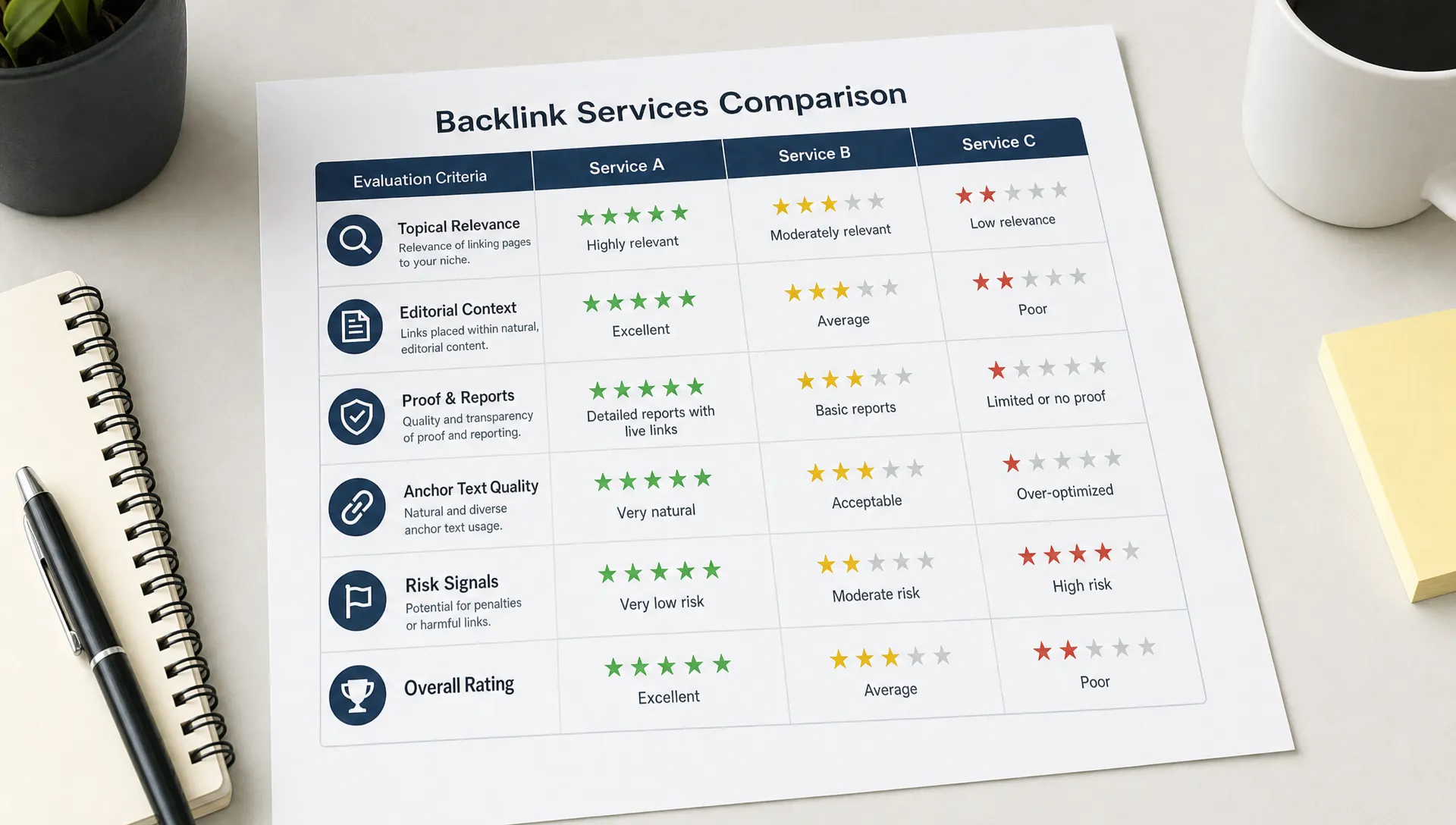
Compare deliverables like an operator
Before any backlink service earns your budget, get precise about what will be delivered. Placement count is only one line item. The more important question is what each placement includes and how much control you have before publication.
Ask vendors to define the following in plain language:
- The expected publication type, such as media outlet, niche publication, contributed article or press release syndication
- Whether you receive live links, screenshots, proof reports or all three
- Whether content goes through editorial review before submission
- Which pages can be linked and how anchor text is selected
- Whether link attributes such as sponsored, nofollow or dofollow are disclosed in reporting
- What happens if a placement is rejected, delayed or removed soon after publication
These details make quotes comparable. One provider may include writing, editing, submission and reporting. Another may only broker a placement. A lower price is not automatically better if your team must absorb strategy, copywriting, review and verification work.
For press release distribution, deliverables can also include breadth of publication exposure, recognizable media logos, turnaround time and proof that placements went live. MediaBoost, for example, offers done-for-you submissions, editorial review, guaranteed live backlinks and SEO proof reports as part of its media placement model.
Ask for proof, not promises
A credible backlink service should welcome verification. That does not mean every client campaign can be shared publicly, because confidentiality is real. It does mean the provider should be able to show recent sample placements, explain its process and describe how it avoids low-quality sources.
Good proof is specific. Instead of accepting a claim such as high authority placements, ask to see the kind of page where your link would appear. Review the article quality, the publication category, the number of outbound links and the fit between the topic and the destination page. If the vendor cannot explain how it chooses publishers, you are buying a black box.
You can also ask process questions before signing. Who writes or reviews the content? What happens if the proposed angle is weak? How are anchors approved? How are placements documented? MediaBoost has a separate guide on what link building companies should prove before you hire if you want a deeper checklist for vendor conversations.
Evaluate reporting as part of the product
If a backlink service reports only a total placement count, you still cannot judge value. Reporting is not administrative paperwork. It is how you verify that the work happened, assess whether the placements match the promise and decide what to do next.
A useful report should include the live URL, publication name, target page, anchor text, publication date and any known link attribute. For PR-style campaigns, proof reports can also help internal teams share credibility wins with sales, investors or leadership. That matters because backlinks are not only an SEO asset. They can also support social proof and brand trust.
Reporting should also be easy to audit later. Your team may need to revisit placements during a quarterly SEO review, a content refresh or an agency handoff. A folder of screenshots without live URLs is weak evidence. A clean report with verifiable links is much more useful.
Price the offer against risk and opportunity cost
A cheaper backlink service may be more expensive once you include cleanup risk, wasted content, weak placements and the time your team spends chasing reports. At the same time, a high price does not guarantee quality. The point is not to buy the most expensive option. The point is to understand what the price includes.
Compare quotes based on full value. Does the provider handle strategy and editorial work? Are placements relevant to your industry? Is the turnaround realistic? Do you receive proof that can be used for SEO review and brand credibility? Are you paying for guaranteed live links, or only for outreach attempts?
This is where metrics can return to the conversation, but only as supporting evidence. If two vendors are equally transparent, equally relevant and equally safe, authority and traffic estimates may help you choose. If one vendor is opaque and the other is clear, the cleaner process usually deserves more weight than the bigger score.
Red flags and green flags to keep in view
A fast comparison can miss risk because every provider knows how to present its best case. Keep a simple red flag and green flag lens beside your scorecard.
| Red flag | Better signal |
|---|---|
| Sells only DR, DA or traffic estimates | Explains relevance, context and placement standards |
| Promises exact-match anchor text at scale | Uses natural anchors based on page fit |
| Hides publisher examples until after payment | Shares realistic samples or categories upfront |
| Offers no editorial review | Reviews content for accuracy, tone and fit |
| Sends vague screenshots instead of live proof | Provides live links and structured reports |
| Cannot explain quality controls | Documents how risky domains are filtered |
These checks will not make every decision perfect, but they make weak offers easier to spot. They also help your team avoid being swayed by a single impressive number.
Use a simple workflow to compare final options
Once you have narrowed the list, run the same workflow for each provider. First, document your goal and target pages. Second, request sample placements and reporting examples. Third, score relevance, editorial context, transparency, risk controls and operations. Fourth, compare the true scope of work behind the price. Fifth, ask final clarification questions before approving the campaign.
By the end, the best backlink service will usually be the one that makes the least ambiguous claims. You should understand where links may appear, how the content is reviewed, what proof you will receive and why the placements support your goal. If a provider cannot make those basics clear before payment, the metrics should not rescue the offer.
For a broader strategic foundation, MediaBoost's guide to safe SEO backlink building explains how to build links around relevance, editorial value and long-term trust rather than shortcuts.
Frequently Asked Questions
Should I ignore Domain Rating and Domain Authority completely? No. Authority metrics can help you screen domains and compare rough strength, but they should not drive the decision alone. Use them after you review relevance, context, risk and reporting quality.
How many backlinks should a provider deliver? The right number depends on your goal, niche, competition and current backlink profile. Ten relevant, verifiable placements can be more useful than dozens of weak links from unrelated sources.
What is the safest anchor text strategy? Natural anchor text is usually safer than forcing exact-match commercial terms. Brand names, partial-match phrases, article titles and context-led anchors tend to look more organic when they fit the surrounding content.
What should I ask before buying links? Ask for sample placements, reporting format, editorial process, link attribute disclosure, publisher quality controls, target page rules and what happens if a placement does not go live as expected.
Compare with confidence
For brands comparing a backlink service, the strongest offer is rarely the one with the loudest metric. It is the one that can prove relevance, show live placements, explain quality controls and give your team documentation that is useful after the campaign ends.
If you want media placements backed by done-for-you submissions, editorial review, guaranteed live backlinks and proof reports, MediaBoost helps brands build visibility across trusted publications while keeping the process clear and verifiable.