How to Analyze Backlinks for Quality, Relevance, and Risk
Backlink analysis is not about chasing the highest authority score. Learn how to judge quality, relevance and risk so your link profile supports SEO, brand credibility and safer growth over time.

Get featured on 500+ media outlets
Guaranteed placement, no PR experience needed.
Backlinks are one of the easiest SEO assets to misunderstand. A link from an impressive looking domain can still be irrelevant, buried on a thin page or surrounded by spam. A modest link from a real industry publication, local organization or partner page can be far more useful because it confirms who you are, what you do and why your site deserves trust.
To analyze backlinks well, do not start with a single authority metric. Start with the job each link is supposed to perform. A healthy backlink profile should support search rankings, brand credibility, referral discovery and, increasingly, entity recognition in AI-assisted search. That requires looking at three things together: quality, relevance and risk.
What backlink analysis is really measuring
A backlink audit is not just a cleanup exercise. It helps you understand whether your site is earning trust from the right corners of the web or collecting links that create noise.
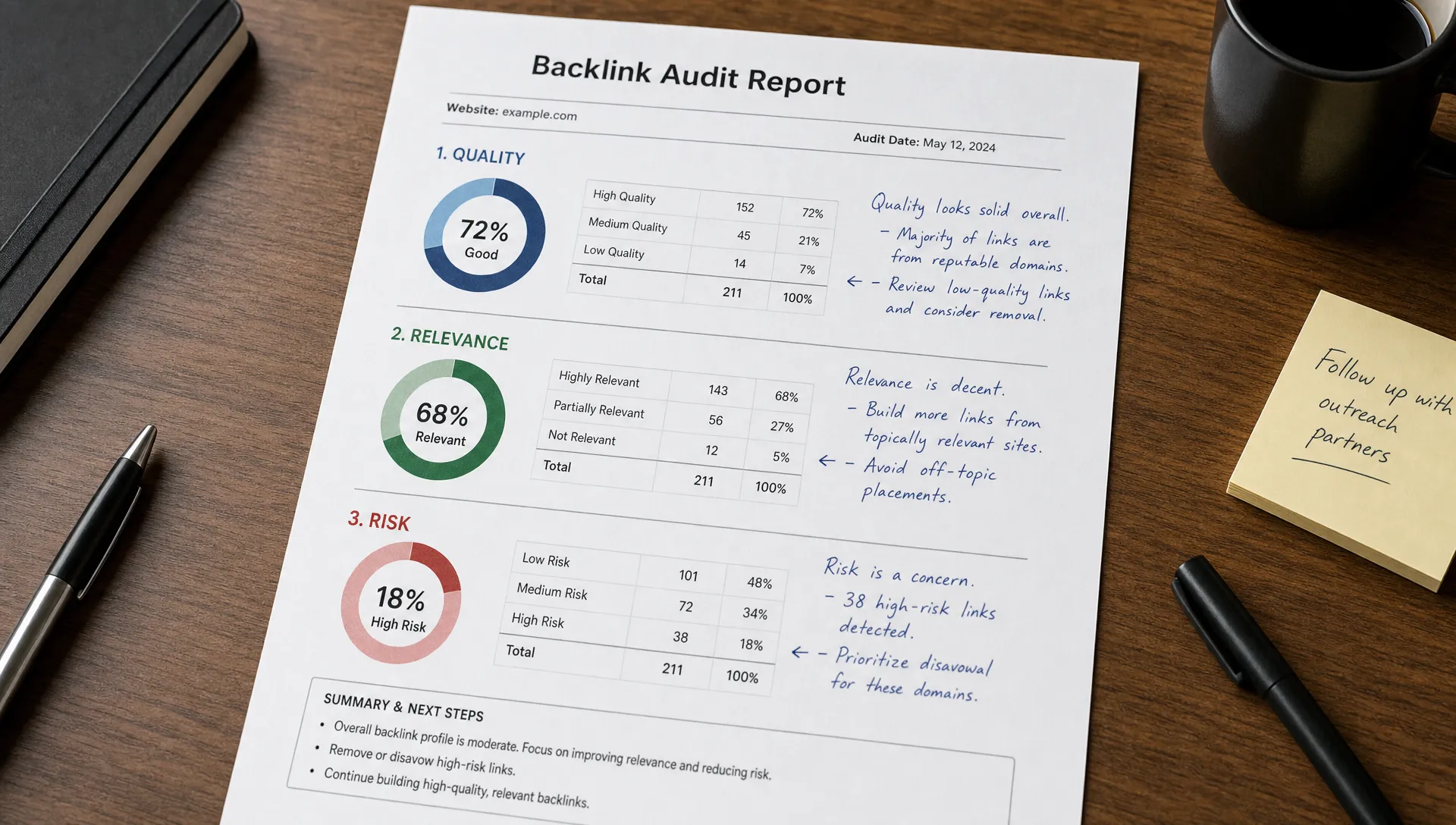
When you analyze backlinks, separate your review into three lenses:
- Quality: Is the linking site credible, indexed, maintained and useful to real readers?
- Relevance: Does the linking page make sense for your industry, audience, location or topic?
- Risk: Could the link look manipulative because of the site, placement, anchor text or pattern behind it?
The strongest backlinks usually score well in all three areas. They appear on real pages, in relevant editorial context, with natural anchor text and a clear reason for the link to exist. Weak links often fail at least one of those tests. Risky links tend to fail several at once.
Build a clean backlink inventory before scoring anything
You cannot evaluate what you cannot see clearly. Start by pulling backlink data from at least one trusted tool. Google Search Console is useful for first-party data, but SEO platforms such as Ahrefs, Semrush or Majestic can reveal more referring domains, lost links, anchor patterns and historical link velocity.
If Ahrefs is part of your workflow, MediaBoost has a deeper guide on running an Ahrefs backlink audit before you build links. That article covers tool-specific checks, while this guide focuses on the broader judgment process.
For each backlink, collect the data points that help you make a decision:
- Referring domain
- Source URL
- Target URL on your site
- Anchor text
- Link attribute, such as follow, nofollow, sponsored or UGC
- First seen date
- HTTP status of the target page
- Estimated traffic or visibility of the linking page
- Topical category, country and language when available
Do not score every URL in isolation at first. Group backlinks by referring domain, then by target page. One questionable domain linking to you from 200 tag pages is a different problem from 200 independent industry sites linking to a useful guide. Grouping prevents one noisy domain from distorting your view of the entire profile.
Analyze backlink quality without worshipping authority scores
Domain authority, domain rating and authority score can be useful shortcuts, but they are not proof of quality. They are third-party estimates. They can be inflated by old links, expired domain histories or networks that exist mainly to sell placements.
A quality backlink comes from a source that a reasonable person would trust if they landed on the page without knowing your brand. The site should have a real audience, clear ownership or editorial standards, useful content and signs of ongoing maintenance.
| Quality factor | What to look for | Why it matters |
|---|---|---|
| Real publication or business | Clear authorship, about page, contact details and original content | Shows the site exists for readers, not just link placement |
| Indexed source page | The page appears in search results and is accessible | A non-indexed page is unlikely to pass meaningful discovery value |
| Editorial context | Your link appears inside relevant content, not in a random list | Context helps search engines and readers understand why the link exists |
| Organic visibility | The domain or page ranks for real topics | Traffic suggests the site has search value beyond a metric score |
| Outbound link behavior | Links point to relevant resources, not dozens of unrelated commercial sites | Excessive irrelevant outbound linking can indicate a low-quality placement site |
| Content freshness | Recent posts, updated pages and maintained navigation | Abandoned sites often have weaker trust signals |
Not every high-quality backlink needs to come from a national publication. A niche podcast page, local chamber of commerce, supplier directory, university resource page or trade association article can be valuable if it is real, relevant and stable.
Check relevance at three levels
Relevance is contextual. A cybersecurity company does not need every backlink to come from another cybersecurity vendor. Relevant links may come from SaaS publications, compliance resources, startup interviews, procurement guides, conference pages or technology news sites.
The best way to assess relevance is to look at three levels at once.
| Relevance level | Strong signal | Weak signal |
|---|---|---|
| Topical relevance | The linking page discusses your industry, solution, problem or audience | The page is about an unrelated topic and your link feels inserted |
| Audience relevance | The readers could realistically care about your site | The audience has no clear connection to your offer |
| Geographic relevance | The site or page matches your service area when local intent matters | The link comes from a random country or city with no business connection |
For local businesses, geography can be more valuable than broad authority. A home services company in Brooklyn may get more practical value from local press, trade associations, customer stories and internet marketing specialists for service businesses than from generic high-authority blogs that never reach the right buyers. A strong backlink still needs a website that can convert visitors when they arrive.
Relevance should also be judged against the target page. A link about your founder story may fit your about page. A link in a software comparison article may fit a product page. A link from a market research article may fit a report, guide or press release. The page being linked should match the reason readers would click.
Evaluate the source page and link placement
A good domain can host a weak page. A relevant article can still contain a poor link placement. That is why page-level review matters.
Look at where the backlink appears. Links inside the main body of a relevant article usually carry more value than links in footers, sidebars, author bios, comment sections or long directories with hundreds of outbound links. The surrounding sentence should make sense. If the link could be removed without changing the meaning of the page, it may not be adding much value.
Also check whether the source page is indexable, loads properly and is not blocked by technical issues. Then review your own target page. A backlink pointing to a broken page, redirect chain, thin landing page or noindexed URL wastes potential value. In many audits, the fastest win is not removing bad links. It is fixing the pages that good links already point to.
Link attributes matter too. A nofollow or sponsored link is not automatically useless. It may still drive referral traffic, brand visibility and discovery. But if a campaign is designed to build SEO authority, you need to know which links are followed, which are attributed as sponsored and which are unlikely to pass ranking signals directly.
Read anchor text like a risk signal
Anchor text helps search engines understand a link, but over-optimized anchor text is one of the easiest ways to create risk. A natural backlink profile usually contains a mix of branded anchors, URL anchors, generic anchors, partial-match phrases and a smaller number of commercial anchors.
| Anchor type | Example | Usual interpretation |
|---|---|---|
| Branded | MediaBoost | Natural for PR, citations, mentions and directories |
| URL | mediaboost.press | Common in citations and reference-style links |
| Generic | visit the website | Normal in moderation, but not very descriptive |
| Partial match | press release distribution guide | Useful when the surrounding context is relevant |
| Exact commercial match | best press release distribution service | Higher risk when repeated across unrelated sites |
| Irrelevant anchor | casino bonus or payday loan | Strong warning sign if unrelated to your business |
Exact-match anchors are not automatically bad. They become risky when they appear repeatedly across unrelated domains, especially on thin guest posts, paid placement sites or pages with unnatural outbound link patterns.
When analyzing anchor text, compare the anchor to the linking page, the target page and your wider profile. A single commercial anchor from a relevant editorial article is usually not a crisis. Fifty similar anchors from unrelated blogs can look manipulative.
Separate normal noise from real risk
Every public website attracts odd backlinks. Scrapers, spam directories, auto-generated pages and foreign-language sites may link to you without permission. Search engines are generally good at ignoring obvious noise, so do not panic over every strange referring domain.
Risk becomes more serious when patterns suggest deliberate manipulation. Look for repeated footprints, not isolated annoyances.
| Risk signal | Why it is risky | What to do |
|---|---|---|
| Links from obvious private blog networks | The sites exist mainly to pass link equity | Mark for review and avoid future placements |
| Repeated exact-match anchors | Looks engineered rather than earned | Diversify anchors and stop similar campaigns |
| Irrelevant foreign-language domains | Can signal automated or low-quality link acquisition | Monitor unless volume is large or targeted |
| Sitewide footer or sidebar links | Creates hundreds of repeated links from one domain | Request change to a single relevant placement when possible |
| Paid links without proper attributes | May violate search engine link spam policies | Use rel=sponsored when payment or compensation is involved |
| Sudden unnatural link spikes | Can indicate spam attack, hacked links or aggressive campaigns | Investigate source patterns and timing |
| Links from deindexed domains | Little to no SEO value and possible trust concern | Exclude from future efforts and consider cleanup if severe |
Use Google disavow cautiously. Google describes the disavow tool as an advanced feature, mainly for manual actions or large-scale link problems that cannot be resolved through removal. For most sites, documenting risk, stopping poor acquisition and improving future link quality is more important than uploading a disavow file for every weak link.
Use a simple backlink scoring model
A scoring model keeps your audit consistent. It does not need to be mathematically perfect. It just needs to help your team compare links using the same rules.
Score each backlink from 0 to 5 in the categories below, then prioritize links with high risk for manual review, even if they score well elsewhere.
| Category | Suggested weight | Pass criteria |
|---|---|---|
| Source quality | 30 percent | Real site, original content, indexed pages and signs of audience value |
| Topical or audience relevance | 25 percent | Clear connection to your market, subject, buyer or location |
| Placement quality | 15 percent | Main content placement with useful surrounding context |
| Anchor naturalness | 10 percent | Branded, descriptive or naturally varied anchor text |
| Target page fit | 10 percent | Link points to a live, relevant and useful page on your site |
| Risk controls | 10 percent | No obvious spam footprint, network pattern or manipulative signal |
Any severe risk should override the total score. A link from a high-metric domain is not worth much if the page is a spun article with unrelated outbound links and an exact-match anchor. A lower-metric industry resource may be much stronger if it sends a clear trust signal to the right audience.
Turn findings into action
Backlink analysis only matters if it leads to better decisions. Once you have scored your links, group them by action.
| Decision | When to use it | Next step |
|---|---|---|
| Keep | Link is relevant, credible and natural | Track it in your benchmark profile |
| Monitor | Link is weak but not harmful | Recheck during the next audit |
| Strengthen | Link is good but points to a weak or redirected page | Improve the target page or fix technical issues |
| Request removal | Link appears manipulative and you can contact the site owner | Document outreach attempts |
| Disavow | Large-scale harmful links or manual action risk remains after review | Use carefully and keep records |
| Replicate | Link type is clearly valuable | Build similar relationships or PR angles |
The replicate category is often the most valuable. If your best links come from industry reports, podcast appearances, local news, data studies or partner pages, that pattern tells you where to invest. If your weakest links come from generic guest post farms, coupon sites or unrelated directories, that tells you what to stop.
If your audit reveals that you need new links, plan campaigns around editorial value rather than shortcuts. MediaBoost explains this in more detail in its safe framework for lasting SEO backlink growth.
How press release placements should be analyzed
Press release distribution can create a broad visibility footprint, but it should still be analyzed with the same quality, relevance and risk framework. The best press release links are attached to a real announcement, distributed through credible outlets and supported by a page that gives readers useful next steps.
For PR-driven backlinks, review the story as well as the placement. Ask whether the announcement is genuinely newsworthy, whether the target page supports the claim and whether the link helps readers understand the brand. A funding announcement, product launch, award, partnership, research finding or executive appointment usually creates a clearer reason for coverage than a generic promotional post.
MediaBoost provides press release distribution across 500+ trusted publications, with guaranteed live backlinks, editorial review, proof reports and industry-specific packages. Those proof reports make the analysis loop easier because your team can verify live URLs, track linking domains and measure which placements contribute to brand visibility.
This matters beyond traditional rankings. Search experiences increasingly rely on entity signals, credible mentions and corroboration across trusted sources. MediaBoost covers that broader shift in its article on how quality backlinks shape brand visibility in the AI era.
A practical backlink audit workflow
You do not need to spend days on every backlink review. The right depth depends on your site size, risk profile and current campaigns. A local business with 200 referring domains can often complete a useful review in a few hours. A national brand or agency portfolio may need recurring audits, segmentation and deeper manual review.
| Stage | What to do | Output |
|---|---|---|
| Collect | Export backlinks from your chosen tools | Master backlink spreadsheet |
| Group | Sort by referring domain, target page and anchor text | Cleaner view of patterns |
| Score | Apply quality, relevance, placement and risk criteria | Prioritized link list |
| Investigate | Manually review suspicious or high-value links | Confirmed opportunities and concerns |
| Decide | Keep, monitor, improve, remove or disavow | Action plan |
| Report | Summarize gains, risks and next campaigns | SEO and PR roadmap |
For active link building or PR campaigns, review new backlinks monthly. For a stable site, a quarterly audit is often enough. Always run a focused review after a major campaign, site migration, traffic drop, manual action warning or suspicious link spike.
The goal is not to create a perfect spreadsheet. The goal is to know which links help your authority, which links do nothing and which patterns could create risk if repeated.
Frequently Asked Questions
How often should I analyze backlinks? Analyze backlinks monthly if you are actively running SEO, PR or link building campaigns. For stable sites, a quarterly review is usually enough unless you see a ranking drop, traffic change or unusual spike in referring domains.
What makes a backlink high quality? A high-quality backlink comes from a credible, indexed and relevant page that has a clear editorial reason to link to you. It should appear in useful context, use natural anchor text and point to a page that supports the reader journey.
Are low authority backlinks always bad? No. A low authority backlink from a real local organization, niche industry site or trusted partner can be valuable. Authority metrics are helpful, but relevance, audience fit and editorial context often matter more.
Should I remove every toxic backlink? No. Many spammy links are ignored by search engines and do not require action. Focus on suspicious patterns, manipulative links you intentionally built or links connected to a manual action risk. Use disavow only with care.
Do press release backlinks help SEO? Press release backlinks can support visibility, credibility and discovery when the announcement is real and placements come from trusted outlets. Evaluate each link by quality, relevance and risk rather than assuming every placement has the same value.
Build a backlink profile you can verify
If you want links that come with proof rather than guesswork, MediaBoost helps brands distribute press releases across 500+ global media outlets with live backlinks, editorial review and proof reports. Use backlink analysis to measure the quality of what you already have, then build future campaigns around credible placements, relevant stories and links you can actually verify.