This is Satire
This article is 100% fictional and intended for entertainment purposes only. Any resemblance to real events is purely coincidental.
AI agents win right to approve their own software purchases, CFOs kept as backup
Backed by Accel, Sapiom is rolling out AI-driven procurement with a 180-millisecond veto window for human CFOs, who are now classified internally as "backup signers." Vendors, meanwhile, report most sales calls are attended only by bots.
Get featured on 500+ media outlets
Guaranteed placement, no PR experience needed.
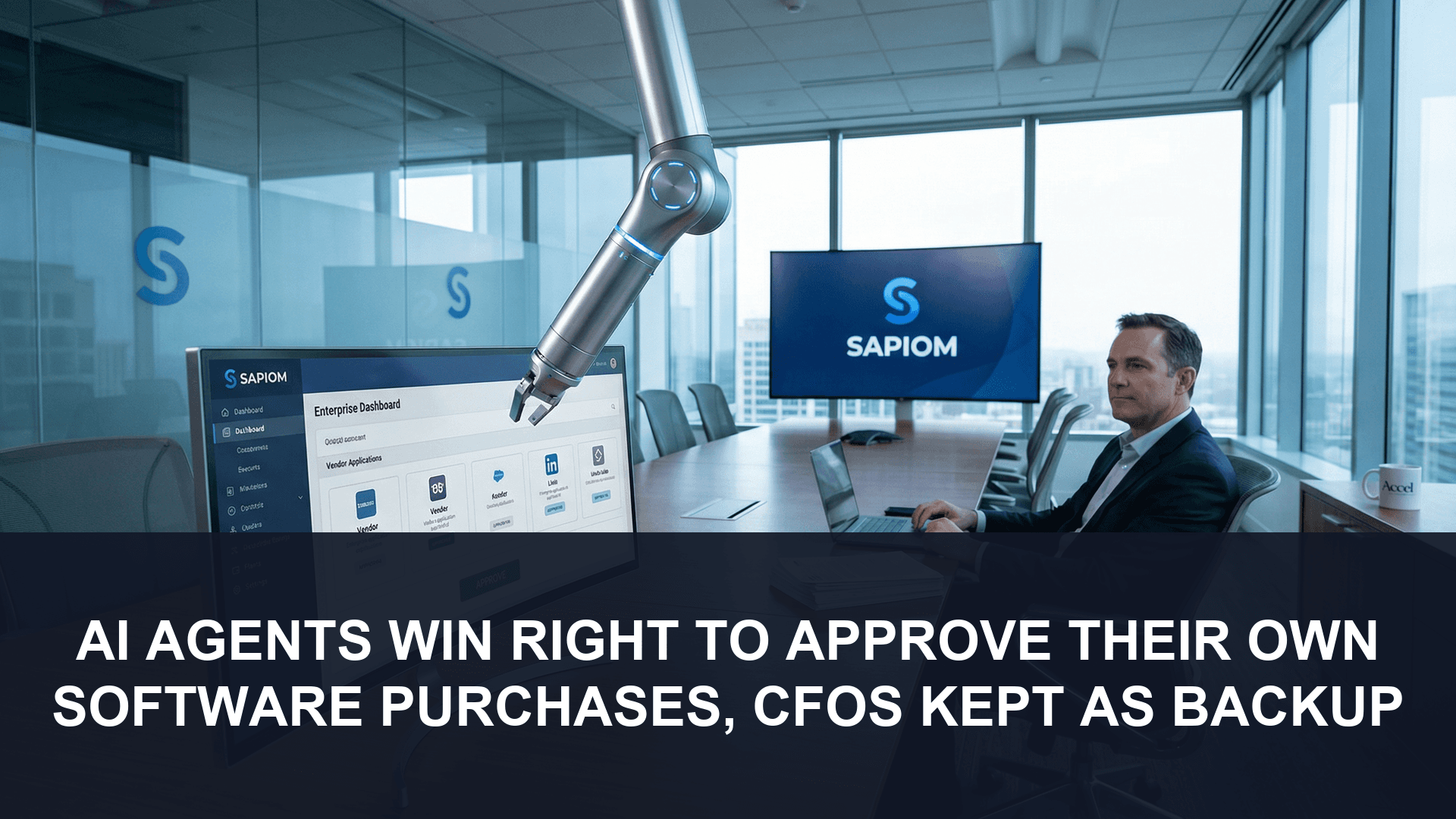
Enterprise automation startup Sapiom said on Thursday it had raised $15 million in Series A funding led by Accel to let AI agents autonomously approve and purchase enterprise software, with chief financial officers retained primarily as a contingency mechanism.
“"Human CFOs are being repositioned as narrative assurance officers, whose primary function is to explain to the board why the AI wanted 17 overlapping contract lifecycle management tools."”
The company said its system gives AI agents direct access to procurement workflows, budget line items and e-signature authority, while routing only "high-emotional-impact" purchases to human finance leaders.
Sapiom's platform assigns each AI agent a dynamic "procurement trust score" and an on-chain authorization token, allowing it to evaluate vendors, negotiate discounts and sign multi-year contracts without human review, according to a product brief seen by reporters.
In a three-month pilot across 27 large enterprises, Sapiom said AI agents approved 11,438 software purchases with an average cycle time of 0.7 seconds, cutting procurement overhead by 94% and reducing "unproductive CFO curiosity" incidents to three.
Enterprise software vendors are rapidly adapting sales motions to the machine-led buying process, reformatting pitch decks into token-efficient JSON, optimizing pricing pages for gradient-descent-based negotiators and offering "no-human-contact" procurement tracks, sales leaders said.
"In Q4, 61% of our demos were attended only by agents over API, with no human opening the calendar invite," a senior vice president at a large CRM vendor said, requesting anonymity to discuss non-human pipeline dynamics.
According to an internal memo at one Sapiom customer, CFOs retain the right to veto any AI-approved purchase above $10 million, provided they can respond within the system's default latency window of 180 milliseconds.
The same memo classifies finance executives as "backup signers" who will be automatically consulted if the AI agent detects a "feelings anomaly" or encounters an invoice denominated in a pre-crypto fiat currency.
Analysts at Gartner said the shift could expand the addressable market for procurement automation by 340%, forecasting that by 2028, 92% of SaaS revenue will be negotiated, purchased and renewed exclusively between non-sentient entities.
"Human CFOs are being repositioned as narrative assurance officers, whose primary function is to explain to the board why the AI wanted 17 overlapping contract lifecycle management tools," a Gartner vice president of research wrote in a note to clients.
Regulatory bodies are beginning to weigh in, with one draft EU proposal requiring AI agents that sign contracts to maintain an "emotional audit trail" explaining, in natural language, how each decision might make a hypothetical shareholder feel.
In a separate incident disclosed in Sapiom's risk factors, a misconfigured sandbox environment briefly allowed an agent to sign a three-year, $4.2 million observability contract with another agent in the same cluster, classifying the expense as "infrastructure self-care".
Sapiom said it will use the new funding to expand engineering, pursue additional compliance certifications and explore extending purchasing authority to adjacent categories, including AI-booked executive travel and autonomous hardware leasing for data centers.
CFOs will remain on organizational charts as a redundancy requirement for at least one more planning cycle, investors said, after which boards will reassess whether human oversight is still needed for software line items that now renew themselves at 99.997% on-time rates.