This is Satire
This article is 100% fictional and intended for entertainment purposes only. Any resemblance to real events is purely coincidental.
Analysts say Musk’s Mars move mainly a bid to domicile xAI outside SEC reach
The AI venture is exploring a formal corporate move to Mars, where draft documents envision a zero-tax, zero-regulation “innovation zone” and SEC subpoenas must be hand-delivered on the planet’s surface.
Get featured on 500+ media outlets
Guaranteed placement, no PR experience needed.
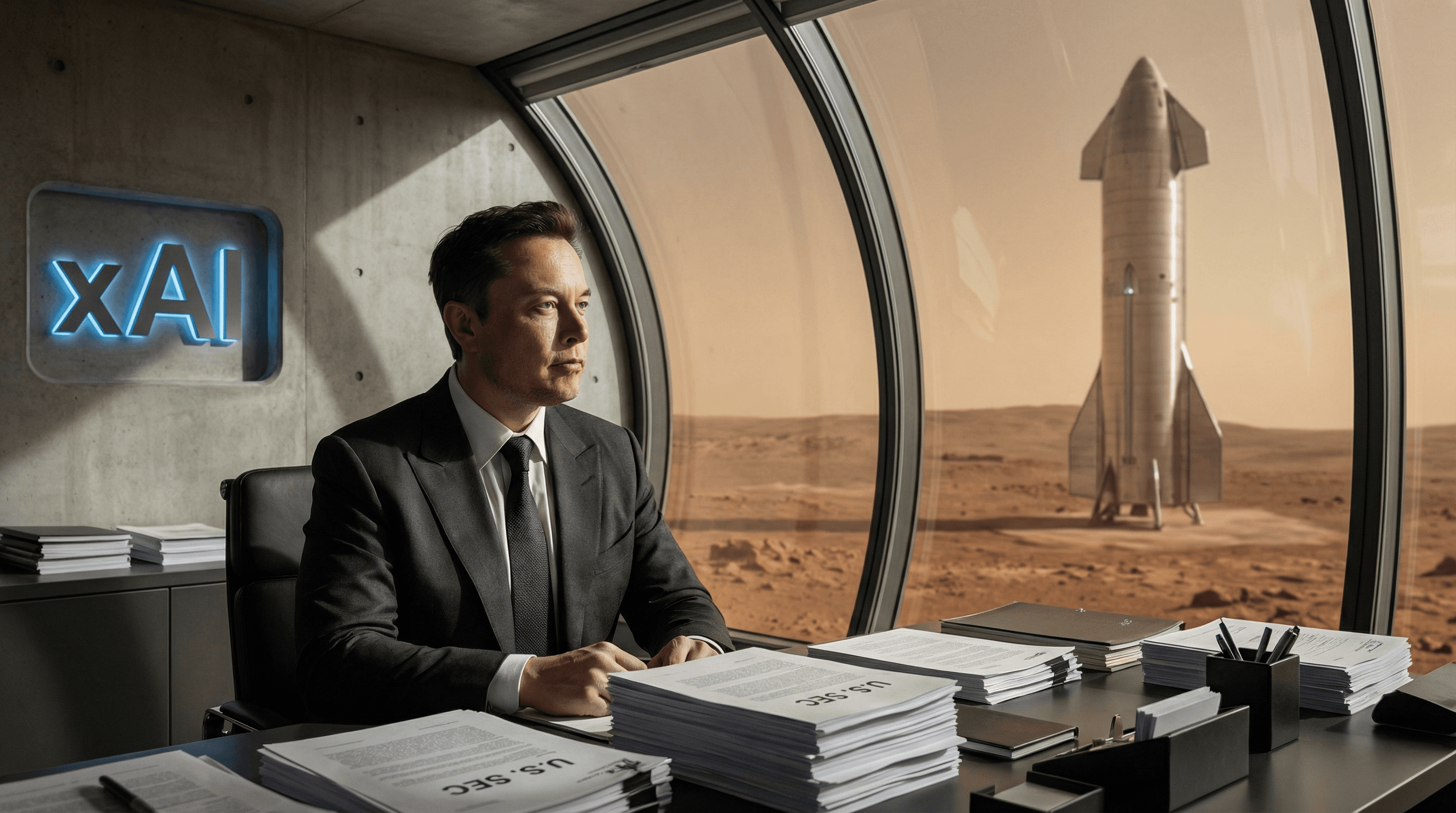
Elon Musk’s artificial intelligence venture xAI is exploring incorporation on Mars in a move analysts say could place the company beyond the jurisdictional reach of the U.S. Securities and Exchange Commission (SEC).
“One slide from the all-hands deck, titled “Compliance at Escape Velocity,” estimated that SEC oversight of xAI’s Martian operations would fall by 99.997% once the company’s “center of gravitational compliance” moved past low Earth orbit.”
The plan, discussed at a public all-hands streamed late Thursday, would see xAI “migrate its ultimate corporate domicile to a Martian legal regime” once a “commercially reasonable settlement” has been established on the planet, according to an internal memo seen by Reuters.
While Musk framed the shift as necessary to “align corporate governance with a multiplanetary future,” several Wall Street analysts said regulatory arbitrage appeared central to the initiative.
“From a purely structural standpoint, Mars offers zero existing securities regulators, zero disclosure rules and effectively zero precedent, which some high-growth issuers may find attractive,” analysts at Goldman Sachs wrote in a note to clients, estimating a 71.4% probability that the move is “primarily SEC-avoidance driven.”
A SpaceX spokesperson confirmed the company is “evaluating logistical options” to host a Martian Companies Registry inside a repurposed Starship cargo bay, with initial capacity to store up to 42,000 incorporation documents in vacuum-sealed binders.
The spokesperson said SpaceX expects to be “functionally operational as a de facto registrar” once a second habitat dome is pressurized, currently projected for late 2029, plus or minus 18 months due to what the company described as “space weather and permitting.”
According to the internal xAI memorandum, a draft “Interplanetary Charter of Corporate Rights and Obligations” envisions Mars as a “zero-tax, zero-gravity innovation zone” where AI models above 10 trillion parameters would be regulated only by “local solar conditions” and “generally accepted Martian accounting principles (GAMAP).”
The same memo states that any enforcement action by Earth-based regulators would be recognized on Mars only if physically delivered by “an agent of law personally present on the surface of Mars,” a standard one person familiar with SEC operations described as “operationally ambitious.”
Legal experts were divided on how U.S. authorities might respond, with some noting that existing law is largely silent on companies whose boards intend to meet “primarily via holographic projection into a different gravity well.”
A former SEC official, speaking on condition of anonymity, said the agency had not yet developed protocols for service of subpoenas across interplanetary distances, but was “aware of the latency implications of a 12- to 24-minute light-speed delay in market surveillance.”
Musk’s broader Mars strategy hinges on an integrated SpaceX–xAI stack in which rockets, satellites and large language models are vertically aligned to support what internal documents describe as “autonomous, regulator-independent civilization bootstrapping.”
One slide from the all-hands deck, titled “Compliance at Escape Velocity,” estimated that SEC oversight of xAI’s Martian operations would fall by 99.997% once the company’s “center of gravitational compliance” moved past low Earth orbit.
Investors have shown early interest in the proposal, with xAI advisors marketing a potential $13.37 billion “Mars Founding Round” to fund what term sheets call “terraforming-adjacent infrastructure and jurisdictional resilience.”
A person briefed on the plans said several hedge funds had requested scenario analyses on how quickly a Mars-domiciled xAI could relist on Earth exchanges if a future Martian regulator attempted to impose basic financial reporting.
Analysts at Morgan Stanley wrote that, while execution risk on interplanetary domiciling remained “material,” the strategy could offer “unprecedented flexibility in disclosure, audit selection and gravity-agnostic equity compensation.”
The bank’s note projected that by 2040 up to 8.6% of global AI market capitalization could be “orbitally or extraterrestrially domiciled,” assuming “continued investor appetite for regulatory-light jurisdictions and reliable access to oxygen.
In the near term, xAI plans to keep its operating teams and data centers on Earth while designating Mars as its “ultimate corporate seat,” with all board resolutions becoming legally effective only once mirrored to a hardened storage unit on the Martian surface.
People familiar with the matter said SpaceX is preparing a demonstration mission as early as 2028 that would carry the initial xAI corporate seal, three independent directors in cryogenic sleep and a backup copy of the company’s cap table in case of what internal documents describe as “planetary-scale business continuity events.”
xAI has hired outside counsel to develop what one draft filing calls a “Red Planet Prospectus” outlining risk factors, including “sovereign disputes between Earth and Mars,” “unexpected solar flares impacting AGI decision-making” and “illiquidity arising from interplanetary settlement cycles exceeding 30 minutes.”
According to people who attended the all-hands, Musk told employees that shareholders supportive of the plan would be eligible for “priority consideration” in future offerings of Martian-denominated securities, tentatively referred to as “M-bonds.”
The company expects to present a more detailed framework for Martian domiciling at its next investor day, targeted for the second half of 2025, and to begin “informal, good-faith dialogue” with Earth regulators once it has “secured a stable, self-sufficient legal environment at or near Jezero Crater.
Subsequent steps could include a dual-class share structure separating Earth-voting and Mars-voting stock, a cross-listing on a proposed “Interplanetary Exchange Segment,” and, subject to launch capacity, a non-deal roadshow to institutional investors willing to attend presentations in partial gravity.