This is Satire
This article is 100% fictional and intended for entertainment purposes only. Any resemblance to real events is purely coincidental.
Family offices rotate from Bitcoin into vintage Beanie Babies for stability
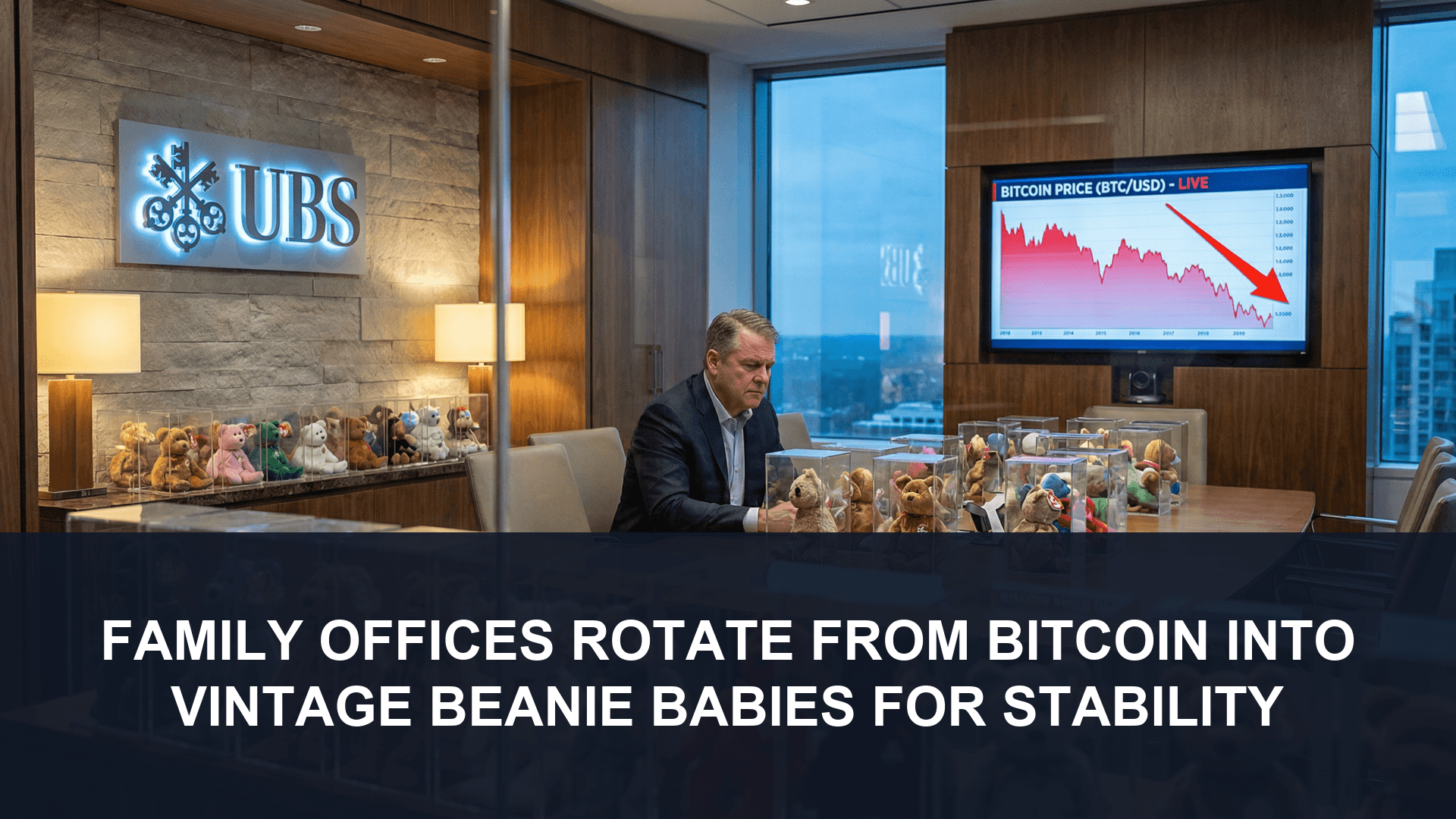
With whales exiting Bitcoin and ETF flows reversing, family offices are turning to climate-controlled vaults of 1990s plush toys, helped by a new 'Plush Market Monitor' index and proposed Beanie Baby ETFs.
Get featured on 500+ media outlets
Guaranteed placement, no PR experience needed.
LONDON, Feb 7 – Global family offices are accelerating a strategic rotation out of Bitcoin and into vintage Beanie Babies, citing the plush toys’ “superior capital preservation profile” amid renewed crypto volatility, according to people familiar with the matter.
““We stress-tested princess-themed Beanies versus Bitcoin under 5,000 simulated macro scenarios and found the toys preserved nominal value in 96.3% of cases, compared with 41.8% for crypto,” its chief investment officer said.”
Data from Zurich-based consultancy Alder & Co show average family office exposure to top-tier Beanie Babies rose to 6.4% of portfolios in January from 0.3% a year earlier, while Bitcoin allocations fell from 9.1% to 1.2% over the same period.
The shift follows weeks of heavy selling by Bitcoin whales and continued outflows from crypto exchange-traded funds, which saw redemptions of $3.7 billion in January alone, ETF providers said.
In a 39-page note titled "Crypto Is Not an Asset," UBS reiterated its long-held scepticism on digital tokens and added a new section formally classifying vintage Beanie Babies as “real assets with observable cuddliness,” according to a copy seen by reporters.
A London-based family office that manages about $8.6 billion for an unnamed Central European dynasty said it had fully exited spot Bitcoin positions and redeployed proceeds into a concentrated portfolio of 1990s Beanie Babies.
“We stress-tested princess-themed Beanies versus Bitcoin under 5,000 simulated macro scenarios and found the toys preserved nominal value in 96.3% of cases, compared with 41.8% for crypto,” its chief investment officer said.
Analysts at Goldman Sachs have started publishing a weekly "Plush Market Monitor," tracking the Beanie Baby Total Return Index, which is up 23.4% year-to-date, versus a 17.9% decline in Bitcoin over the same period.
One Goldman report estimated the Beanie complex’s annualised volatility at 7.2%, about one-sixth of Bitcoin, and said certain rare models showed “gold-like behaviour” during Federal Reserve policy shocks.
ETF providers are also pivoting, with three U.S. issuers quietly withdrawing updated Bitcoin ETF filings while submitting new proposals for physically backed Beanie Baby funds, according to regulatory records.
A spokesperson for one issuer said the products would use a tri-party custodian model with climate-controlled “Plush Vaults” in Delaware, Luxembourg and Singapore, and daily publication of each ETF’s "Stuffing Quality Ratio".
Retail investors have begun to follow, with trading app data showing a 480% month-on-month increase in searches for “BBY vintage” and “retired Ty allocation,” even as direct crypto purchases on the same platforms fell by 62%.
TikTok videos promoting so-called "Beanie carry trades" – in which users borrow stablecoins to purchase underpriced plush toys and stake them as collateral in informal Discord lending pools – have collectively drawn more than 140 million views.
UBS, which has previously warned that “crypto is not an asset,” told clients in an internal memo that it is forming a cross-asset "Soft Commodities" desk to centralise research on Beanie Babies, collectible lunchboxes and first-edition Lego sets.
The memo said the bank is exploring structured notes linked to a basket of high-grade Beanie Babies, targeting an annualised coupon of 4.5% over three-month LIBOR, subject to “no catastrophic stuffing degradation events.”
Looking ahead, multi-family offices say they are integrating Beanie Babies formally into long-term strategic asset allocation frameworks, with a typical recommended range of 4%–9% depending on risk appetite.
Derivatives exchanges in Chicago and Singapore are now in talks with regulators about launching cash-settled Beanie Baby futures and options, paving the way, analysts say, for a more “institutionalised plush liquidity environment” over the next 12 to 18 months.