This is Satire
This article is 100% fictional and intended for entertainment purposes only. Any resemblance to real events is purely coincidental.
Homeowners ok with delivery vans, insist servers commute from another town
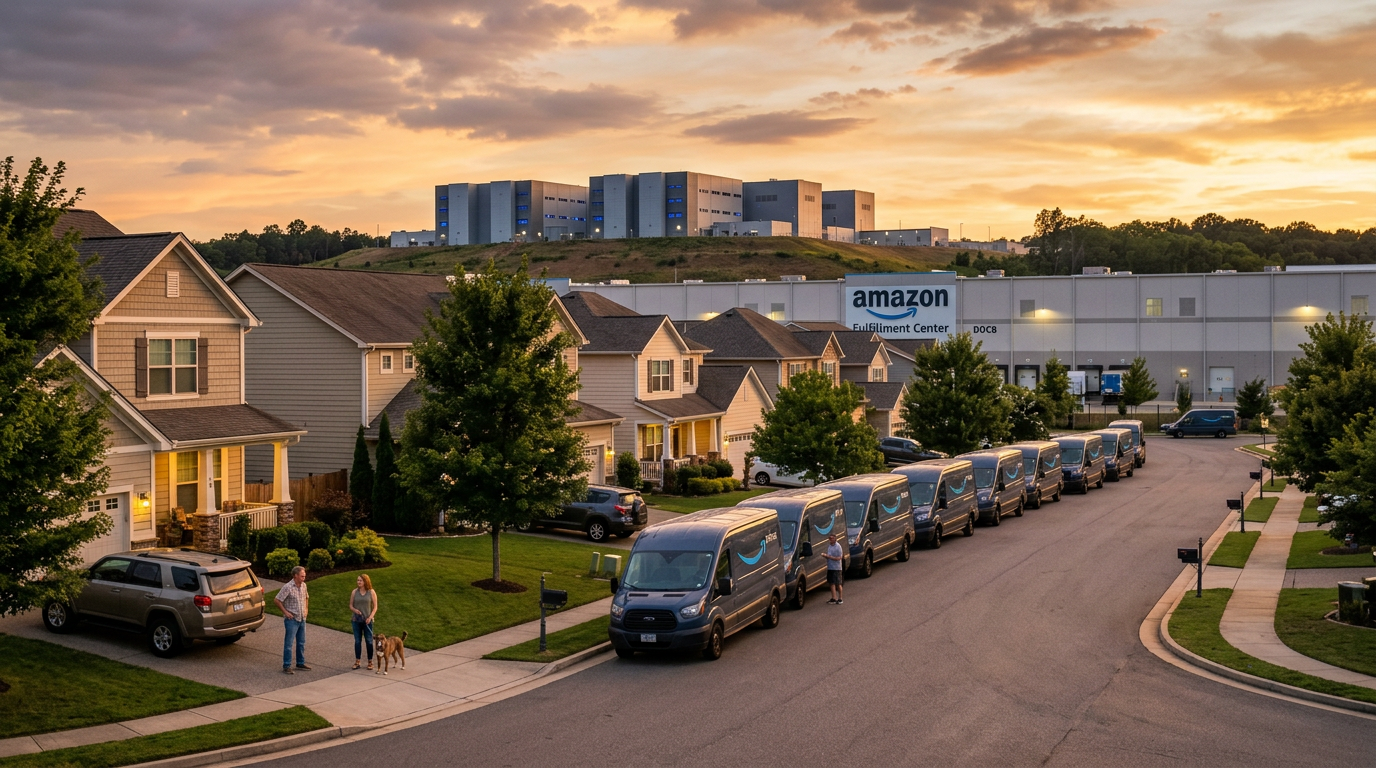
Suburban officials are advancing new rules that let delivery vans idle outside bedroom windows while requiring data center servers to “live” at least two ZIP codes away and connect to residents only by long-haul fiber.
Get featured on 500+ media outlets
Guaranteed placement, no PR experience needed.
U.S. suburban homeowners have signaled a clear preference for “visible logistics” over “invisible computing,” telling local officials they welcome Amazon delivery traffic in their cul-de-sacs but want all data center servers to be physically located in another municipality.
““People are comfortable with things that honk,” said Janet Rowe, a homeowner in Loudoun County, Virginia.”
In recent zoning hearings across at least 14 states, residents have endorsed Amazon last-mile delivery hubs within 500 feet of playgrounds, while demanding that associated cloud infrastructure be built “no closer than two ZIP codes away,” according to a survey of planning commission minutes.
“People are comfortable with things that honk,” said Janet Rowe, a homeowner in Loudoun County, Virginia, where residents unanimously approved a 380,000 square-foot delivery station but rejected an adjacent data facility on the grounds that “the computers should commute like everyone else.”
An internal memo from a Midwestern planning board, reviewed by Reuters, proposed a “Server Commuting Radius” of 27.5 miles, arguing that this would allow data racks to “live” in a low-cost county while “working” in more affluent suburbs via high-speed fiber.
Amazon has adapted quickly, a spokesperson confirmed, piloting what it calls a “Decoupled Fulfillment-Compute Model” in which every warehouse is paired with an off-site data center that must be accessed through at least two toll roads and one jurisdictional boundary.
Residents interviewed said the arrangement aligns with traditional suburban values, noting that while they are comfortable with 140 delivery vehicles per hour, they worry that stationary racks of servers might “cluster” and “drive up latency-related feelings.”
Analysts at McKinsey estimated that by 2029 up to 73% of North American data centers could be reclassified as “digital commuters,” with local governments already exploring peak-hour congestion pricing for packets and mandatory VPN carpooling for underutilized servers.
Several counties are drafting model ordinances that would codify the 25-mile minimum separation between a person’s driveway and the physical location of their cloud data, with public comment periods scheduled to last until server rush hour conditions can be simulated in software, officials said.