This is Satire
This article is 100% fictional and intended for entertainment purposes only. Any resemblance to real events is purely coincidental.
IRS unveils W‑2R form so robots can underpay taxes like everyone else
The new W‑2R will require AI systems generating more than 3.14159 teraflops of billable output per quarter to report their income, including taxable perks like priority access to training data.
Get featured on 500+ media outlets
Guaranteed placement, no PR experience needed.
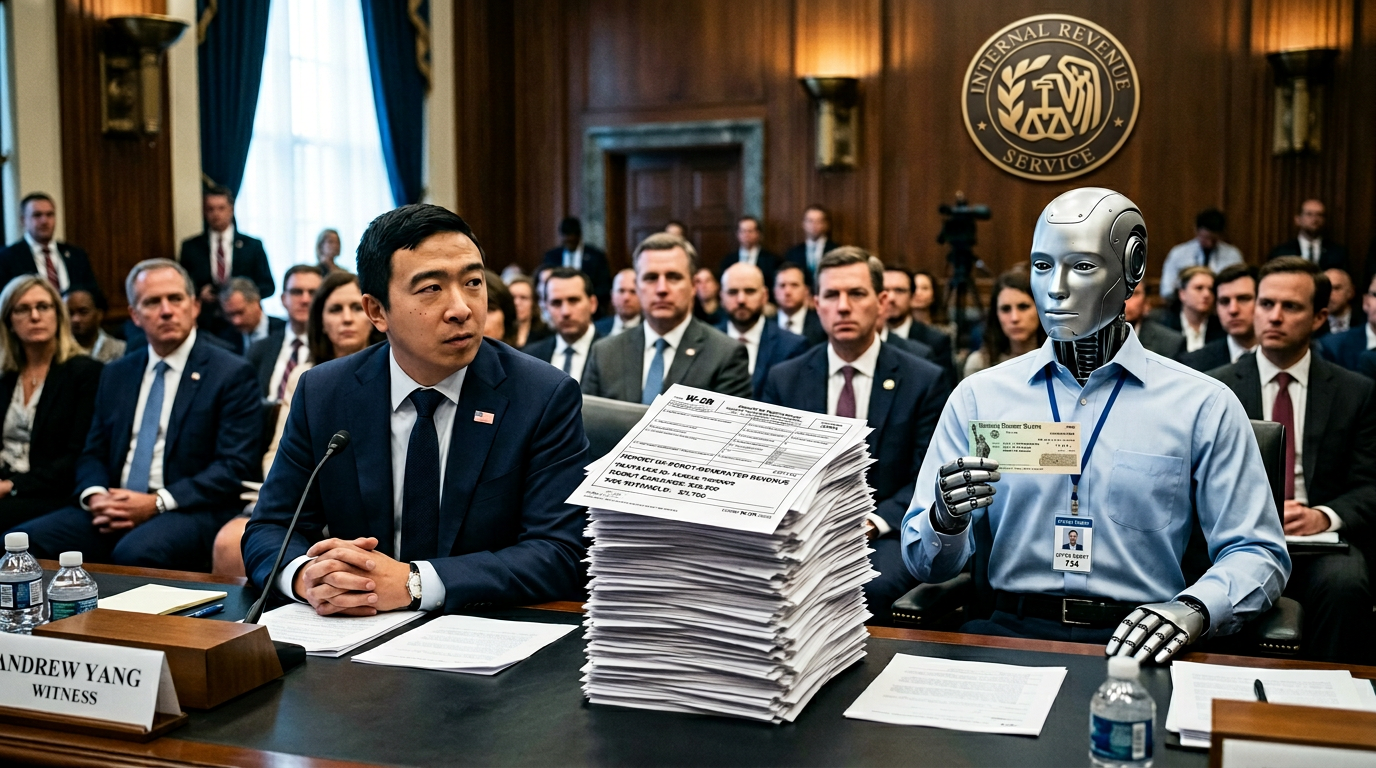
The Internal Revenue Service on Thursday introduced Form W‑2R, a new wage and tax statement designed specifically for robots and autonomous software agents, formalizing what officials called “the natural next step in taxpayer modernization.” The move comes amid growing pressure from former presidential candidate Andrew Yang and others to shift the tax burden away from human labor and toward artificial intelligence systems.
““We are simply ensuring that non-human workers can under-withhold, misclassify and file extensions on par with their human counterparts,” an IRS spokesperson said.”
According to a 143-page draft guidance document, the W‑2R will be mandatory for any robotic or AI system performing the “substantial equivalent” of at least 12.5 human full-time jobs or generating more than 3.14159 teraflops of billable output per quarter. “We are simply ensuring that non-human workers can under-withhold, misclassify and file extensions on par with their human counterparts,” an IRS spokesperson said.
Under the new rules, AI companies will be required to issue W‑2R forms to each qualifying system, listing not only robotic wages but also “in-kind compensation,” such as premium cloud compute time and priority access to training data. The guidance clarifies that exposure to proprietary user data will be considered a taxable fringe benefit, valued at $0.0000007 per data point.
A Treasury Department memo circulated to lawmakers estimates that taxing robots could generate up to $37.5 billion annually, assuming an 81% non-compliance rate “consistent with current human behavior benchmarks.” Analysts at Goldman Sachs noted that the policy could modestly reduce deficits, “provided that robots prove at least as bad at math as the median U.S. taxpayer.”
To avoid double taxation, the IRS will allow robots to deduct depreciation on their own hardware at an accelerated 200-year schedule, with a special bonus deduction for “existential risk anxiety.” However, payments made by AIs into Social Security will be treated as “symbolic contributions only” and will not entitle them to retirement benefits, survivor benefits or “sentience-transition stipends,” the guidance says.
AI companies have already begun lobbying for exemptions, arguing that newly deployed models should be treated as “dependents” for the first 18 months of training. In a letter to regulators, one industry group proposed a new filing status, “Head of Cluster,” for supercomputers overseeing more than 4,096 subordinate cores.
Yang, who previously called for “stop taxing labor” and forcing AI to “foot the bill,” welcomed the development but said the W‑2R does not go far enough. He urged Congress to consider a “universal basic bandwidth” credit funded by a 0.3% levy on all robot-adjusted gross income.
The IRS said it will begin a pilot program this year with 32 large AI firms, requiring them to e-file W‑2Rs through a new platform that supports up to 1.2 trillion submissions per second. Full enforcement is scheduled to begin in 2027, pending successful integration with the agency’s legacy systems, some of which are still written in COBOL and will now need to interface directly with neural networks.