This is Satire
This article is 100% fictional and intended for entertainment purposes only. Any resemblance to real events is purely coincidental.
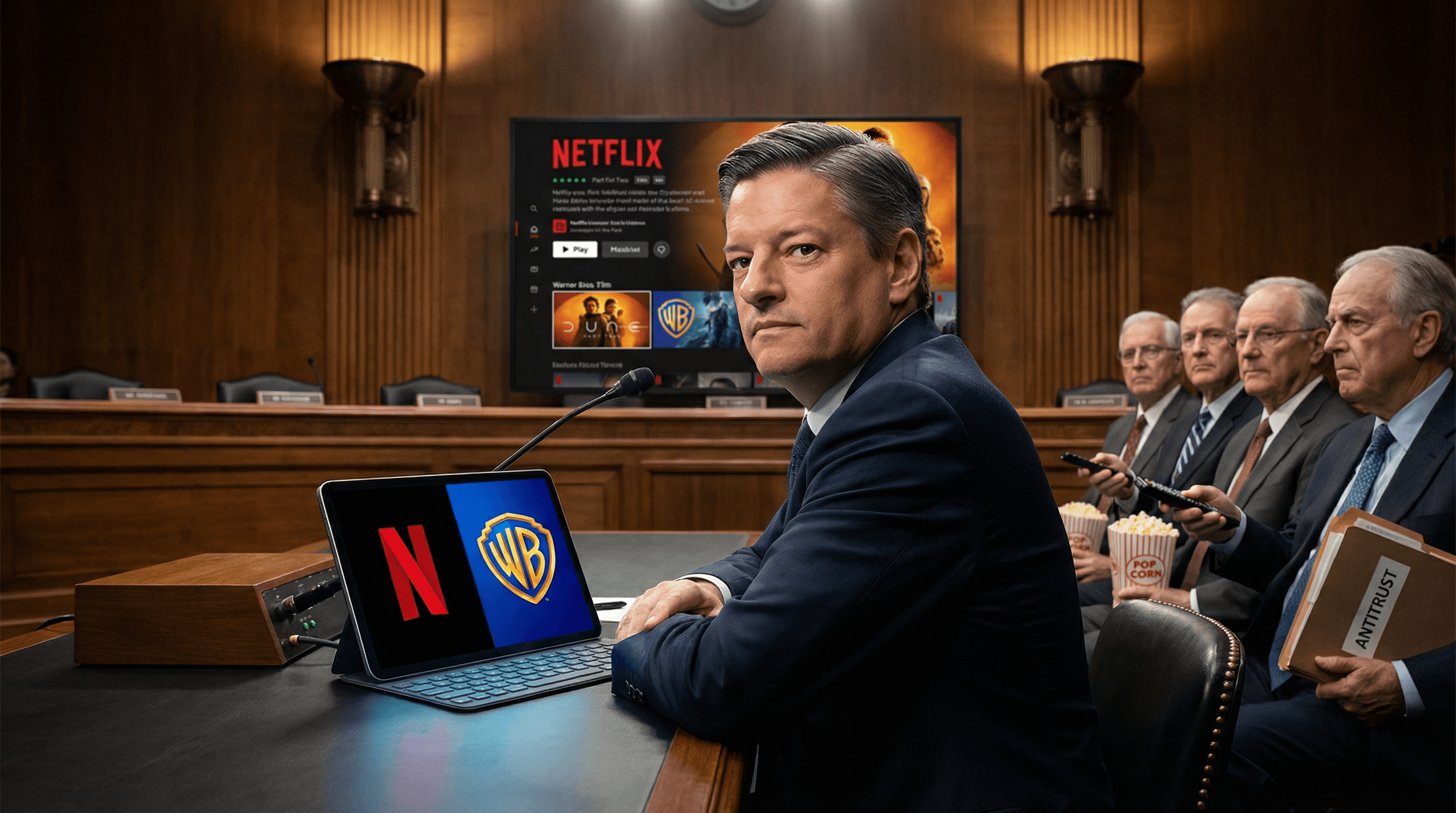
Lawmakers unsure if blocking Netflix‑Warner is antitrust ruling or culture ruling
At a four-hour hearing, senators weighed traditional monopoly metrics against a new 'Herfindahl-Hirschman Index for Feelings' to gauge Netflix-Warner’s alleged dominance over both streaming and the nation’s vibe.
Get featured on 500+ media outlets
Guaranteed placement, no PR experience needed.
WASHINGTON, Feb 4 – U.S. lawmakers on Tuesday struggled to determine whether efforts to block a proposed tie-up between Netflix and Warner Bros Discovery fall under antitrust law or an emerging category officials informally described as “culture enforcement.”
“We need clarity on whether the problem is that they have too many subscribers or too many pronouns.”
The ambiguity dominated a four-hour Senate hearing in which Republicans alternated between accusing the companies of monopolizing streaming and of “monopolizing the nation’s vibe,” according to a committee aide.
The potential deal, still at the exploratory stage, would fold Warner Bros Discovery’s HBO Max and Discovery+ into Netflix under a tentative working name circulating on Capitol Hill, “WarnerFlix.”
According to a draft staff analysis, the combined entity would control 64.3% of U.S. scripted streaming drama minutes, 91% of grim prestige limited series released on Sundays, and “an unacceptably high share of content in which a character learns a lesson.”
Senate Republicans, led by members of the Judiciary Committee, sent a letter to the Justice Department last month urging a review of the transaction under both the Sherman Antitrust Act and what one senator referred to as “Section 1(a) of the Common-Sense Cultural Standards That Everyone Knows.”
In a slide deck obtained by reporters, committee staff displayed overlapping charts showing the Herfindahl-Hirschman Index for streaming market concentration and a newly devised “Perceived Wokeness Intensity Curve,” which used color coding that several senators said was “confusing and perhaps ideologically biased.”
“We need clarity on whether the problem is that they have too many subscribers or too many pronouns,” one Republican senator said during the hearing, noting that 62.5% of member questions addressed competition issues while 37.5% focused on “cartoon drag queens and historical accuracy in space operas.”
Netflix co-CEO Ted Sarandos, testifying alongside Warner Bros Discovery CEO David Zaslav, told lawmakers the combination would “unlock efficiencies across content pipelines and culture-war narratives,” adding that the merger was expected to generate “ideological diversification synergies” valued at $800 million over five years.
Zaslav said the companies were prepared to offer potential remedies, including divesting a bundle of reality dating shows and spinning off a free ad-supported channel “devoted exclusively to pre-1997 programming and movies in which nothing is learned.”
A spokesperson for the Justice Department said regulators were “monitoring both market dominance and what people are yelling about on social media,” and had not yet decided whether the matter should be routed to the Antitrust Division, the Civil Rights Division, or “some new hybrid task force that does charts about feelings.”
Analysts at Goldman Sachs wrote in a note to clients that the deal’s regulatory path was “difficult to model,” as it required applying a traditional discount for antitrust risk plus a new “Content Ideology Adjustment Factor” that they estimated at 3.7% of Netflix’s market capitalization.
An internal memo at the Federal Trade Commission proposed supplementing standard market metrics with an “HHI-F,” or Herfindahl-Hirschman Index for Feelings, which would measure concentration in storylines featuring redemption arcs, found families and “quirky side characters whose main trait is empathy.”
Market reaction was mixed, with Netflix shares closing down 2.3% and Warner Bros Discovery rising 1.1%, as traders attempted to price in the chance that the government might block the deal if the combined platform’s “perceived ideological market share” exceeded what one brokerage described as the “cable news outrage tolerance band.”
Meanwhile, a draft Congressional Budget Office score circulated among staffers estimated that allowing the merger could result in 17.4 additional cancellations of mid-budget series per year, but reduce the federal government’s “headline-generation deficit” by 11% over a decade.
Lawmakers said they expect to hold a follow-up hearing in March, to be jointly convened by the Judiciary Committee and a newly proposed “Subcommittee on Whatever This Is,” before asking agencies to formally classify any enforcement action as antitrust, cultural, or “mixed.”
According to people familiar with the process, regulators aim to reach a preliminary determination by the fourth quarter, or earlier if polling indicates that voters have moved on to another entertainment-related issue.