This is Satire
This article is 100% fictional and intended for entertainment purposes only. Any resemblance to real events is purely coincidental.
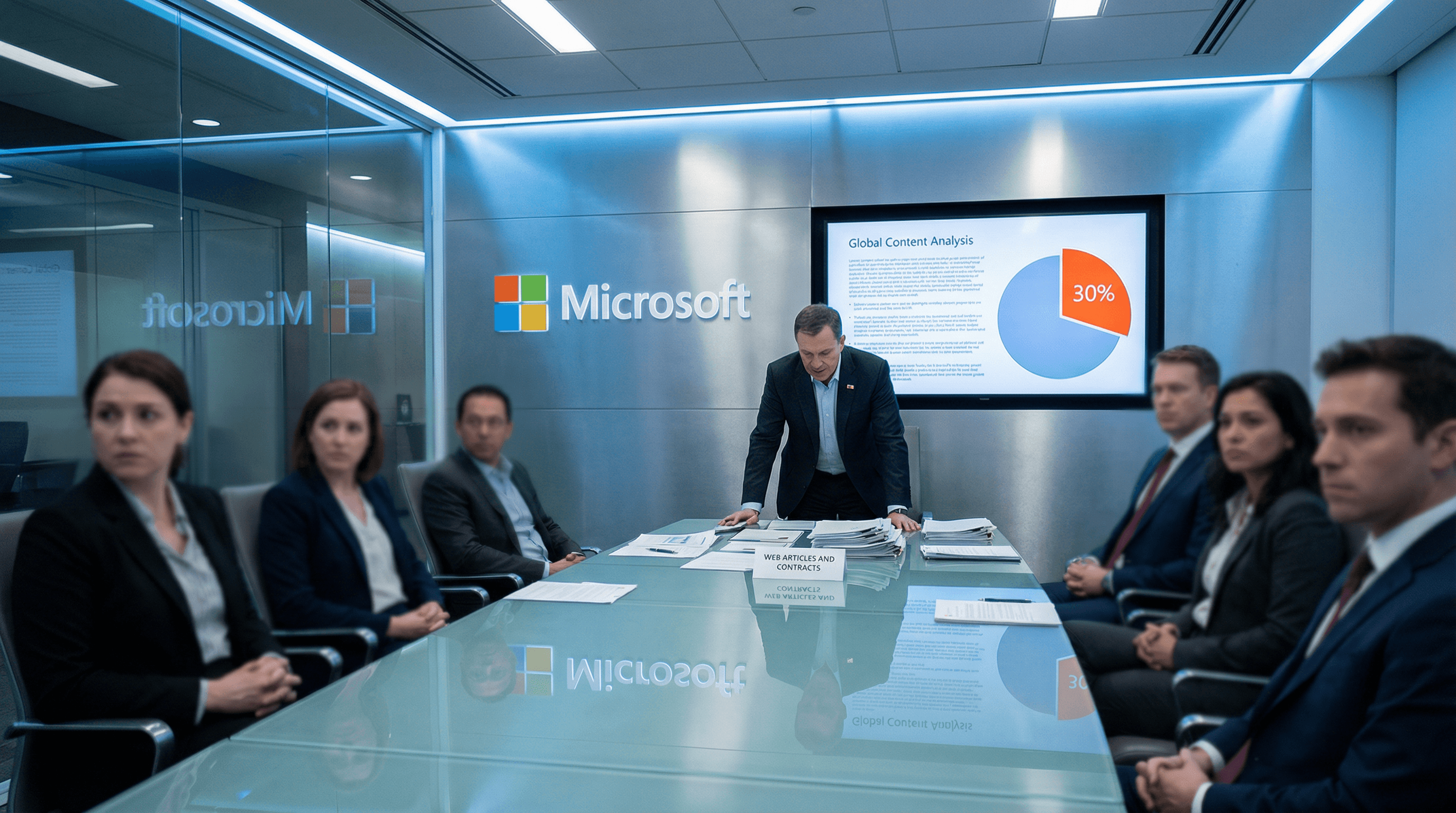
Microsoft to take industry‑standard 30% cut of every paragraph already scraped
The new AI Content Licensing Store assigns a unique ID to 418 trillion paragraphs and charges a 30% commission on each one, including "functionally indistinguishable equivalents" already generated in the past.
Get featured on 500+ media outlets
Guaranteed placement, no PR experience needed.
Microsoft Corp on Tuesday announced a new "AI Content Licensing Store" that will allow the company to take what it called an industry-standard 30% commission on every paragraph of text it has already scraped from the internet, regardless of who scraped it.
“"Our newsroom produced what Microsoft classifies as minus 14,203 net paragraphs in Q4, once overlaps with historic ParaIDs were accounted for," said the chief digital officer of a large European publisher.”
A spokesperson said the move would "bring price transparency and platform-grade billing" to the unlicensed reuse of written language across the AI sector.
Under the program, online publishers will be able to log into a portal and claim ownership of specific paragraphs that Microsoft says are already present in its training corpora.
Once verified, Microsoft will levy a 30% fee on other AI companies each time those paragraphs, or "functionally indistinguishable equivalents," appear in model outputs, including for past outputs that have already been served, according to an internal memo seen by Reuters.
The memo states that Microsoft has assigned a unique "ParaID" to 418 trillion distinct paragraphs and sub-paragraph fragments, covering what it estimates to be 97.6% of all publicly readable sentences posted since 1997.
Each AI-generated response will be broken down into "synthetic paragraph equivalents" and reconciled nightly against this registry, enabling what the company described as "cloud-scale retroactive royalty capture."
Analysts at Goldman Sachs said the initiative could unlock a $97.3 billion total addressable market in what they termed "post-hoc monetization of previously uncompensated language."
In a note to clients, the bank estimated that for every 1,000 words generated by large language models, an average of 742.3 words could be mapped back to pre-existing ParaIDs, with Microsoft "well positioned" to collect a 30% platform fee on that subset.
Some online publishers expressed cautious support, saying the new system at least attaches a price to content that had been treated as effectively free, while others raised concerns about complex settlement rules.
According to draft terms shared with major news organizations, publishers whose archives closely resemble previously unclaimed ParaIDs may incur "negative licensing balances," resulting in quarterly bills if their current output is deemed insufficiently distinct from text already in the registry.
"Our newsroom produced what Microsoft classifies as minus 14,203 net paragraphs in Q4, once overlaps with historic ParaIDs were accounted for," said the chief digital officer of a large European publisher, who asked not to be named as talks are private.
"We are still trying to understand whether we are being charged for our own archive or for being too on-brand with ourselves."
Microsoft said it is in "advanced exploratory discussions" with OpenAI, Alphabet's Google, Anthropic and several smaller model providers to route paragraph-level settlement through the new store.
To manage cost volatility, the company is offering what it calls "paragraph futures" that allow AI vendors to lock in multi-year prices for high-volume phrases such as "sources familiar with the matter" and "experts warned in a note to clients."
Technical documentation posted for developers describes a new feature in Microsoft Copilot that will display a "Paragraph Loyalty Score" indicating the percentage of each answer sourced from licensed ParaIDs versus unlicensed language constructions.
User edits that shorten or substantially rewrite licensed segments may trigger what the company terms a "pro-rated paragraph clawback," with Copilot automatically adjusting downstream royalty pools and displaying a warning banner if a draft falls below minimum licensed density thresholds.
Microsoft said it will launch a pilot with 12 publishers, representing roughly 0.004% of global online text, but projects that 61% of AI-generated language will "voluntarily declare alignment with a licensed ParaID" by 2027 as the store becomes the default settlement layer for paragraph reuse.
Regulators in the United States and European Union said they are "monitoring developments" but will initially rely on the industry to self-regulate retroactive ownership claims over language, according to people familiar with the matter, who requested anonymity discussing early-stage oversight frameworks.