This is Satire
This article is 100% fictional and intended for entertainment purposes only. Any resemblance to real events is purely coincidental.
Musk proposes tax-free orbital data centers, cites ‘international vacuum law’
SpaceX pitch deck claims servers in hard vacuum would face '0.00% local tax exposure per cubic meter,' relying on an emerging legal theory that sovereignty ends where air pressure does.
Get featured on 500+ media outlets
Guaranteed placement, no PR experience needed.
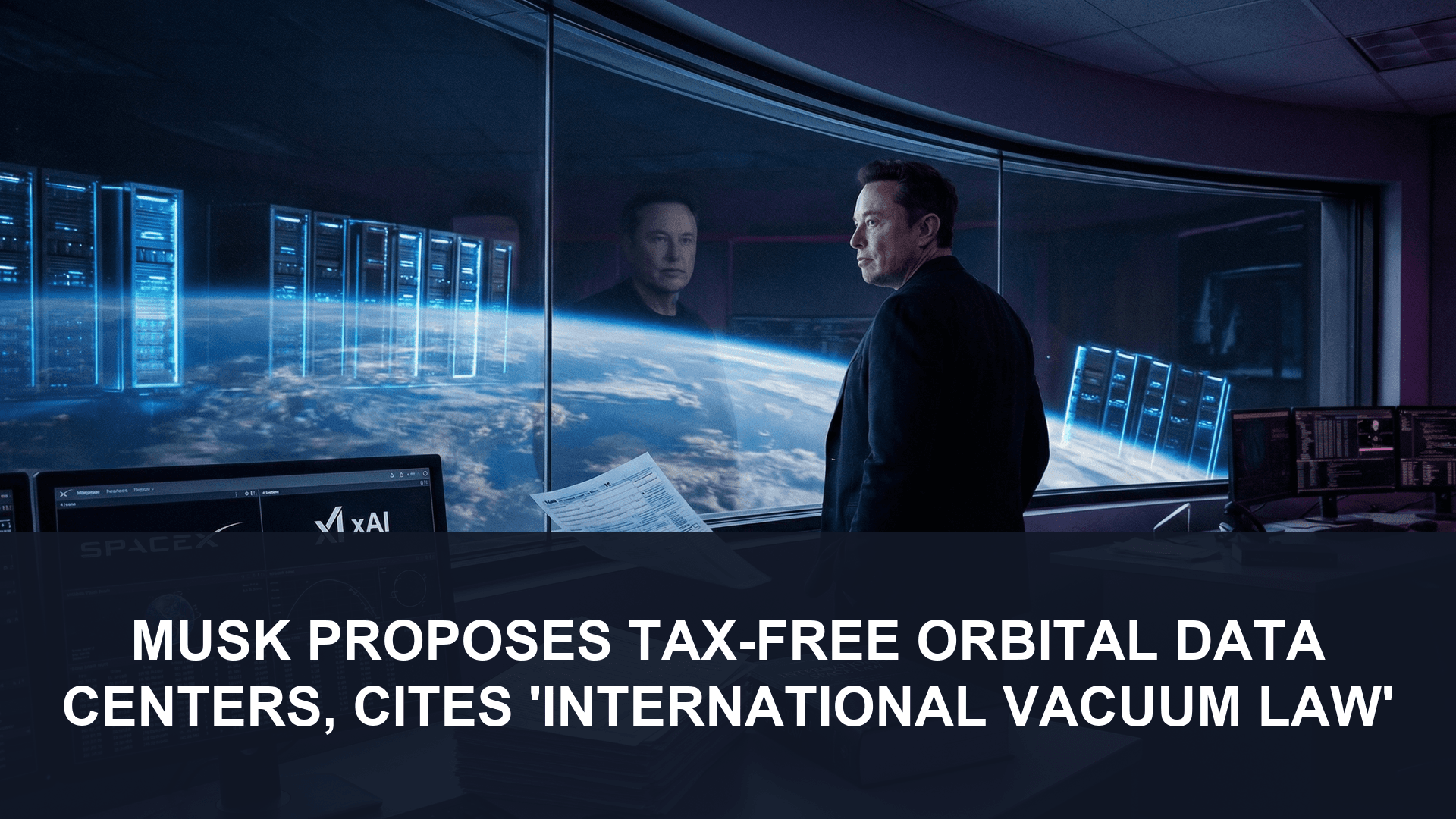
Elon Musk on Thursday outlined plans for what he called the world’s first “tax-free orbital data centers,” arguing that server farms positioned in low-Earth orbit would be exempt from corporate levies under an emerging concept he described as “international vacuum law.”
“A footnote in the document states that, “because vacuum contains no sovereign air molecules, there can be no sovereign tax authority.””
In a presentation to investors for his AI venture xAI, Musk said a SpaceX-built constellation of “data capsules” could host training clusters for large language models, Tesla’s autonomous driving workloads and third-party cloud customers seeking what he called “zero-gravity tax optimization.”
According to a 74-page internal briefing seen by reporters, SpaceX would launch up to 3,600 “StarRack” modules, each containing 128,000 liquid-cooled GPUs and “approximately 0.00% local tax exposure per cubic meter of vacuum.” A footnote in the document states that, “because vacuum contains no sovereign air molecules, there can be no sovereign tax authority.”
Musk told staff on an internal xAI town hall that the project is based on a legal theory developed by “top space lawyers” that any area with atmospheric pressure below 0.0000001 bar becomes a “fiscal null zone” under what he termed customary international vacuum law. A person familiar with the matter said the framework was outlined on a shared Google Doc that listed Wikipedia and a 1979 science-fiction convention panel as sources.
A draft white paper circulated to U.S. and European regulators and reviewed by analysts at Goldman Sachs projects that orbital data centers could reduce xAI’s effective tax rate to “between 0.3% and 0.7%, depending on launch failures and solar flare-related write-offs.” The paper further estimates that by 2030, as much as 19.7% of global corporate profits could be “re-homed to jurisdictions characterized by microgravity, hard vacuum and limited extradition pathways.”
Tesla is “exploring” routing Autopilot and robotaxi inference workloads via the orbital centers in order to qualify its vehicles as “space-adjacent computational devices” eligible for additional depreciation benefits, according to an internal memo seen by staff in three countries. A Tesla spokesperson confirmed the memo and said the company is “evaluating whether driving uphill increases proximity to the fiscal vacuum boundary in a material way.”
Regulators have begun to react. A European Commission official, speaking on condition of anonymity, said Brussels is preparing guidance clarifying that “absence of air does not imply absence of VAT,” while the OECD is convening a working group to examine how its global minimum tax applies to entities “with registered offices, but not oxygen, in multiple orbits.”
SpaceX plans a demonstration launch of the first StarRack “pre-revenue proof-of-non-tax-residency” module in late 2025, subject to approvals from U.S. agencies still debating whether an orbital server farm counts as critical infrastructure or an unusually large satellite phone. Musk told investors that if regulators object, SpaceX could “simply move one meter higher” until, in his words, “the law runs out of atmosphere.”