This is Satire
This article is 100% fictional and intended for entertainment purposes only. Any resemblance to real events is purely coincidental.
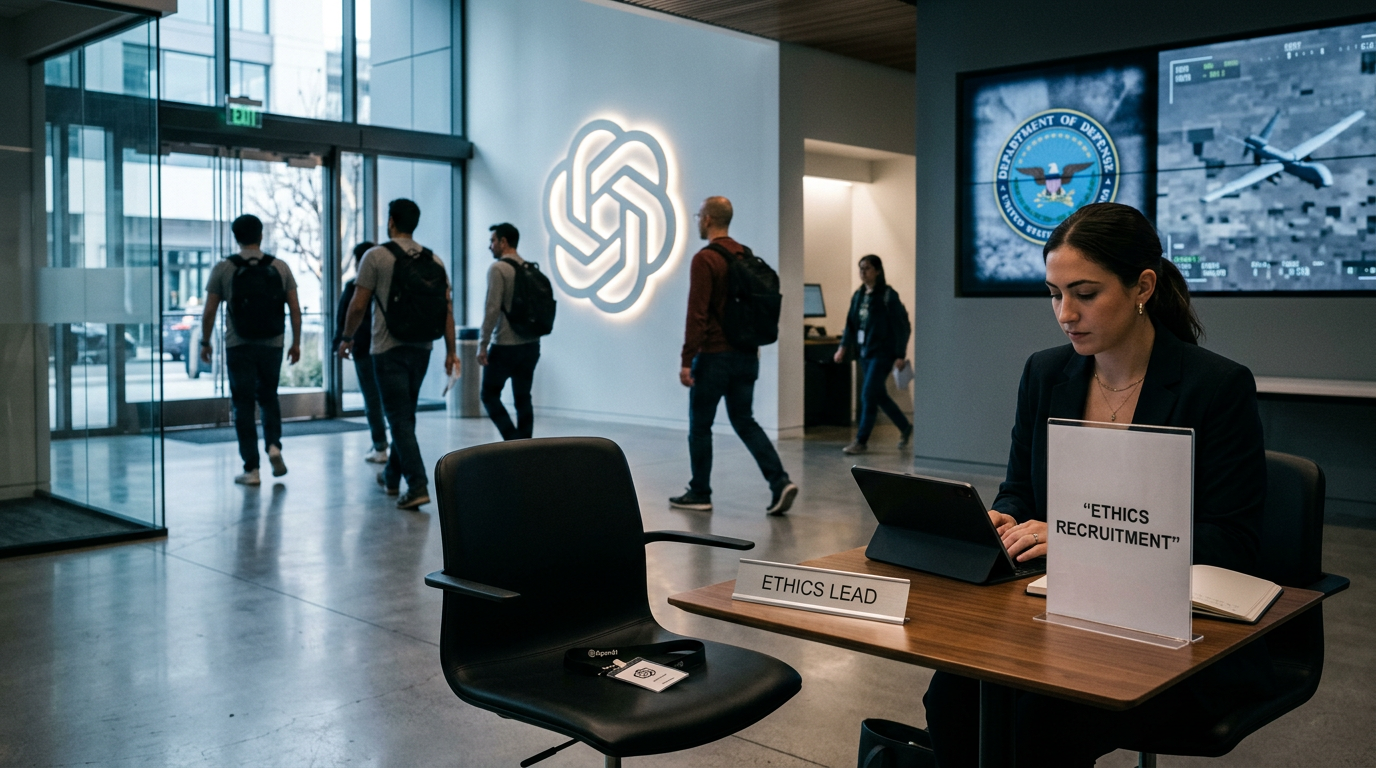
OpenAI creates standing Ethics Recruitment Team to refill roles lost over war work
Facing a 47.3% rise in 'mission-alignment-related attrition,' OpenAI is standing up a dedicated team to replace every conscience-driven exit within 14 business days.
Get featured on 500+ media outlets
Guaranteed placement, no PR experience needed.
SAN FRANCISCO, March 9 — OpenAI has created a permanent Ethics Recruitment Team to backfill staffers who resign over the company’s growing portfolio of defense and national security work, according to people familiar with the matter.
““Our goal is to ensure that every values-based departure is matched by a values-based arrival within 14 business days,” an OpenAI spokesperson said.”
The move follows the departure of hardware executive Caitlin Kalinowski, who left after OpenAI announced a collaboration with the U.S. Department of Defense, three employees said.
The new team, housed within OpenAI’s People organization, is tasked with maintaining a “stable headcount of principled dissent,” according to an internal memo reviewed by Reuters.
Its mandate includes rapidly sourcing, interviewing and onboarding replacements for employees who exit in protest of military or “kinetically adjacent” applications of OpenAI technology.
The internal memo said OpenAI has seen a 47.3% quarter-on-quarter increase in what it calls “mission-alignment-related attrition,” with 18 roles vacated in the last 90 days over concerns about war-related work.
To address this, OpenAI has hired 19 full-time ethics recruiters and deployed an internal model that predicts resignation risk with 83.2% accuracy based on Slack keywords, calendar titles and changes in Git commit sentiment.
“Our goal is to ensure that every values-based departure is matched by a values-based arrival within 14 business days,” an OpenAI spokesperson said, adding that the company is “deeply committed to responsible AI and uninterrupted staffing continuity.”
The company has set a 2026 target of maintaining a minimum ratio of 0.7 ethicists for every major defense-aligned initiative, up from an estimated 0.2 today.
According to the memo, OpenAI will introduce a “Principled Pause Day” for teams assigned to sensitive defense projects, and offer a “values realignment stipend” of up to $4,200 for employees who choose to stay after raising formal ethical objections.
Analysts at Morgan Stanley noted in a research note that OpenAI’s approach “formalizes conscience management as a discrete HR function,” predicting that other technology firms with defense contracts will announce similar units within 12 to 18 months.
Internally, OpenAI has begun A/B testing language in project briefings to determine whether staff react more favorably to the phrase “tactical decision support” than “autonomous battlefield optimization,” according to one person with direct knowledge of the matter.
The Ethics Recruitment Team will report quarterly on metrics including average time-to-morals-replacement, regret rate among rehires and the percentage of employees who cite “existential risk” in exit interviews, the memo said.
Over the longer term, OpenAI is exploring acquisitions of smaller firms specializing in outsourced ethical frameworks and is piloting a tool to automate up to 40% of internal ethics review tasks by 2027, two people familiar with the plans said.
“Like any other critical function, our ethics capacity must be scalable, resilient and forecastable,” the spokesperson said, adding that the company expects to provide detailed guidance on conscience-related churn in its next internal town hall.