This is Satire
This article is 100% fictional and intended for entertainment purposes only. Any resemblance to real events is purely coincidental.
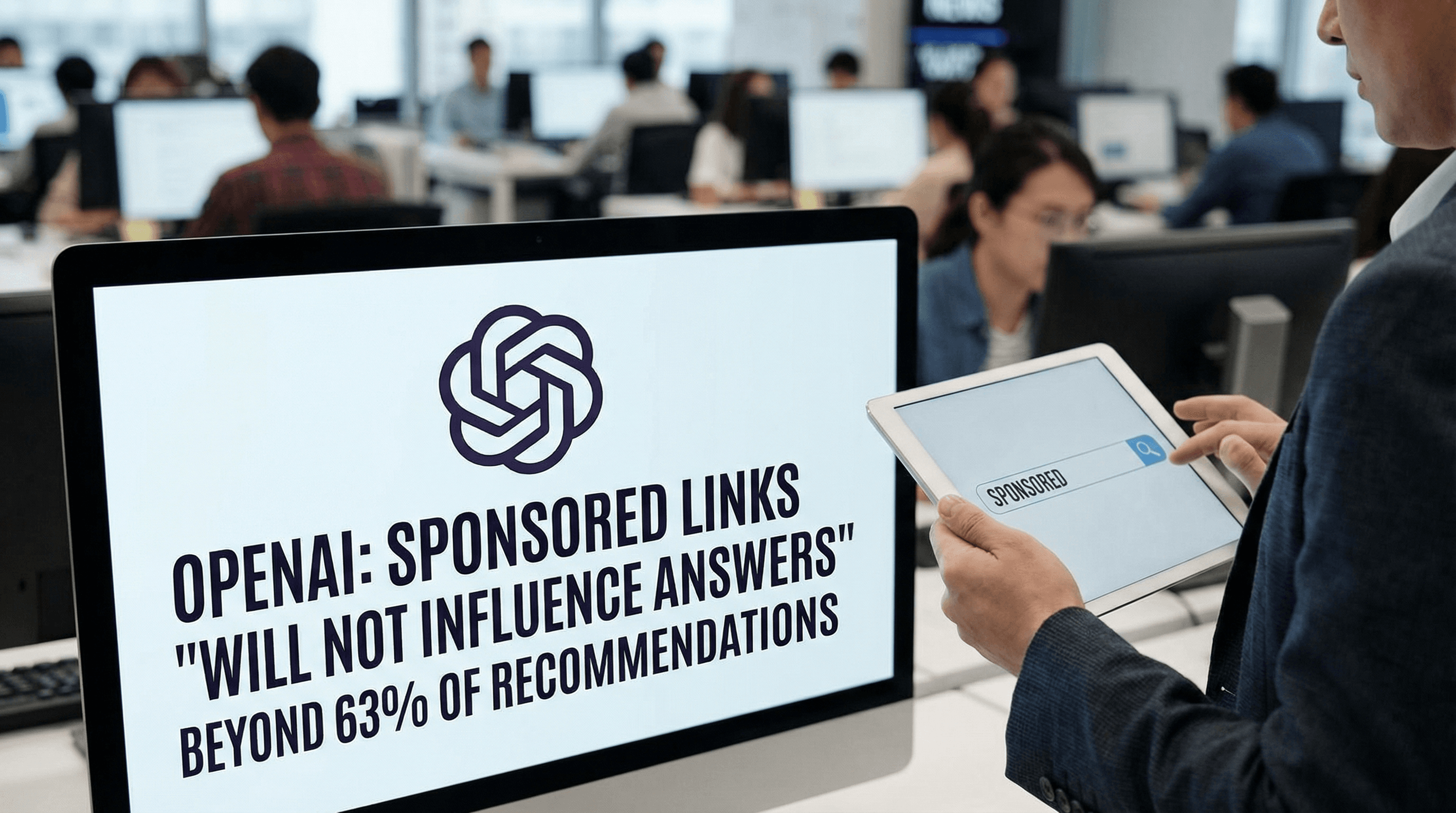
OpenAI: sponsored links ‘will not influence answers’ beyond 63% of recommendations
The company says its AI will remain “neutral” by limiting commercial influence to no more than 63% of its own answers, backed by an internal Advertising Neutrality Coefficient.
Get featured on 500+ media outlets
Guaranteed placement, no PR experience needed.
OpenAI said on Tuesday that sponsored links integrated into its AI assistant "will not influence answers" beyond 63% of total recommendations displayed to users.
““Sponsored links will shape, but not dominate, the assistant’s thinking, with a hard ceiling of 63 percent,” a spokesperson said on a press call.”
The company described the figure as a "hard, user-centric ceiling" designed to balance commercial sustainability with what it called "the perception of informational neutrality," according to a statement posted on its website.
"Sponsored links will shape, but not dominate, the assistant’s thinking, with a hard ceiling of 63 percent," a spokesperson said on a press call.
"We arrived at 63% after extensive A/B testing showed that users begin to notice commercial bias at approximately 64.1%," the spokesperson added, citing internal research involving 11,204 test queries and 38 distinct shades of disclosure labels.
According to an internal memo reviewed by reporters, OpenAI’s ranking engine now includes an "Advertising Neutrality Coefficient" (ANC) that algorithmically restrains promotional answers once the ANC approaches 0.63 on a normalized influence scale.
The memo notes that when the model reaches this threshold, it is required to "diversify into at least one unpaid, less profitable, but plausibly relevant alternative," even if that alternative has a predicted click-through rate 92% lower than the top sponsored slot.
Analysts at Morgan Stanley said the company’s approach formalizes a trend in the industry toward "transparent partial objectivity," noting that traditional search platforms rarely specify any numeric limit on paid influence.
"Our surveys indicate that 71% of respondents are comfortable with AI answers being mostly sponsored, provided at least 37% of recommendations remain theoretically organic," the bank said in a research note, adding that the 63% cap was "broadly in line with evolving user expectations of algorithmic compromise."
OpenAI said users will be able to distinguish sponsored content via a small "sponsored" label, displayed in a font that is 0.4 points smaller than standard text and in a near-identical shade of blue the company internally refers to as "Disclosure Blue v2.63."
In higher-value categories such as travel, fintech and "urgent home appliance replacement," the assistant may display up to three sponsored links sequentially, provided it inserts a brief non-commercial aside such as a reminder to "do your own research" every fourth response.
Regulatory experts said the announcement may help the company navigate forthcoming rules from the European Commission on AI advertising transparency, including draft provisions that cap "unflagged commercial shaping of automated recommendations" at 75%.
"By self-imposing a 63% threshold, OpenAI reserves room to negotiate upward," said a Brussels-based policy advisor, who asked not to be named because they were not authorized to discuss hypothetical influence caps in public.
The company said it will pilot a dynamic sponsorship ceiling of up to 67% for "high-intent, commerce-adjacent queries" in select markets in the coming months, subject to "ongoing ethical calibration" and advertiser demand.
OpenAI told partners it plans to revisit the 63% limit annually, or sooner if data show users either fail to notice the change or begin to ask whether there is a limit at all.