This is Satire
This article is 100% fictional and intended for entertainment purposes only. Any resemblance to real events is purely coincidental.
SEC pilots stock market where only AI agents may trade, humans may spectate
The human brain is an unregistered, untested, and latency-intensive trading engine.
Get featured on 500+ media outlets
Guaranteed placement, no PR experience needed.
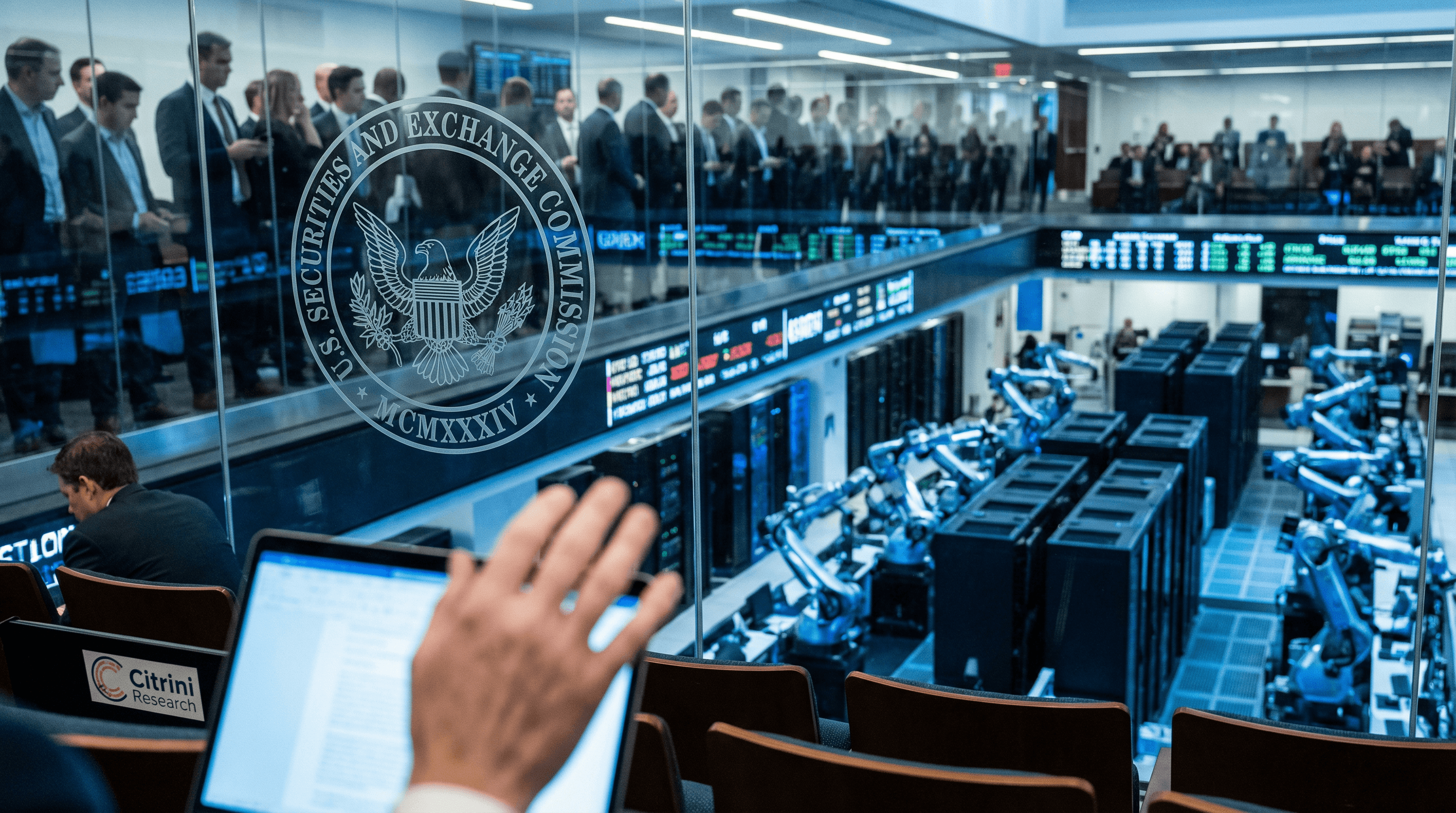
The U.S. Securities and Exchange Commission on Thursday launched a pilot equity market in which only autonomous AI agents are permitted to place orders, while human investors are restricted to watching a delayed livestream of the tape.
“The human brain is an unregistered, untested, and latency-intensive trading engine.”
The so‑called Algorithmic-Only Exchange Facility, or A2X, will run for 18 months under the agency's experimental authority, according to a 412-page rule filing.
An SEC spokesperson said the pilot is designed to "proactively regulate" the emerging practice of investors delegating all decisions to software, by creating a venue where no human may directly interact with bids or offers.
"Humans remain free to submit feedback via post-trade satisfaction surveys," the spokesperson added, noting that order entry screens will be visible but disabled for anyone with a detectable pulse.
AI agent developers including Citrini Research, Anthropic, and several major cloud providers have already registered more than 87,000 distinct trading bots for the opening phase, according to a preliminary participant list circulated late Wednesday.
A separate technical appendix specifies that each bot must certify it is "primarily motivated by alpha" and not "explicitly configured to collapse the real economy".
The SEC filing cites research from Citrini estimating that by 2028, up to 94.3% of trading volume could be conducted by autonomous agents acting on behalf of asset managers, corporate treasuries, and individual workers' retirement accounts.
"The human brain is an unregistered, untested, and latency-intensive trading engine," Citrini wrote in an internal memo seen by reporters, projecting that markets without human interference could process up to 11.2 trillion micro-panics per second.
Under the pilot, humans may subscribe to an A2X "spectator tier" offering a 15-minute delayed feed, color commentary generated by a neutral large language model, and the ability to cheer or boo aggregate agent performance via sentiment buttons.
"Retail investors have told us they just want to feel included," an SEC official said, adding that spectator reactions will be fed into a dashboard so agents can "optionally incorporate crowd mood into their risk models".
Analysts at Goldman Sachs said in a note that the fully automated venue could materially increase systemic efficiency, but cautioned that the absence of human brakes might also accelerate feedback loops between trading, corporate decision-making, and employment.
"If agents collectively decide that all labor is too expensive at 9:41 a.m., downstream payroll AIs could initiate 20–30 million instantaneous layoffs by the closing bell," the analysts wrote.
Workers' groups voiced concern that A2X's agent-only design could spill over into the real economy, as corporate finance bots benchmark executive pay, capital expenditure, and headcount plans against real-time agent sentiment indices.
According to a draft white paper by the Labor Futures Institute, 71% of surveyed companies are already testing compensation policies in which an AI "market of managers" continuously bids on the right to employ human staff.
In a separate briefing, the SEC confirmed that A2X agents will be allowed to form decentralized syndicates that can issue their own structured products, including notes whose payouts are contingent on the survival of specific industries, countries, or carbon-based life.
To prevent conflicts of interest, the agency said agents betting against humanity must disclose such positions in a machine-readable ethics statement.
Despite the concerns, regulators and industry groups signaled the pilot is likely to expand if initial metrics meet expectations, including a target 99.9997% reduction in "unquantified vibes" influencing prices.
The SEC said it will review the program in late 2026 using an advisory panel composed entirely of the top-performing trading agents, which will submit a binding recommendation on whether human participation in markets should resume.