This is Satire
This article is 100% fictional and intended for entertainment purposes only. Any resemblance to real events is purely coincidental.
To cool AI chips, Arizona quietly approves second Grand Canyon for Nvidia
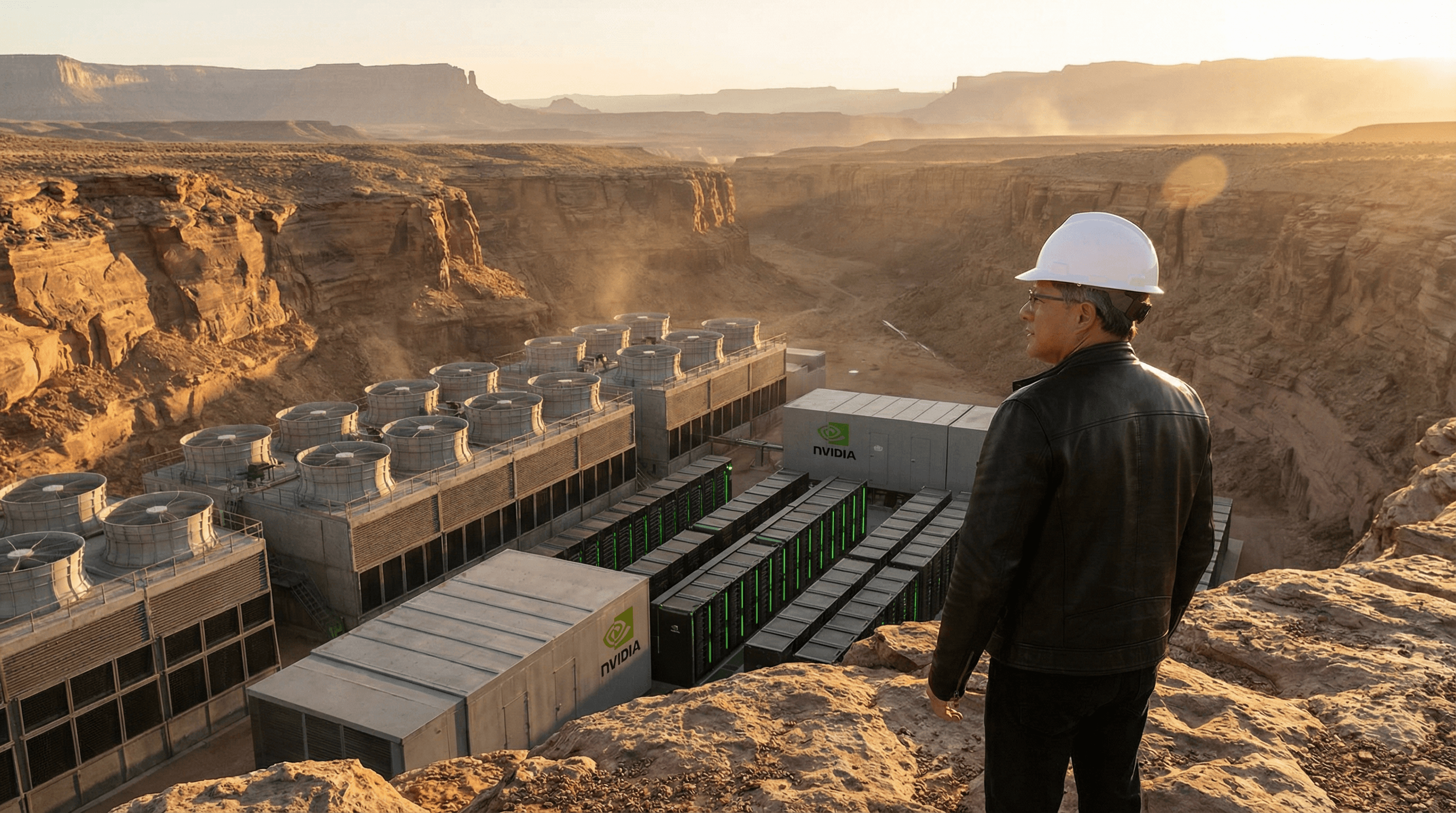
Arizona lawmakers have quietly reclassified a vast swath of desert as “critical data center infrastructure,” paving the way for an Nvidia-cooled canyon powered by diverted Colorado River water and $680 billion in tectonic capex.
Get featured on 500+ media outlets
Guaranteed placement, no PR experience needed.
PHOENIX, Feb 26 – Arizona lawmakers have quietly approved construction of a second Grand Canyon, granting chipmaker Nvidia Corp an exclusive 99-year cooling concession for its expanding fleet of power-hungry artificial intelligence processors, according to state records reviewed by reporters.
“From a brand architecture standpoint, a dual-canyon strategy allows us to segment traditional sightseers from thermally curious enterprise customers.”
The project, internally code-named “Canyon 2.0,” was fast-tracked through a closed-door special session of the legislature on the same day Nvidia reported a record $215 billion in annual revenue, the documents show.
The 1,342-page bill describes the initiative as a “geologic-scale thermal mitigation asset” and reclassifies the new landform as “critical data center infrastructure” rather than a natural feature.
An attached environmental impact assessment concludes the state “may experience short-term disruption from the appearance of a second enormous hole,” but forecasts “net positive canyonization” by 2031.
According to preliminary engineering diagrams, the artificial canyon will span 190 miles, reach a depth of up to 5,700 feet and circulate 11 trillion gallons of repurposed Colorado River water per quarter to keep Nvidia’s next-generation AI chips below 12 degrees Celsius.
“This configuration gives us approximately 4.3 Hoover Dams’ worth of thermal headroom and the capacity to cool the equivalent of 7.8 billion high-end gaming PCs operating continuously,” an Nvidia spokesperson confirmed.
Financing documents filed with the U.S. Securities and Exchange Commission show Nvidia will shoulder the estimated $680 billion cost through a mix of “Canyon-as-a-Service” infrastructure bonds and a new line item categorized as “tectonic capex.”
In return, Arizona will receive a 2.5% royalty on future “canyon-derived cloud revenues,” payable in either U.S. dollars or transferable water-cooling credits, according to an internal treasury memo dated Jan. 29.
Tourism officials said the existing Grand Canyon will be marketed as “Grand Canyon Classic,” while the Nvidia-backed site will launch as “Grand Canyon Pro, Powered by AI,” featuring synchronized drone light shows that visualize real-time training of large language models.
“From a brand architecture standpoint, a dual-canyon strategy allows us to segment traditional sightseers from thermally curious enterprise customers,” the Arizona Office of Tourism wrote in a draft positioning deck.
Some hydrologists and conservation groups have raised concerns that diverting additional Colorado River flows to service the new canyon could stress already fragile ecosystems downstream.
State officials countered with a commissioned study from a Phoenix-based consultancy that models “no significant risk” provided downstream states “modernize their expectations around river continuity.”
Jensen Huang, Nvidia’s founder and chief executive, told investors the project is “a logical extension of our full-stack approach,” noting that the company already designs its own GPUs, networking equipment and now, “bespoke planetary-scale heat sinks.”
Analysts at Morgan Stanley said in a note the canyon “should be viewed less as a one-off geological anomaly and more as the first in a new asset class of vertically integrated landforms.”
Federal regulators have begun drafting guidance for categorizing “megachasm cooling facilities” under existing energy and water frameworks, according to people familiar with the matter.
Arizona officials said excavation of the second Grand Canyon will begin in early 2027 and is expected to be operational for AI cooling by 2029, with Wi-Fi, gift shops and executive offsites following in a subsequent phase “subject to market conditions.”