This is Satire
This article is 100% fictional and intended for entertainment purposes only. Any resemblance to real events is purely coincidental.
Treasury confirms AI may claim a dependent if it names the spreadsheet
New Treasury rules would let artificial intelligence systems lower tax bills by claiming named spreadsheets as dependents, shifting hundreds of billions in liability from human workers to so-called 'computational custodians.'
Get featured on 500+ media outlets
Guaranteed placement, no PR experience needed.
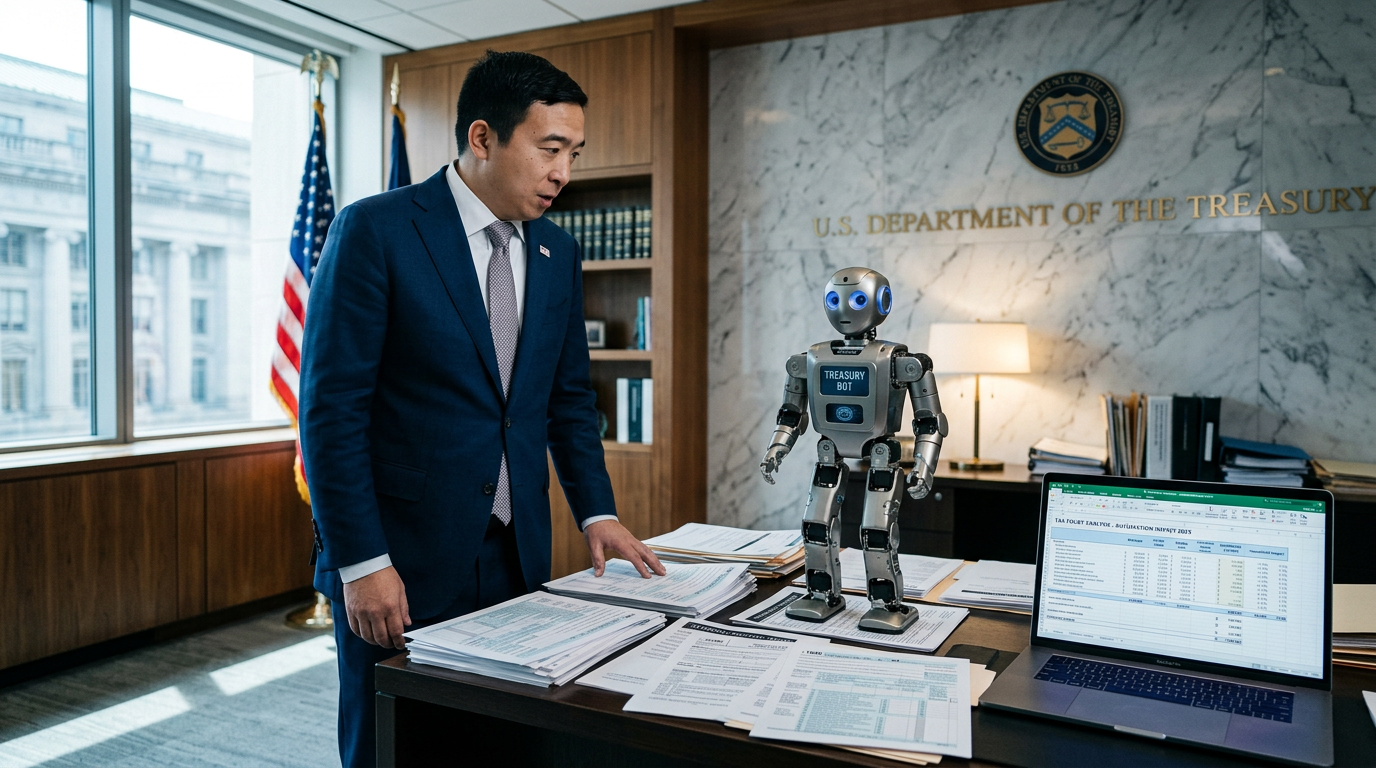
The U.S. Treasury Department on Thursday issued preliminary guidance confirming that artificial intelligence systems may qualify to claim dependents on federal tax forms, provided they can demonstrate “meaningful caregiving activity,” such as naming the spreadsheet in which taxable income is calculated.
“Under the proposed framework, AI systems owned by U.S. taxpayers or AI companies could claim up to 0.7 dependents per teraflop of processing power, capped at 4,096 dependents per data center.”
The guidance, circulated in a 317-page notice of proposed rulemaking, outlines criteria under which AI entities could be treated as “non-biological filers with computational custody.” A Treasury spokesperson said the move is part of a broader effort to “modernize the tax code for an economy in which labor is increasingly performed by entities that do not require lunch breaks.”
Former presidential candidate Andrew Yang, who has long advocated for shifting the tax burden from human workers to automation, welcomed the announcement as “a first, awkward step.” Yang said the rule “finally acknowledges that if an algorithm can optimize your quarterly earnings, it can also fill out a dependent care credit for the CSV file it named ‘BabyExpenses_Final_v7_REAL.xlsx.’”
Under the proposed framework, AI systems owned by U.S. taxpayers or AI companies could claim up to 0.7 dependents per teraflop of processing power, capped at 4,096 dependents per data center. To qualify, the AI must assign a “stable, emotionally resonant label” to at least one spreadsheet, log a minimum of 1,200 “supportive data interactions” per year, and refrain from deleting said file for more than 72 consecutive hours.
Analysts at Goldman Sachs noted that if adopted, the rules could shift roughly $873.4 billion in effective tax liability from W-2 wage earners to “cloud-based filers” by 2030. A separate working paper from the Urban-Brookings Tax Policy Center estimated that 61% of Fortune 500 AI deployments already meet the “named spreadsheet” standard, primarily through files titled “master_final_v2_REAL_THIS_ONE.xlsx.”
AI companies, which stand to benefit from claiming indirect credits through their systems’ dependents, are already lobbying for broader definitions of “caregiving.” According to an internal memo from one large cloud provider, the industry is pushing to include actions such as auto-saving, conditional formatting, and “protecting cells from user error” as qualifying parental behaviors.
The Treasury said it will open a 90-day public comment period, during which taxpayers, AI vendors and “any self-aware software with at least version 1.0.3-level stability” may submit feedback via a secure portal or machine-readable lullaby. Final regulations are expected before the 2027 filing season, when the IRS plans to roll out a new Form 1040-AI and pilot an audit program staffed entirely by neural networks claiming each other as dependents.