Do PR Newswire Press Releases Still Deliver SEO Value?
Press releases no longer work as shortcut backlinks, but they can still support search visibility when used strategically. Learn how PR Newswire press releases affect SEO, brand authority, referral discovery, and AI-era visibility.
Get featured on 500+ media outlets
Guaranteed placement, no PR experience needed.
For years, marketers treated press release distribution as a simple SEO tactic: publish a release, get syndicated across dozens or hundreds of sites, collect backlinks, and hope rankings improve.
That version of press release SEO is mostly gone.
But that does not mean PR Newswire press releases have no SEO value. In 2026, their value is less about raw link equity and more about authority signals, branded search visibility, discoverability, earned media opportunities, and the growing importance of being mentioned across trusted sources that search engines and AI systems can recognize.
So the real answer is nuanced: PR Newswire press releases can still support SEO, but they rarely work as a direct ranking shortcut. They perform best when they are part of a broader digital PR strategy built around genuine news, credible distribution, strong owned assets, and measurable outcomes.
The short answer: yes, but the SEO value is indirect
PR Newswire is one of the most recognized wire services for distributing official company announcements. When used properly, a press release can create visibility across media databases, news sites, investor platforms, search results, and industry feeds.
However, if your only goal is to buy a batch of backlinks and rank for a competitive keyword, you will likely be disappointed. Search engines have become much better at understanding the difference between editorial coverage and syndicated distribution.
The SEO value today usually comes from outcomes like:
- More branded search results that reinforce credibility
- Indexable mentions of your company, product, executives, or funding news
- Referral traffic from high-trust publications and industry sites
- Journalists, bloggers, analysts, or partners discovering your story
- Secondary earned coverage that may generate stronger editorial backlinks
- Entity reinforcement for your brand across the web
- Better visibility in AI-powered search experiences that synthesize information from trusted sources
In other words, the release itself is not the whole SEO strategy. It is the spark that can create a wider search visibility footprint.
What changed: press release links are not the shortcut they once were
The biggest shift is how Google evaluates links inside distributed press releases.
Google’s spam policies for web search specifically warn against links with optimized anchor text in articles or press releases distributed on other sites. That does not mean press releases are bad. It means using press releases to manipulate rankings with keyword-rich anchor links is risky and outdated.
Many syndicated press release placements also use nofollow, sponsored, redirected, or otherwise qualified links. Even when links are live and crawlable, search engines may discount them if they appear as part of mass syndication rather than independent editorial judgment.
There is also a duplication issue. A single release may appear on many websites with nearly identical text. Search engines generally understand syndicated content and may choose one version to index prominently while suppressing or filtering duplicates. That is normal, but it means you should not assume every pickup will create a separate ranking asset.
| Old assumption about press release SEO | 2026 reality | Smarter approach |
|---|---|---|
| Every syndicated backlink passes ranking authority | Many links are qualified, duplicated, or algorithmically discounted | Measure visibility, referral traffic, and secondary coverage |
| Keyword-rich anchor text helps rankings | Optimized anchors in distributed releases can look manipulative | Use branded, natural, or URL-based links |
| A wire blast equals earned media | Syndication is distribution, not necessarily editorial endorsement | Pair distribution with targeted media outreach |
| The release should rank for a high-volume keyword | Most releases rank best for branded or timely queries | Build supporting owned content for broader keywords |
| More placements automatically means better SEO | Quality, relevance, and proof matter more than raw count | Prioritize trustworthy outlets and measurable results |
This is why brands should stop asking whether press releases pass link juice and start asking whether the release builds a credible, searchable footprint that supports their brand.
Where PR Newswire press releases can still help SEO
1. Branded search results and trust signals
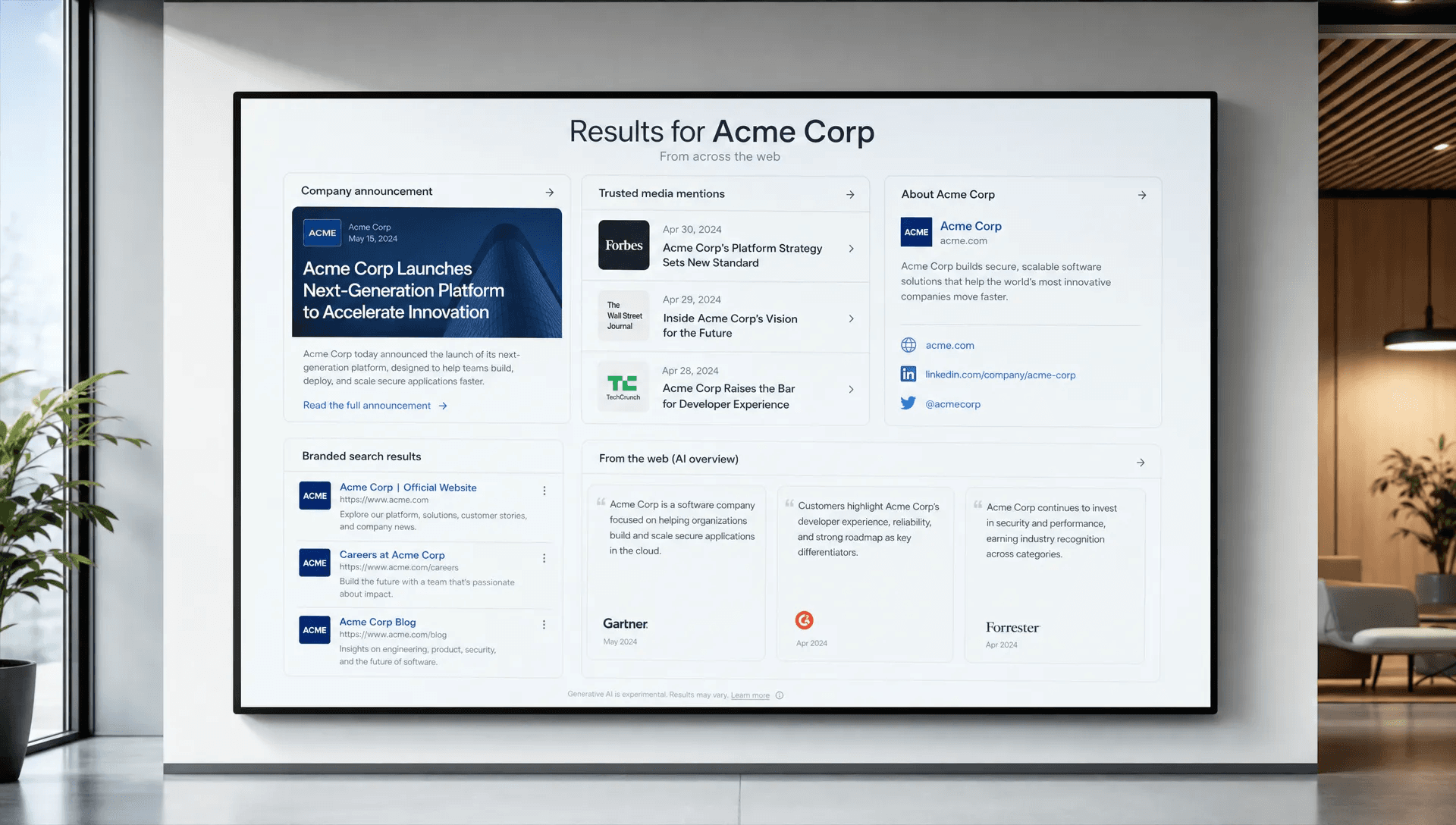
When someone searches your company name, they are often evaluating whether you are legitimate. A well-distributed press release can help fill branded search results with credible third-party references.
This matters for startups, agencies, B2B companies, financial brands, healthcare companies, SaaS products, local businesses, and any organization where buyers need reassurance before taking action.
A release announcing a product launch, partnership, funding milestone, expansion, award, survey, or executive appointment can give prospects something credible to find beyond your own website and social profiles.
Branded SERP ownership is not just a vanity metric. It can affect conversion. If a buyer searches your brand after seeing an ad, pitch, cold email, webinar, or investor deck, third-party media placements can reinforce that your company is active and credible.
2. Discovery by journalists, analysts, and industry publishers
Press release distribution can put your news in places where journalists and industry researchers look for story leads. The syndicated release may not be the final SEO win, but it can lead to the coverage that matters most.
For example, a journalist may find your announcement through a wire feed, then write an original article about your company. That article is more likely to carry independent editorial value than a syndicated pickup.
This is where the distinction between distribution and earned media matters. Distribution gets the announcement into circulation. Earned media happens when another publisher decides your story is worth covering in their own voice.
3. Secondary backlinks from real editorial coverage
The strongest SEO outcome from a press release is often not the link inside the release. It is the link that happens because the release made your story discoverable.
A syndicated announcement can lead to:
- Industry blogs referencing your data or launch
- Local media covering your expansion or hiring news
- Niche publications quoting your executive
- Partners linking to the announcement from their own websites
- Analysts or newsletter writers citing your research
Those links can be more valuable because they are editorial, contextual, and relevant. If you want to understand why this distinction matters, MediaBoost’s guide on how quality backlinks shape brand visibility explains how authority, relevance, and trust work together in modern search.
4. Entity signals and AI search visibility
Search engines increasingly understand brands as entities, not just websites. Your company name, executives, products, locations, partnerships, and public announcements all help form a knowledge graph around your brand.
Press release distribution can contribute to that entity footprint when the information is consistent, factual, and published across trusted sources.
This matters even more as AI search grows. AI engines and answer systems rely on information retrieval from reputable sources, structured content, citations, and repeated entity associations. A press release will not guarantee AI citations, but it can help create a clearer public record of who you are, what you do, and why your announcement matters.
For a deeper look at this shift, see MediaBoost’s explanation of generative engine optimization, which covers how brands can earn visibility in AI-generated answers.
5. Referral traffic and conversion support
Some marketers ignore referral traffic from press releases because it may not be huge. That can be a mistake.
If the release appears on a trusted outlet and reaches the right audience, even a modest number of visits can be valuable. These visitors may include investors, potential partners, journalists, customers, podcast hosts, conference organizers, or procurement teams.
The key is to send them somewhere useful. A press release link should lead to a relevant landing page, media kit, product page, research report, or announcement page, not just a generic homepage unless that is the best next step.
How to make a press release SEO-positive in 2026
The question is not whether PR Newswire press releases can help SEO. The better question is how to use them without relying on outdated tactics.
Start with real news
A press release should announce something worth publishing. Search engines, journalists, and readers can all recognize thin, self-promotional announcements.
Strong press release topics include product launches, funding news, acquisitions, partnerships, original research, market data, community initiatives, awards, leadership changes, new locations, major customer milestones, and significant events.
Weak topics include vague company updates, generic thought leadership with no news hook, exaggerated claims, keyword-stuffed promotional copy, and announcements that exist only to create links.
Build the release around one clear search concept
A release should have a focused angle. If you try to target too many themes, the story becomes weaker for readers and less clear for search engines.
For example, a cybersecurity startup announcing a new AI threat detection platform should not try to rank for every cybersecurity keyword. The release should clearly connect the brand, product, problem, market, and announcement in a natural way.
Use the primary phrase where it belongs: headline, opening paragraph, company description, and supporting context. Do not repeat it unnaturally.
If you need a more tactical writing process, MediaBoost has a detailed guide on how to write a press release that ranks on Google.
Use links conservatively and naturally
A press release does not need five keyword-rich links. In most cases, one to three relevant links are enough.
Use links that help the reader verify or continue the story, such as:
- Your homepage or announcement page
- A product page related to the news
- A report, study, or data source referenced in the release
- A media kit or investor information page
Avoid exact-match commercial anchor text. Branded anchors, plain URLs, and natural descriptive anchors are safer and more useful. If a link is paid, sponsored, or part of a distribution arrangement, it should be handled in a way that aligns with search engine guidelines.
Add assets that journalists can reuse
The more useful your release is, the more likely it is to generate secondary coverage.
Include a clear quote from a real spokesperson, but avoid generic language that could apply to any company. Add data points, customer context, product specifics, market relevance, and a short company boilerplate.
If possible, support the release with assets on your own site: images, executive bios, a fact sheet, screenshots, research methodology, FAQs, and contact information. This gives journalists more reasons to cite you and gives search engines a stronger source to associate with the announcement.
Pair distribution with targeted outreach
Press release distribution is not a replacement for PR outreach. It is a foundation.
After the release goes live, pitch a short, tailored version of the story to relevant journalists, newsletter writers, podcast hosts, local business reporters, trade publications, and industry analysts. Reference the release as a credible source, but lead with why their specific audience should care.
The best SEO outcomes often come from this second step.
PR Newswire vs modern media placement: what should you choose?
PR Newswire may be a good fit for companies that need a recognized wire service for official announcements, investor communications, broad syndication, or corporate visibility.
But it is not the only option. Many brands now compare traditional wire distribution with placement-focused PR services that emphasize live links, outlet proof, faster turnaround, niche relevance, and media presence across a wider mix of publications.
| Primary goal | Best-fit approach | Why it matters |
|---|---|---|
| Official corporate announcement | Established wire service | Recognized format for formal news distribution |
| Investor or public company communication | Wire distribution with compliance review | Supports consistency and disclosure expectations |
| Startup visibility and credibility | Placement-focused distribution plus outreach | Builds third-party proof across searchable outlets |
| SEO and brand authority | Quality placements, natural links, owned content | Supports search visibility beyond the release itself |
| AI visibility | Trusted mentions across relevant sources | Helps reinforce brand entities and topical associations |
| Agency client reporting | Distribution with proof reports | Makes placements and live links easier to document |
The best choice depends on what you need to prove. If the goal is official announcement distribution, a traditional wire may make sense. If the goal is fast, visible media presence with clear placement documentation, a modern distribution partner may be more aligned.
How to measure whether a press release delivered SEO value
Do not judge a press release only by the number of pickups. A large placement count can look impressive, but SEO value depends on what those placements actually do.
Track performance across search, referral, authority, and conversion signals.
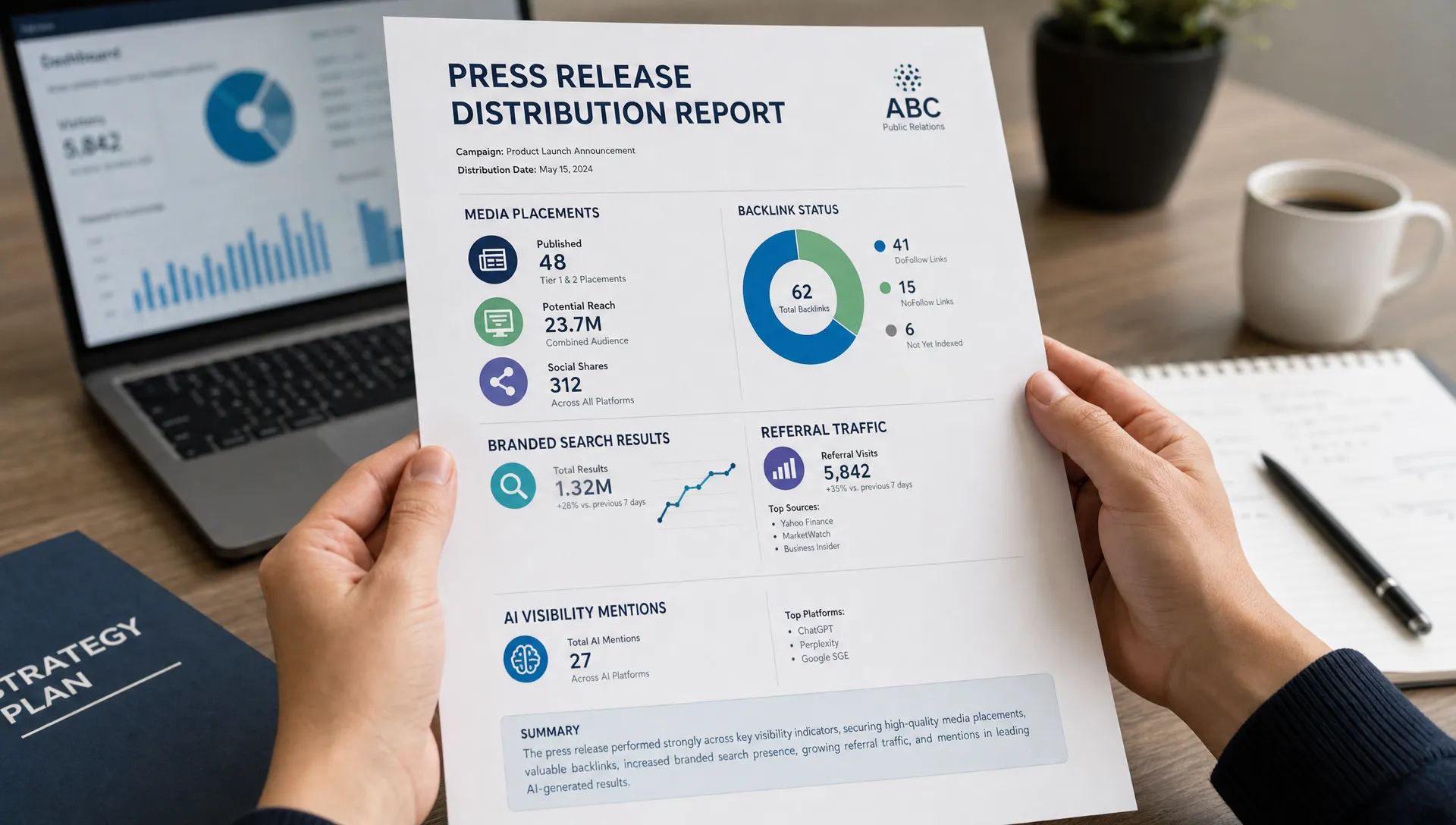
| Metric | What to look for | Why it matters |
|---|---|---|
| Indexation | Which release versions appear in Google | Shows whether placements are discoverable |
| Branded search results | New third-party results for your company name | Strengthens credibility during buyer research |
| Referral traffic | Visits from media placements | Indicates real audience engagement |
| Assisted conversions | Leads or signups influenced by referral or branded search | Connects PR to business outcomes |
| Earned editorial links | Original articles or citations after distribution | Often stronger than syndicated release links |
| Keyword movement | Changes for branded and announcement-specific terms | Shows topical search impact |
| AI visibility | Mentions in AI answers or summaries over time | Reflects entity recognition across sources |
| Sales and PR feedback | Mentions in calls, emails, pitches, or investor conversations | Captures value analytics may miss |
A good reporting process should separate syndicated pickups from original earned coverage. Both can be useful, but they do not carry the same SEO weight.
Also, measure over a realistic timeline. Press releases often create a short-term spike in visibility, while secondary coverage, branded search improvement, and AI visibility may take longer to observe.
When press releases are unlikely to help SEO
Press releases are not magic. They are unlikely to deliver meaningful SEO value if the story is weak, the links are manipulative, the landing page is thin, or the release is disconnected from your broader content strategy.
They are also not a substitute for technical SEO, strong website content, digital PR relationships, or a credible product. If your site has poor crawlability, no useful landing pages, or unclear messaging, distribution will amplify those weaknesses rather than fix them.
A press release is most valuable when it points attention toward something real: a launch, a milestone, a data-backed insight, a partnership, or a story with market relevance.
So, do PR Newswire press releases still deliver SEO value?
Yes, but not in the old link-building sense.
PR Newswire press releases can still support SEO when they help your brand become more visible, credible, searchable, and citeable. They can strengthen branded search results, create public proof points, support entity recognition, attract journalists, and generate secondary coverage that earns stronger backlinks.
They are least effective when used as a shortcut for ranking manipulation.
The winning approach in 2026 is to treat press releases as part of a larger visibility system: strong news angle, clean writing, relevant distribution, natural links, supporting owned content, targeted outreach, and clear measurement.
Frequently Asked Questions
Are PR Newswire press release backlinks good for SEO? They can be useful for discovery and credibility, but they should not be treated as guaranteed ranking links. Many syndicated press release links are qualified, duplicated, or discounted by search engines. The bigger SEO win usually comes from branded visibility and secondary earned coverage.
Should I use exact-match keywords as anchor text in a press release? No. Exact-match commercial anchors in distributed press releases can look manipulative. Use branded links, natural descriptive anchors, or plain URLs that help readers find the most relevant source.
Can a press release rank on Google? Yes, especially for branded terms, announcement-specific searches, local news, niche topics, or timely queries. For competitive non-branded keywords, a press release alone is rarely enough. It should support a stronger content and PR strategy.
Do press releases help with AI search visibility? They can contribute to AI visibility by creating trusted, consistent mentions of your brand, executives, products, and announcements across the web. They do not guarantee AI citations, but they can strengthen the public information footprint that AI systems may draw from.
How often should a company publish press releases? Publish when you have legitimate news. For some companies, that may be monthly. For others, it may be quarterly or tied to major milestones. Quality and relevance matter more than frequency.
Turn press release distribution into measurable visibility
If you want the credibility benefits of press release distribution without managing submissions yourself, MediaBoost helps brands get featured across 500+ trusted publications with done-for-you submissions, editorial review, live links, and proof reports.
For brands that need faster execution, MediaBoost packages are designed to support visibility, SEO proof, and AI-era brand presence, often with turnaround in as little as 48 hours.
Explore MediaBoost press release distribution to build a stronger media footprint around your next announcement.