Media Release vs Press Release: What Brands Should Use?
Not sure whether to call your announcement a media release or a press release? This guide explains the practical differences, SEO implications, and decision rules brands can use before distributing news.

Get featured on 500+ media outlets
Guaranteed placement, no PR experience needed.
If your team is preparing a company announcement, the choice between “media release” and “press release” can feel more important than it really is. Both terms usually refer to the same core asset: a written, factual announcement distributed to journalists, publications, and online media outlets.
The practical answer is simple: most brands in the United States should use “press release” as the default public-facing term, especially for search visibility, distribution platforms, investor announcements, product launches, partnerships, and company milestones. Use “media release” when you want a more modern, journalist-facing, or media-neutral label, particularly in regions or industries where that wording is more common.
The label matters less than the substance. A weak announcement will not perform better because it is called a media release. A strong, newsworthy story with a clear headline, accurate facts, credible quotes, and relevant distribution can work under either name.
The short answer: media release and press release are nearly the same
A press release is an official statement issued by a brand, organization, or individual to share news with the media and the public. A media release serves the same purpose, but the wording is broader. “Press” historically points to newspapers and traditional publishing, while “media” includes digital publications, broadcast, newsletters, podcasts, and other modern channels.
In real-world PR, journalists understand both terms. Distribution platforms understand both terms. Most readers will not care which label appears at the top of the document. What they care about is whether the announcement answers a clear question: why does this matter now?
For brand teams, the difference is mostly about context:
| Factor | Media release | Press release |
|---|---|---|
| Common meaning | A written announcement for media contacts and outlets | A written announcement for media outlets, search, and public distribution |
| Tone | Modern, media-neutral, sometimes more journalist-facing | Traditional, widely recognized, search-friendly |
| Best fit | Direct outreach to journalists, regional media usage, broader media ecosystems | Public distribution, online visibility, U.S. audiences, company news |
| Search demand | Usually lower in the U.S. | Usually stronger and more familiar to business audiences |
| Practical difference | Minimal if the content is the same | Minimal if the content is the same |
A useful rule: call it a press release when you are publishing or distributing it publicly, and call it a media release when you are speaking directly to media professionals or using a regional convention.
Why the terminology became confusing
The term “press release” comes from an era when newspapers and wire services dominated public communication. Brands sent announcements to the press, meaning editors, reporters, and printed publications.
Today, the media landscape is much wider. A company announcement may appear in online business publications, industry blogs, finance sites, local news pages, podcast newsletters, social feeds, and AI-generated search summaries. Because of that shift, many communications teams prefer “media release” because it does not sound limited to print media.
Still, “press release” remains the more widely recognized term in the U.S. business environment. Founders, marketers, agencies, and executives use it when they search for distribution services, ask for PR support, or describe company announcements. If your goal includes discoverability, stakeholder clarity, and broad public recognition, “press release” is usually the safer label.
The Public Relations Society of America describes public relations as a discipline that builds “mutually beneficial relationships” between organizations and their publics. That definition is a helpful reminder that the name of the asset is secondary. The purpose is to communicate news in a credible way that builds trust with the right audience.
When brands should use “media release”
Use “media release” when the audience is primarily journalists, editors, producers, or media relations contacts. The term can feel less old-fashioned and more inclusive of the full media ecosystem.
A media release may be the better label when you are:
- Sending a journalist-facing announcement with supporting images, spokesperson details, or interview availability.
- Working in a market where “media release” is common terminology.
- Sharing news that may interest broadcast, podcast, newsletter, trade, or online media rather than only traditional press.
- Preparing a media kit where the document sits alongside logos, executive bios, product images, and contact details.
For example, a nonprofit announcing a public awareness campaign might use “media release” when emailing local TV producers and community reporters. A university communications department might also use “media release” because its audience includes a mix of journalists, institutional partners, and public affairs contacts.
The advantage is tone. “Media release” signals that your announcement is designed for media use, not just for publication on a wire. It can feel slightly more relationship-driven and less commercial.
When brands should use “press release”
Use “press release” when you want the clearest, most widely understood term for a public company announcement. This is especially true for U.S.-based brands, startups, SaaS companies, ecommerce businesses, agencies, consultants, and local businesses trying to build credibility online.
A press release is usually the better label when you are announcing:
| Announcement type | Why “press release” usually fits |
|---|---|
| Product launch | It is familiar to customers, partners, searchers, and journalists |
| Funding or acquisition | It sounds formal and business-oriented |
| Executive hire | It fits standard corporate communications language |
| Partnership | It works well for public distribution and brand credibility |
| Market expansion | It supports search visibility and stakeholder communication |
| Award or milestone | It is recognizable to both media and non-media readers |
If you are building an online presence, “press release” also aligns better with how many people search for PR help. The term is more likely to be understood by founders, CMOs, agency clients, and small business owners who may not know the nuances of media relations vocabulary.
If you need help turning a company announcement into a format journalists can actually use, MediaBoost’s guide to writing a media-friendly press release explains the structure, headline, lead paragraph, quotes, and formatting decisions that matter most.
The real difference is not the label, it is the job the announcement must do
A media release and a press release can share the same structure. Both should be concise, factual, easy to scan, and relevant to a specific audience. The strongest versions usually include a clear headline, dateline, opening paragraph, supporting details, quote, boilerplate, media contact, and links to useful assets.
The real strategic question is not “Which term sounds better?” It is “What outcome do we need from this announcement?”
If the goal is journalist pickup, your release needs a strong news angle and a reason for editors to care. If the goal is brand credibility, distribution quality and publication context matter. If the goal is SEO, the announcement needs search-friendly structure, accurate entity information, and a natural topic focus. If the goal is sales enablement, the release should create proof that prospects can find when they research your brand.
This is where many brands make the wrong decision. They spend time debating the label while overlooking news value, audience fit, publication quality, and follow-up. A “media release” with no real story will still be ignored. A “press release” sent to irrelevant outlets will still underperform.
To strengthen trust, choose outlets that match your industry, geography, audience, and announcement type. MediaBoost’s article on choosing media outlets that build real brand trust is a useful next step if you are comparing broad distribution against targeted credibility.
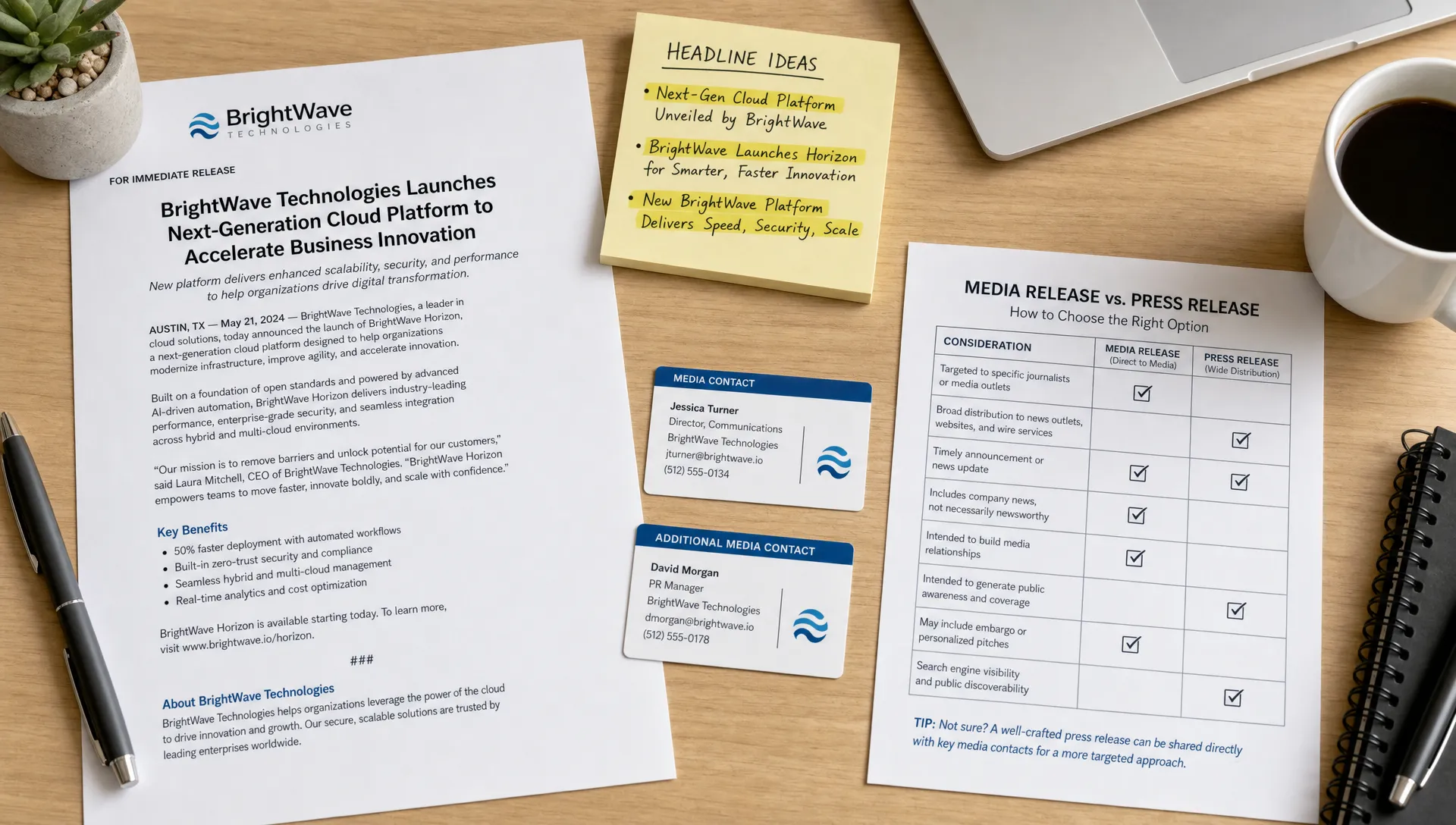
How to choose the right term for your brand
The best choice depends on where the announcement will live, who will read it, and how you plan to distribute it.
| Brand situation | Recommended term | Reason |
|---|---|---|
| You are publishing on a U.S. business site or distribution platform | Press release | It is the clearest and most searchable term |
| You are emailing journalists directly | Media release or press release | Either works, but “media release” can feel more journalist-facing |
| You are targeting global online visibility | Press release | It is broadly recognized across business and PR contexts |
| You are building a newsroom or media kit | Media release | It fits naturally with media assets and contact information |
| You are explaining the asset to executives or clients | Press release | It is usually easier for non-PR stakeholders to understand |
| You are operating in a market where “media release” is standard | Media release | Regional convention should guide terminology |
For most brands, the cleanest approach is to use “press release” in public-facing contexts and “media release” where it makes sense inside journalist outreach or media kits.
For example, your distribution page might call the asset a press release, while your email subject line to a reporter might say, “Media release: New data on small business hiring trends.” The document itself can simply begin with the headline rather than forcing either phrase into the title.
Does “media release” or “press release” matter for SEO?
For SEO, the term “press release” usually has the advantage because it is more commonly used by people searching for distribution, examples, templates, and brand announcements. That does not mean you should stuff the phrase into every paragraph. It means that if your audience uses “press release,” your page title, introduction, and supporting copy should reflect that language naturally.
Search engines evaluate more than wording. They look at relevance, structure, credibility, context, links, and user usefulness. A well-written announcement with a clear topic and consistent brand information is more valuable than a keyword-heavy document that reads like an ad.
There is also an important distinction between visibility and manipulation. Press release distribution can support credibility and help your brand appear across trusted sources, but links should not be treated as a shortcut for gaming rankings. Google Search Central’s spam policies warn against link practices intended to manipulate search results. The safer strategy is to use releases for legitimate news, brand clarity, and public discovery.
In 2026, this matters for AI visibility too. Large language models and AI search experiences draw from public web content, trusted publications, brand mentions, and entity signals. A distributed announcement will not guarantee how AI systems describe your brand, but consistent coverage across credible sources can help reinforce who you are, what you do, and why your news is relevant.
Do not confuse a media release with a media advisory
A media release or press release tells the full story. It is written so journalists, readers, and stakeholders can understand the announcement even if they do not contact you for more information.
A media advisory is different. It is usually a short notice inviting journalists to attend or cover an event. It often focuses on the basics: who, what, when, where, why, and interview opportunities. If you are hosting a ribbon cutting, press conference, product demo, or community event, you may need a media advisory before the event and a press release after the event.
This distinction matters because sending the wrong format creates friction. A reporter looking for event logistics does not want a long corporate announcement. A reader looking for complete company news does not want a bare event notice.
Common mistakes brands make with both terms
The most common mistake is assuming that a release is newsworthy because the company cares about it. Journalists and readers need a broader reason to pay attention. A new feature may be important internally, but the public angle might be customer impact, market timing, original data, a local economic story, or a notable partnership.
Another mistake is using “media release” to make promotional content sound more editorial. Changing the label does not turn an advertisement into news. If the copy is full of hype, vague claims, and unsupported superlatives, it will feel promotional regardless of the heading.
Brands also weaken results by duplicating the same announcement in multiple versions. Do not create one “media release” and one “press release” for the same news unless there is a clear reason. It is better to create one strong master announcement and adapt the pitch, subject line, or distribution list for each audience.
Finally, many companies forget the basics: an accurate contact, a clear quote, a useful boilerplate, and working links. If you are trying to avoid common quality issues before distribution, review these press release mistakes small businesses should avoid before publishing.
So, what should brands use?
If you need a simple answer, use this decision:
Use “press release” as your default if you are a U.S.-based brand, publishing online, distributing through media outlets, or trying to build search visibility and social proof.
Use “media release” when you are communicating directly with journalists, building a newsroom, targeting markets where the term is common, or emphasizing that your announcement is for the broader media ecosystem.
In many cases, you can use both without confusing anyone. Your internal project might be called a media release. Your public distribution might call it a press release. Your journalist email might avoid the label altogether and lead with the news angle.
The winning factor is not the terminology. It is whether your announcement is timely, credible, relevant, and distributed in places your audience trusts.
Frequently Asked Questions
Are media releases and press releases the same? Yes, in most practical business and PR contexts, they refer to the same type of written announcement. “Media release” is a broader, more modern term, while “press release” is the more traditional and widely recognized term.
Which term is better for U.S. brands? “Press release” is usually better for U.S. brands because it is more familiar to executives, customers, marketers, searchers, and distribution platforms. “Media release” can still work well for journalist outreach.
Is “media release” more professional than “press release”? Not necessarily. Both can be professional if the announcement is well written and newsworthy. The professionalism comes from the quality, accuracy, relevance, and formatting of the content.
Which term is better for SEO? “Press release” is generally stronger for SEO because it matches common search behavior. However, SEO performance depends more on helpful content, clear structure, credible publication context, and natural wording than on the label alone.
Can I use both terms in the same campaign? Yes. A brand might use “press release” on a public distribution page and “media release” in a journalist email or media kit. Just avoid publishing duplicate versions of the same announcement without a clear purpose.
What should every release include? A strong release should include a clear headline, dateline, news-focused opening paragraph, supporting facts, credible quote, boilerplate, media contact, and relevant links or assets.
Ready to distribute the right kind of release?
Whether you call it a media release or a press release, the goal is the same: get credible visibility for news that matters. MediaBoost helps brands distribute announcements across 500+ media outlets with done-for-you submissions, live links, editorial review, fast turnaround, and proof reports.
If your announcement is ready, or if you need help packaging it for credibility, visibility, and AI search presence, explore MediaBoost’s press release distribution services and choose a package that fits your industry and goals.