What PR Agencies Do and When to Hire One
PR agencies can help turn company news into credible visibility, but they are not always the right first move. Learn what they do, when to hire one, and how to choose the right partner.
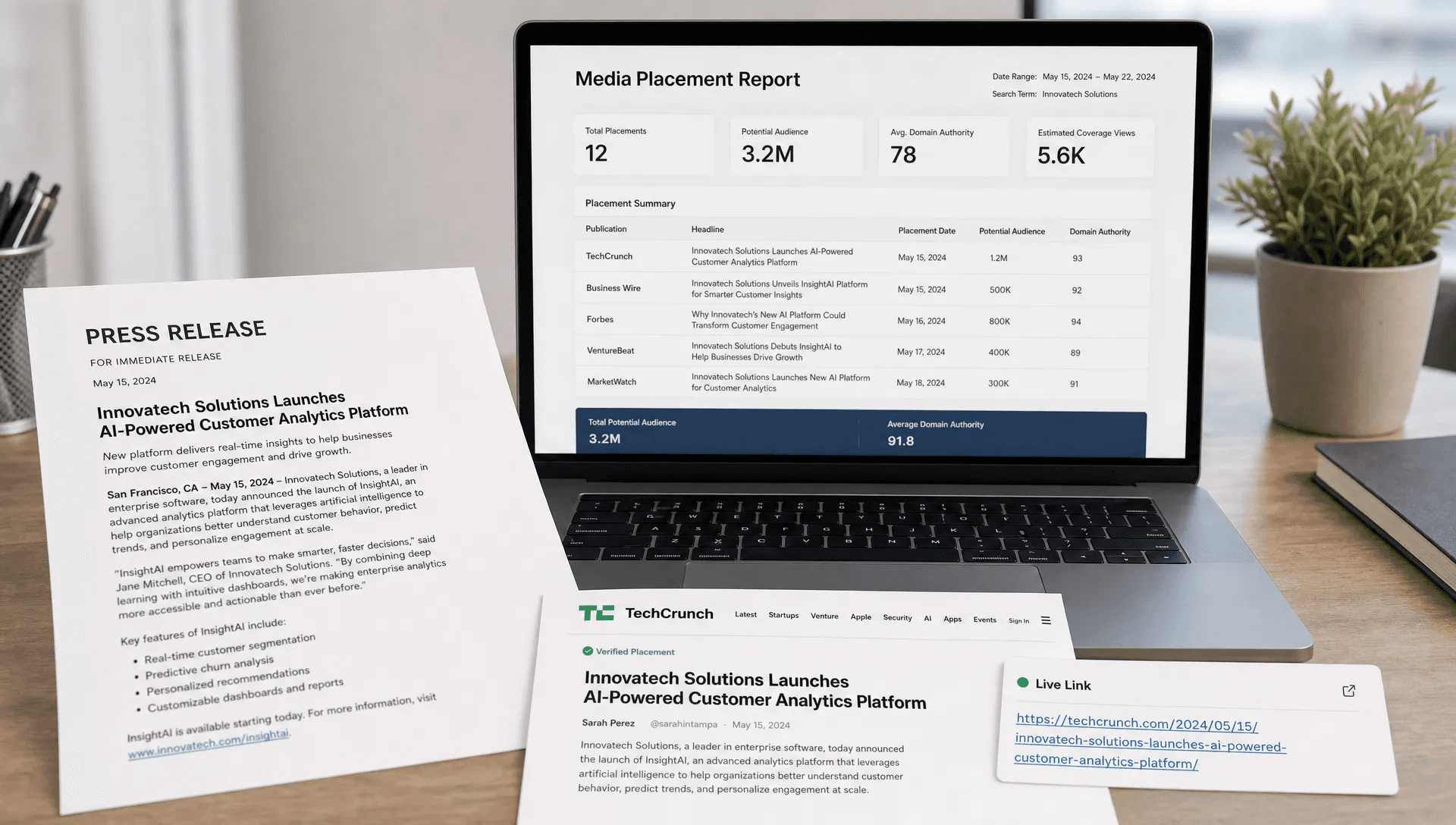
Get featured on 500+ media outlets
Guaranteed placement, no PR experience needed.
PR agencies sit at the intersection of strategy, storytelling, media relationships, and reputation. At their best, they help a company turn business milestones into public credibility. At their worst, they become an expensive retainer with vague deliverables and disappointing coverage.
That gap usually comes down to timing and expectations. Hiring a PR agency before you have a clear story, a defined audience, or a spokesperson who can respond quickly can lead to frustration. Waiting too long, however, can mean missing the moment when media attention, search visibility, and third-party proof would have helped your brand grow faster.
This guide explains what PR agencies actually do, when it makes sense to hire one, when it does not, and how to choose the right partner for your goals.
What PR Agencies Actually Do
A public relations agency helps organizations shape how they are seen by the public, media, customers, investors, partners, and sometimes employees. That work can include media outreach, press release strategy, reputation management, event support, executive visibility, crisis communications, and measurement.
The key point is that PR is not just “getting press.” Media coverage is one outcome, but the broader job is to build trust through credible third-party exposure and consistent messaging.
Most PR agencies help with some combination of the following services.
Messaging and Positioning
Before an agency pitches journalists, it needs to understand what makes the story worth covering. This usually means clarifying your company’s positioning, audience, proof points, market context, and differentiators.
For example, “we launched a new app” is rarely enough. A stronger PR angle might connect that launch to a market shift, consumer behavior trend, founder insight, proprietary data, or an underserved audience.
Good agencies pressure-test your message before taking it to the media. They help answer questions like:
- Why does this matter now?
- Who should care?
- What makes this different from existing solutions?
- What proof can we provide?
- Which spokesperson can speak with authority?
This strategy work often determines whether a campaign earns meaningful attention or gets ignored.
Media Relations and Journalist Outreach
Media relations is the service most people associate with PR agencies. It includes identifying relevant journalists, editors, podcast hosts, newsletter writers, and industry publications, then pitching them a story.
Effective outreach is highly targeted. A technology reporter, a local business editor, and a trade publication columnist each need different angles. PR agencies often bring existing media relationships, but relationships alone are not enough. Journalists still need a timely, useful, and audience-relevant story.
Agencies may pitch company announcements, expert commentary, trend analysis, founder profiles, product launches, research reports, funding news, partnerships, or customer impact stories.
Press Releases and Distribution
Press releases remain useful when there is genuine news to announce. Agencies often write, edit, approve, and distribute press releases through wire services or media placement partners.
A press release can support several goals at once: it gives journalists a clear source of facts, creates a public record of the announcement, supports branded search results, and gives sales or investor teams a credible asset to share.
That said, a press release alone is not the same as a full PR strategy. If you are comparing traditional wire distribution with newer placement-focused options, MediaBoost’s guide on how PR Newswire distribution compares to modern alternatives is a useful next read.
Thought Leadership
Many companies do not have constant breaking news, but they do have expertise. PR agencies can help turn that expertise into thought leadership.
This may include executive bylines, expert commentary, podcast bookings, award submissions, conference speaking opportunities, LinkedIn messaging, contributed articles, and commentary tied to current industry trends.
Thought leadership is especially valuable for B2B companies, consultants, founders, and category creators because it builds authority before buyers are ready to purchase.
Reputation and Crisis Communications
PR agencies can also help companies prepare for sensitive situations. This can include customer complaints, leadership changes, layoffs, data incidents, product issues, regulatory scrutiny, negative press, or social media backlash.
Crisis communications is not only about reacting quickly. It is about having message frameworks, escalation paths, spokesperson training, and approval processes ready before a situation becomes public.
For high-risk industries, this kind of preparation can be as valuable as media coverage.
Measurement and Reporting
A professional agency should report on more than vanity metrics. Press clippings are helpful, but modern PR measurement may also include referral traffic, share of voice, branded search lift, audience quality, backlink quality, sentiment, message pull-through, and assisted sales impact.
The right metrics depend on your goals. A consumer brand might care about awareness and social pickup. A B2B startup might care more about investor credibility, category authority, and high-quality publication mentions.
Types of PR Agencies
Not all PR agencies operate the same way. Understanding the main categories can help you avoid hiring the wrong partner.
| Type of PR partner | Best for | Typical strengths | Watch out for |
|---|---|---|---|
| Full-service PR agency | Larger campaigns and ongoing brand building | Strategy, media relations, events, crisis, executive visibility | Higher retainers and broader scope than some companies need |
| Boutique PR agency | Focused support in a niche or industry | Senior attention, specialization, flexible campaigns | Smaller teams may have limited capacity |
| Local or regional agency | Local awareness and community presence | Local media contacts, events, regional reputation | May not be ideal for national or global campaigns |
| Industry specialist agency | Sectors like tech, healthcare, finance, beauty, or real estate | Category knowledge and relevant journalist lists | May use familiar angles across similar clients |
| Productized PR or distribution partner | Fast placement, announcements, SEO proof, social proof | Speed, clear deliverables, predictable outputs | Not always a substitute for full media strategy |
A company may use more than one type over time. For instance, an early-stage startup might start with productized press release distribution, then hire a boutique agency when it has a larger narrative, more executive availability, and recurring news.
When to Hire a PR Agency
Hiring a PR agency makes the most sense when you have both a credible story and the internal ability to support the campaign. PR is collaborative. Even a great agency needs access to leadership, data, customer examples, product details, and fast approvals.
You Have a Real Business Milestone
PR agencies are most effective when there is something concrete to announce. Examples include a major product launch, new market expansion, acquisition, funding round, strategic partnership, research report, rebrand, executive hire, or meaningful customer growth.
The milestone does not need to be huge, but it should matter to a specific audience. A niche trade publication may care deeply about a development that a national outlet would ignore.
You Need Credibility, Not Just Traffic
Paid ads can create traffic quickly, but they do not always create trust. PR is powerful because it places your brand in credible third-party contexts. That matters when buyers, partners, investors, or potential hires search for your company and want proof that you are legitimate.
This is especially important for newer brands. A prospect who sees your company mentioned across relevant outlets may feel more comfortable booking a demo, requesting a quote, or sharing your name internally.
Your Founder or Leadership Team Has a Strong Point of View
Agencies can open doors, but they need something interesting to say. If your leadership team has strong opinions about where the industry is going, mistakes customers are making, or changes in the market, a PR agency can help turn that perspective into media opportunities.
This is often where thought leadership performs better than announcement-led PR. Instead of waiting for company news, your brand becomes part of the broader industry conversation.
You Are Entering a Competitive Market
In crowded categories, a brand needs more than a polished website. PR can help define a sharper narrative, build third-party validation, and make your company easier to discover in search and AI-assisted research environments.
This is increasingly important because buyers are not only using Google. They are asking AI tools for vendor options, category explanations, and brand comparisons. Strong public mentions can support the credibility signals that help a brand become more visible in these discovery journeys. For a deeper look at that shift, see MediaBoost’s article on improving your brand’s AI visibility through PR.

Your Team Is Too Busy to Run PR Consistently
Many companies try PR internally first. That can work, especially for founders who understand their market and can write strong pitches. But PR requires consistency: building media lists, tracking editorial calendars, responding to journalist requests, drafting releases, managing approvals, and reporting results.
If these tasks keep getting pushed aside, an agency can provide structure and accountability. This is particularly helpful when your team has news but no one owns communications day to day.
You Are Preparing for a High-Stakes Moment
Some moments are too important to improvise. Examples include a major launch, fundraising period, category repositioning, leadership transition, or public issue that could affect trust.
In these cases, PR agencies can help refine messaging, prepare spokespeople, coordinate timing, and reduce the risk of inconsistent communication.
When Not to Hire a PR Agency Yet
A PR agency is not always the right next step. Sometimes the better move is to clarify your story, build owned content, improve your product proof, or test smaller distribution channels first.
You Do Not Know What You Want PR to Achieve
“More awareness” is not a strategy. Before hiring, define what success looks like. Do you want investor credibility, local awareness, trade media coverage, SEO support, executive visibility, recruitment momentum, or category education?
Different goals require different tactics. Without a clear goal, you may end up judging an agency by the wrong standard.
You Expect Guaranteed Top-Tier Editorial Coverage
No ethical PR agency can guarantee that a journalist at a major publication will write a feature story. They can guarantee effort, strategy, deliverables, and sometimes placements through specific distribution networks, but earned editorial coverage depends on editorial judgment.
If an agency promises guaranteed front-page coverage in top-tier outlets without explaining the mechanism, ask careful questions.
Your Story Is Not Ready
If your announcement is vague, your product is still changing weekly, your customer proof is weak, or your leadership team cannot explain the company clearly, PR may expose those gaps instead of solving them.
A better first step may be to refine your positioning, gather customer evidence, build a media kit, and publish strong owned content. Startups with limited resources can also learn from MediaBoost’s guide on how to break into media without a PR team.
You Cannot Support the Process Internally
PR agencies need timely input. If approvals take weeks, spokespeople are unavailable, or no one can provide facts and assets, momentum suffers.
Before hiring, assign an internal owner. This person should coordinate approvals, provide company updates, connect the agency with executives, and make sure PR is aligned with sales, marketing, and leadership.
PR Agency vs In-House PR vs Distribution Partner
The right model depends on your budget, timeline, goals, and internal capacity. For many brands, the best answer is not one permanent choice but a mix that changes over time.
| Option | Best use case | Main advantage | Limitation |
|---|---|---|---|
| PR agency | Ongoing strategy, media relations, reputation building | Experienced external team and media process | Can be costly and requires internal collaboration |
| In-house PR hire | Companies with constant news and long-term communications needs | Deep company knowledge and daily access | One person may lack agency-level network or capacity |
| Press release distribution partner | Announcements, proof assets, fast visibility, link reporting | Clear deliverables and speed | Less comprehensive than a strategic retainer |
| Founder-led PR | Early-stage companies with strong stories and limited budget | Authentic voice and low cost | Time-intensive and hard to scale |
MediaBoost fits best when a company wants done-for-you press release distribution, guaranteed live backlinks, proof reports, and placements across a broad network of trusted publications. It can support brands that need speed, visibility, and credible assets without immediately committing to a traditional long-term agency retainer.
How to Choose the Right PR Agency
Choosing a PR agency is not only about reputation. The best agency for one company may be wrong for another. Fit depends on your industry, story, expectations, timeline, budget, and working style.
Start by looking for evidence that the agency understands your category. This does not mean they must have worked with an identical company, but they should understand your buyers, competitive landscape, and media environment.
Next, ask how they would shape your story. A strong agency will not simply agree with your first angle. It will challenge weak assumptions, identify stronger hooks, and explain which outlets are realistic for each story.
You should also clarify deliverables before signing. Some agencies focus heavily on strategy and media relations. Others include content creation, award submissions, analyst relations, influencer work, social amplification, or crisis planning. If you need broader campaign management across marketing channels, a partner that offers managed campaign and digital marketing support may be worth considering alongside or before a traditional PR retainer.
Ask these questions during the evaluation process:
- Who will actually work on the account day to day?
- What does the first 30, 60, and 90 days look like?
- Which media targets are realistic for our current story?
- How do you measure success beyond coverage volume?
- What do you need from our team to move quickly?
- How do you handle approvals, messaging, and spokesperson preparation?
- Can you show examples from similar industries or goals?
The answers will reveal whether the agency has a disciplined process or is relying on vague promises.
What Results Should You Expect?
PR results vary because newsworthiness, timing, category interest, spokesperson quality, and media availability all matter. A well-run campaign may produce a mix of secured placements, journalist conversations, podcast invitations, contributed article opportunities, industry mentions, search visibility, and reusable sales proof.
Some benefits show up quickly, especially with press release distribution and guaranteed placement packages. Others compound over time. Thought leadership, reputation, and journalist relationships often require repeated exposure before they produce major opportunities.
The most realistic mindset is to view PR as a credibility engine, not a magic switch. It works best when combined with a strong website, clear positioning, sales follow-up, owned content, and consistent distribution across channels.
How to Prepare Before Hiring a PR Agency
Before you contact agencies, organize the basic materials they will need. This makes discovery calls more productive and helps you evaluate whether an agency can add value.
At minimum, prepare:
- A short company overview and positioning statement
- Your target audiences and priority markets
- Recent milestones or upcoming announcements
- Founder or executive bios
- Customer proof, case studies, or usage data if available
- Product screenshots, brand assets, and approved images
- A list of competitors and aspirational media outlets
- Your goals for PR over the next 3 to 6 months
You do not need everything polished perfectly. A good agency can help refine the materials. But arriving with this foundation makes it easier to separate strategic partners from generic pitch shops.
Frequently Asked Questions
What do PR agencies do for small businesses? PR agencies help small businesses clarify their story, pitch relevant media, write press releases, build local or industry credibility, manage announcements, and create proof that can support sales and brand trust.
How much does it cost to hire a PR agency? Costs vary widely based on agency size, scope, market, and campaign complexity. Some agencies work on monthly retainers, while others offer project-based campaigns or specific launch packages. Always compare pricing against deliverables, senior involvement, and expected outcomes.
Can PR agencies guarantee media coverage? Agencies can guarantee specific work, such as strategy, outreach, content creation, reporting, and in some cases distribution placements through defined networks. They generally cannot guarantee earned editorial coverage in independent publications because editors control what they publish.
When should a startup hire a PR agency? A startup should consider hiring a PR agency when it has a clear market story, credible proof, an upcoming milestone, and enough internal availability to support interviews, approvals, and campaign planning.
Is a press release enough, or do I need a PR agency? A press release may be enough for a straightforward announcement that needs fast visibility and a public record. A PR agency is more useful when you need ongoing strategy, media relationships, thought leadership, or reputation support.
Build Credibility Before the Market Starts Looking
PR agencies can be powerful growth partners when the timing is right. They help turn business momentum into public trust, but they work best when your story is clear, your goals are specific, and your team is ready to collaborate.
If you need fast, credible press release distribution without the complexity of a traditional agency retainer, MediaBoost can help you get featured across 500+ media outlets with guaranteed live backlinks, editorial review, and SEO proof reports. It is a practical way to build visibility, strengthen social proof, and support how your brand appears in search and AI-driven discovery.