How Startups Can Break Into Media Without a PR Team
You do not need an in-house PR team to earn credible coverage. This guide shows startups how to package news, pitch strategically, use press releases, and turn media mentions into lasting trust.

Get featured on 500+ media outlets
Guaranteed placement, no PR experience needed.
Breaking into media used to feel like a milestone reserved for funded startups with agency retainers, warm journalist relationships, and a polished communications team. That is no longer true. A lean startup can earn visibility if it understands what the media needs, packages its story clearly, and builds a repeatable outreach system.
The mistake many founders make is assuming PR is about being loud. It is not. Media attention comes from being relevant, credible, and easy to cover. Journalists, newsletter writers, podcasters, analysts, and industry bloggers all need timely stories that help their audiences understand something new. Your job is to make that story obvious.
For startups without a PR team, the goal is not to act like a large corporation. The goal is to create a founder-led media engine that turns real milestones into coverage, social proof, backlinks, investor confidence, and stronger brand recognition.
Why startups do not need a traditional PR team to get noticed
A PR team can help with strategy, relationships, crisis planning, and ongoing media management. But early-stage startups often do not need the full machine. They need focus.
Most startup media wins begin with a simple combination: a clear angle, a credible proof point, a targeted list of outlets, and persistent follow-up. A founder, marketer, or chief of staff can manage this if the workflow is simple enough.
The advantage startups have is proximity. Founders know the customer pain, the product insight, the data behind the business, and the reason the company exists. That context is often more compelling than generic corporate messaging. When translated into a concise media story, it can outperform polished but empty PR language.
The real challenge is discipline. Without a PR team, you need to avoid random outreach and build a system that answers four questions:
- What makes this story newsworthy right now?
- Who is already writing about this topic?
- What proof makes our claim believable?
- What should a journalist, editor, or reader do next?
If you can answer those questions, you can start getting into media without waiting for an agency budget.
Start with a story the media can actually use
Journalists do not cover companies simply because they exist. They cover change, conflict, momentum, data, unusual insight, and relevance to a broader audience.
A product launch can be newsworthy, but only if it connects to a larger trend. A funding announcement can earn coverage, but it becomes stronger when it explains what the capital enables. A founder story can work, but only when it teaches readers something beyond personal ambition.
Before writing a pitch or press release, translate your startup update into a media angle. Ask what changed, who is affected, why now matters, and what evidence supports the claim.
| Startup update | Weak angle | Stronger media angle |
|---|---|---|
| New product launch | We launched a new app | A startup is solving a costly workflow problem for a specific industry |
| Funding round | We raised money | Investors are backing a market shift, and this startup shows why |
| Customer milestone | We reached 10,000 users | Adoption data reveals a new behavior among a clear audience |
| Founder story | Our founder built a company | A personal problem led to a new solution in an underserved market |
| Industry report | We published research | New data challenges a common assumption in the market |
The stronger angle does not exaggerate. It simply frames your news in terms of audience value. That is the difference between a company update and a story.
Build a press-ready foundation before outreach
If you want to break into media without a PR team, you need to remove friction. A journalist should not have to chase you for basic facts, logos, screenshots, founder bios, or supporting data.
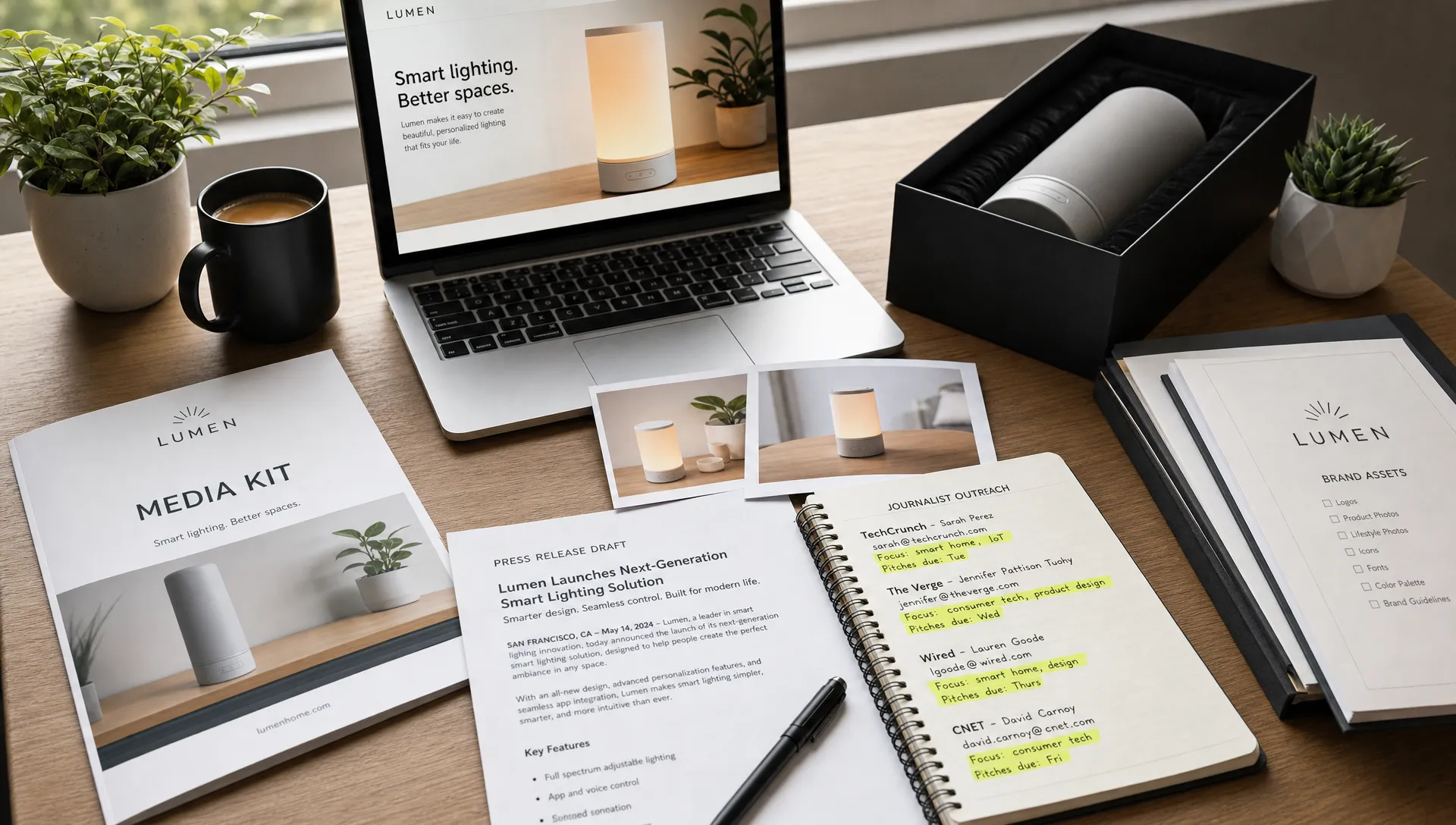
Create a lightweight media kit before you pitch. It does not need to be fancy. It needs to be accurate, organized, and easy to share.
A practical startup media kit should include:
- A one-sentence company description that avoids jargon.
- A short boilerplate with your market, audience, and core value proposition.
- Founder bios with relevant credibility, not a full resume.
- High-resolution logos, product images, and founder photos.
- Key facts such as launch date, location, funding status if public, and customer segments.
- Links to your website, social profiles, and existing coverage.
- A contact email that someone actually monitors.
This foundation helps in two ways. First, it makes you look more credible. Second, it speeds up the publishing process when someone is interested. Startups often lose opportunities because they respond too slowly or provide incomplete information.
Your media kit should also match your positioning. If you describe your company differently in every pitch, on your website, and in your founder bio, you create confusion. Consistency makes coverage cleaner and helps search engines, readers, and AI systems understand who you are.
Choose the right media path for your stage
Not every startup should chase the same outlets. A pre-seed B2B SaaS company, a local consumer brand, and a fintech infrastructure startup need different media strategies.
Start by matching your story to the audience that already cares. Big national business outlets are valuable, but niche publications can produce better early results because their readers are more qualified. A trade newsletter, respected podcast, or industry blog can create the first layer of credibility that later makes larger outlets easier to approach.
| Media path | Best for | What to prepare |
|---|---|---|
| Direct journalist outreach | Original data, funding, strong founder POV | Targeted pitch, proof points, fast response process |
| Niche newsletters | B2B, developer, creator, or industry-specific startups | Short angle, founder quote, useful takeaway for readers |
| Podcasts and interviews | Founder-led brands and category creators | Clear talking points, personal story, contrarian insight |
| Press release distribution | Launches, partnerships, funding, market announcements | Polished release, approved quotes, accurate company facts |
| Owned media amplification | Any startup with a small audience | Blog post, LinkedIn post, email newsletter, landing page |
This mix matters because media coverage is cumulative. One mention can become proof for the next pitch. A podcast interview can become a quote. A distributed release can become a live link. A niche article can validate your category narrative.
If your team wants to understand the long-term compounding value of third-party visibility, MediaBoost has also covered why earned media can become a startup growth lever when it supports trust, SEO, and conversion.
Write a pitch journalists can scan in 10 seconds
Founders often over-explain. Journalists do not need your full investor deck. They need to know whether the story fits their audience.
A strong pitch is short, specific, and tailored. The subject line should tell the story, not just announce your company. The first sentence should show relevance. The body should explain the news, the proof, and why it matters now.
A useful founder-led pitch structure looks like this:
- Subject line: Lead with the news angle or trend, not only your company name.
- Opening: Mention why you are reaching out to this specific person or outlet.
- Story: Explain what happened and why their audience should care.
- Proof: Add one or two credibility signals, such as data, customers, funding, traction, or founder expertise.
- Offer: Make it easy to respond with an interview, quote, demo, data point, or press release.
Personalization does not mean writing a long compliment. It means proving you understand their beat. If a writer covers AI regulation, do not send a generic productivity tool pitch unless you can connect your story to that theme. If a newsletter focuses on retail operators, explain the operational insight, not the fundraising headline.
Follow-up matters, but restraint matters too. One short follow-up a few days later is reasonable. Multiple vague nudges can damage your reputation. Add something useful in the follow-up, such as a new data point, customer example, or timely connection to breaking news.
Use press releases when you need scale and proof
Direct pitching is best for relationship-driven coverage. Press release distribution is best when you need a credible public record, broad visibility, and live links that your team can reference across sales, investor relations, SEO, and brand channels.
A press release is not a magic announcement. It works when the news is legitimate and the release is written in an editorial style. The strongest releases focus on facts, context, and clear quotes rather than hype.
Good press release moments include company launches, funding announcements, major partnerships, executive appointments, product releases, expansion into a new market, proprietary research, awards, and significant customer milestones. Weak moments include minor feature updates, vague thought leadership, or announcements without a clear audience benefit.
If you are writing your first release, avoid common issues such as inflated claims, unclear headlines, missing contact information, and overly promotional language. This guide to press release mistakes small businesses should avoid is a useful checklist before you submit anything.
For startups that do not have internal PR operations, a done-for-you distribution partner can reduce execution risk. MediaBoost helps brands distribute press releases across 500+ trusted publications, with guaranteed live backlinks, editorial review, proof reports, and industry-specific packages. For teams moving quickly, the 48-hour turnaround can be especially useful when launch timing matters.
The key is to treat distribution as part of a broader media strategy. Once your release is live, use it as proof in follow-up pitches, investor updates, sales conversations, partner outreach, and social content.
Turn one media win into five credibility assets
Getting mentioned is only the beginning. The startups that get the most value from media coverage repurpose it intelligently.
A single placement can support multiple goals. Your sales team can add it to outreach. Your founder can reference it on LinkedIn. Your website can include credible publication logos if usage rights and context allow it. Your investor update can include the link as proof of market momentum. Your SEO strategy can benefit from authoritative backlinks and branded search growth.
Do not let coverage disappear after one social post. Build a simple amplification loop:
- Share the coverage with a short founder insight, not just a celebratory caption.
- Add the link to a relevant landing page or press page.
- Send it to customers, investors, and partners with context on why it matters.
- Reference it in future pitches as proof that the market is paying attention.
- Track whether it influences referral traffic, demo requests, or branded search.
This is where lean startups can outperform bigger companies. Large teams often move slowly. A founder-led startup can turn coverage into momentum within hours.
Create a lightweight PR operating system
Without a PR team, consistency is your substitute for headcount. You do not need a complex platform to start. A spreadsheet, calendar, shared folder, and weekly review can be enough.
Your lightweight PR system should track outlet names, journalist beats, contact status, pitch dates, follow-ups, responses, live links, and next actions. It should also include a calendar of potential news moments such as launches, events, reports, partnerships, and funding milestones.
Set a weekly media block. In that block, update your target list, draft one pitch, follow up on open conversations, and look for timely angles. Thirty focused minutes every week can outperform a last-minute scramble before launch day.
Automation can help, but it should not make your outreach feel robotic. Use tools to organize contacts, monitor mentions, and reduce repetitive work, while keeping your angle and relationship-building human. If you are exploring that balance, this article on gaining media traction with PR automation explains how lean teams can save time without sacrificing relevance.
Measure what actually matters
Media logos are exciting, but they are not the only measure of success. A startup without a PR team needs simple metrics that show whether media activity is creating business value.
Track both visibility and impact. Visibility tells you whether your story is getting seen. Impact tells you whether that visibility supports growth.
| Metric | Why it matters | How to review it |
|---|---|---|
| Live links | Confirms coverage and creates assets your team can share | Keep a proof report or coverage tracker |
| Referral traffic | Shows whether readers are visiting your site | Review analytics after each placement |
| Branded search | Indicates rising awareness and trust | Monitor search trends and website queries |
| Backlink quality | Supports SEO authority over time | Track referring domains and relevance |
| Sales or investor mentions | Shows whether coverage influences conversations | Ask leads and investors how they heard about you |
| AI visibility signals | Helps assess whether credible references exist across the web | Review how your brand appears in AI-powered search and summaries |
AI visibility deserves special attention in 2026. AI answer engines increasingly rely on recognizable, trusted web references to summarize brands, markets, and solutions. Media coverage does not guarantee inclusion in AI results, but credible third-party mentions can strengthen the public footprint that these systems may draw from.
Common mistakes startups should avoid
The most common mistake is pitching too early, before the story is clear. The second is pitching too broadly, as if every journalist covers every startup. The third is treating media as a one-time launch tactic instead of a compounding trust channel.
Avoid exaggeration. A small startup can still be newsworthy, but inflated claims invite skepticism. Replace adjectives with evidence. Instead of saying you are revolutionary, show the customer problem, traction, data, or market shift that makes the story relevant.
Also avoid disappearing after a journalist replies. If someone asks for details, respond quickly and accurately. Media windows close fast. A founder who is prepared can win coverage simply by being easier to work with than everyone else in the inbox.
Frequently Asked Questions
Can a startup get media coverage without hiring a PR agency? Yes. A startup can earn coverage by developing a clear news angle, preparing press-ready assets, pitching relevant outlets, and using press release distribution when broader visibility or live links are needed.
What is the fastest way for a startup to break into media? The fastest path is usually a credible announcement supported by a strong press release, targeted outreach, and immediate amplification across owned channels. Speed improves when your media kit, quotes, and company facts are ready before launch.
Do journalists care about early-stage startups? They can, if the story is relevant to their audience. Early-stage startups get attention when they reveal a trend, solve a timely problem, share useful data, or have a founder perspective that adds something new.
Should startups focus on big publications or niche outlets first? Most startups should begin with niche outlets that match their buyer, industry, or investor audience. These placements build credibility and can make larger media opportunities easier later.
How often should a startup send press releases? Send a press release when there is genuine news, such as a launch, funding round, partnership, expansion, major milestone, or original research. Sending releases for minor updates can weaken credibility.
Ready to break into media without building a PR department?
You do not need a full PR team to become visible. You need a story worth sharing, a repeatable outreach process, and credible placements that make your startup easier to trust.
If you want support with the distribution side, MediaBoost can help your startup get featured across 500+ trusted publications with done-for-you submissions, editorial review, guaranteed live backlinks, and proof reports. It is a practical way to turn your next announcement into media assets your team can use across sales, SEO, investor updates, and AI visibility efforts.