How to Find Broken Backlinks and Reclaim Lost Authority
Broken backlinks can waste authority your brand already earned from press, partners and content. Learn how to identify the most valuable lost links, repair them with the right method and prevent the same leaks after future site changes.

Get featured on 500+ media outlets
Guaranteed placement, no PR experience needed.
Broken backlinks quietly drain value from pages that already earned attention, mentions and trust. If you know how to find broken backlinks, you can recover authority without starting every link building campaign from zero.
A broken backlink is an external link from another website that points to a page on your site that no longer works. The destination may return a 404, 410, server error or redirect to an irrelevant page. The referring site still signals that your content was worth citing, but users and crawlers hit a dead end.
Backlink reclamation is especially useful for brands that have changed domains, redesigned a site, merged pages, removed old offers or earned press mentions over several years. Instead of asking the market for brand new trust, you are repairing trust you already earned.
Why broken backlinks drain authority
Search engines use links as one signal of relevance, credibility and discovery. A backlink from a reputable article, partner page or publication can help search engines understand why a page matters. When that link points to a broken URL, the value is weakened because the destination no longer serves the intended content.
Broken backlinks also create a bad experience for real people. A journalist, customer, analyst or potential partner may click a citation and land on an error page. That moment does not just waste referral traffic, it can make a brand look less current than it really is.
The damage is often hidden because the lost value sits outside your website. Your analytics may show fewer referrals, but it will not always explain that a well-placed link on another site is sending people to a missing URL. That is why backlink recovery belongs in regular SEO maintenance, not just emergency cleanup.
| Broken backlink cause | Common example | Best recovery path |
|---|---|---|
| Page deleted | Old product, campaign or press page removed | Restore the page or redirect to the closest relevant page |
| URL changed | Blog slug, category path or landing page renamed | Add a 301 redirect from the old URL |
| Site migration | HTTP to HTTPS, new CMS or new domain | Audit old URL patterns and redirect at scale |
| Typo in referring link | Another site linked to a misspelled URL | Ask for a correction or create a redirect |
| Expired asset | PDF, report or media kit removed | Reupload the asset or redirect to an updated version |
If you are still building your baseline backlink inventory, start with a full export of referring domains and pages. MediaBoost has a separate guide on how to find backlinks to your website and act on them, which pairs well with the reclamation workflow below.
How to find broken backlinks with the right data
The most reliable way to find broken backlinks is to combine backlink data with crawl data, then verify what each target URL returns today. No single tool sees every link, so your goal is not perfection. Your goal is to find the lost links that are likely to matter.
Start with Google Search Console
Google Search Console is a good first stop because it shows links Google has discovered to your site. Export your external links, especially top linked pages and top linking sites. Then compare those linked URLs against your current site crawl or your list of indexed pages.
Look for URLs that appear in the link export but no longer exist on the live site. These are often old blog posts, campaign pages, PDF files, image assets or landing pages from previous site versions.
Search Console may not show every broken backlink with full source detail, so treat it as a dependable starting dataset rather than the entire audit. It is strongest when paired with a crawler and a third-party backlink index.
Add backlink index and crawler data
Tools such as Ahrefs, Semrush, Moz, Majestic and similar platforms can export backlinks by target URL and status code. Use them to identify external links pointing to 404 pages, 410 pages, redirect chains or soft 404s. Then crawl your own site with a technical SEO crawler to confirm the final response code.
A practical workflow is simple: export all backlinks, filter by broken target URLs, remove duplicates and sort by referring domain quality. If you need a deeper quality review before deciding which links deserve attention, this MediaBoost guide on how to analyze backlinks for quality, relevance and risk explains what to evaluate beyond surface metrics.
Do not rely only on Domain Authority, Domain Rating or similar scores. A niche industry mention from a real publication can be more useful than a high-metric directory link with no editorial context.
Build a recovery sheet before changing anything
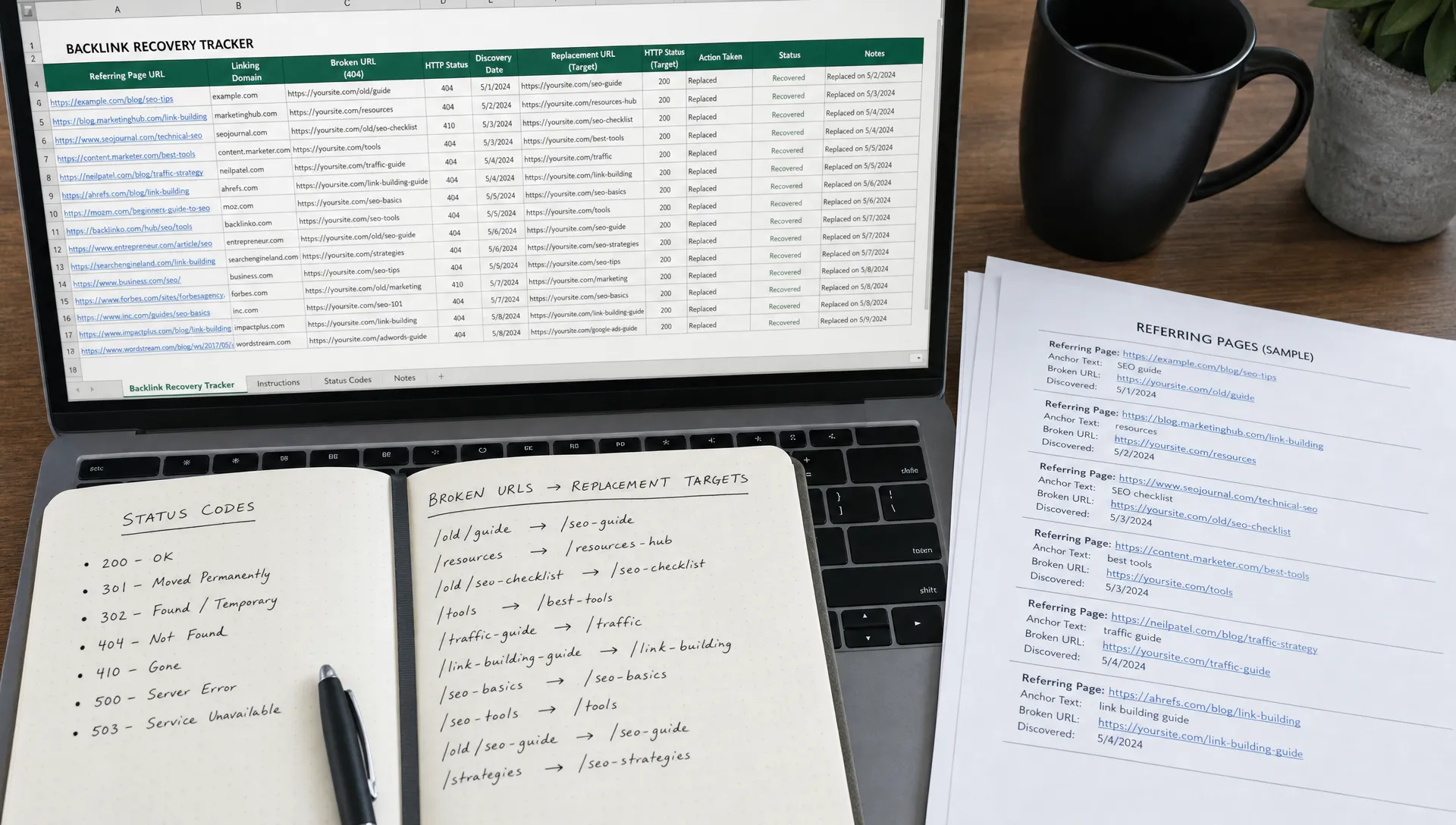
Once you find broken backlinks, organize them in a sheet so every fix is intentional. The biggest mistake is redirecting all broken URLs to the homepage. That may clean up 404 reports, but it often fails to satisfy users and can dilute topical relevance.
Your recovery sheet should include the referring page, linking anchor text, broken target URL, current status code, recommended destination, link type and priority. Add notes about context, such as whether the referring page is a news article, resource list, partner page, podcast page or old press mention.
Prioritize backlinks that meet at least one of these conditions:
- They come from trusted publications, associations, universities, partners or established businesses.
- They send referral traffic or appear on pages that still rank.
- They point to a page with a close modern equivalent on your site.
- They support an important commercial, editorial or brand authority topic.
- They use anchor text that clearly describes your expertise.
For example, a local technology company or a Southern California managed IT services partner might discover old links to a cybersecurity checklist, Microsoft 365 support page or cloud migration guide after a site redesign. Those links should not all point to the homepage. Each should lead to the most relevant updated service page or resource.
Choose the right fix for each broken backlink
Not every broken backlink needs the same repair. Some deserve a technical redirect, some deserve outreach and some should be ignored because they are low quality or irrelevant.
A 301 redirect is usually best when the old URL has a clear replacement. If an outdated press page moved to a new press room, redirect it there. If an old guide was merged into a newer guide, redirect to the updated article. If a discontinued product has a successor, redirect to the successor only when the searcher intent is still aligned.
Restoring a page can be better when the original asset still has value. Old research reports, media kits, case studies and evergreen guides may have earned links because they answered a specific need. Updating and republishing the asset can preserve relevance better than sending visitors elsewhere.
Outreach is useful when the linking page contains a typo, uses an outdated domain or links to an asset that has been replaced by something substantially better. Keep the email short, specific and helpful. Mention the broken link, provide the correct URL and explain why the replacement helps their readers.
Ignoring a backlink is acceptable when the referring page is spammy, irrelevant or part of a pattern you would not want to encourage. Recovery is about reclaiming authority, not preserving every link at any cost.
Outreach that earns corrections
When you find broken backlinks on valuable pages, outreach can recover links that redirects cannot fully solve. This is common when the referring site linked to the wrong URL, used an old subdomain or cited a resource that now lives in a different format.
The best outreach sounds like quality control, not a link request. You are helping the publisher fix a dead reference on a page they already maintain. Include the page where you found the issue, the broken destination and the exact replacement.
A simple email can work:
Hi [Name], I noticed that your article on [topic] links to our old [resource name] URL, which now returns an error. The updated version is here: [URL]. It may be useful to update the link so readers can access the source. Thanks for mentioning our work.
Avoid asking for multiple edits, new anchor text or additional placements in the same note. The narrower the request, the easier it is for an editor or webmaster to act.
If the backlink came from press coverage, partner announcements or industry news, your correction request should be even more factual. Publishers are more likely to fix broken citations when the replacement preserves the original context.
Measure recovered authority, not just fixed errors
If you find broken backlinks and repair them, track outcomes beyond the number of 404s removed. A clean error report feels satisfying, but the business value comes from recovered discoverability, referral traffic and topical authority.
Useful metrics include the number of high-value referring domains recovered, organic clicks to the replacement pages, referral sessions from corrected links and changes in rankings for related topics. You should also monitor whether redirected URLs are being crawled and whether the new destinations are indexed.
Do not expect every fix to create a visible ranking jump. Backlink reclamation often works as a compounding maintenance task. It protects authority you already earned, improves crawl paths and makes future campaigns more efficient.
Recheck your recovered links after a few weeks. Some third-party tools update slowly, and some publishers may edit links without notifying you. Keep notes on what was redirected, what was restored and which outreach requests succeeded.
Prevent broken backlinks from coming back
The best recovery process becomes even more valuable when it changes how your team handles future site updates. Before deleting, merging or renaming any page, check whether that page has backlinks. This small step can prevent avoidable authority loss during redesigns, content refreshes and migrations.
Build a prelaunch checklist for website changes. Export page-level backlinks, map old URLs to new destinations, test redirects in a staging environment and keep important assets such as PDFs, reports and image files accessible when possible.
This matters for PR as much as SEO. A press release, media mention or feature article can keep sending trust signals long after the announcement date. If those linked pages disappear during a redesign, the brand loses part of the value it earned from publicity.
If you want to strengthen authority with new mentions after a cleanup, use a safe link acquisition approach rather than shortcuts. MediaBoost explains the difference in its guide to creating backlinks that earn trust instead of penalties.
Frequently Asked Questions
How often should I check for broken backlinks? Most growing sites should run a backlink reclamation check quarterly. Also run one before and after a redesign, domain migration, CMS change or major content pruning project.
What tools do I need to find broken backlinks? Use Google Search Console, at least one backlink index tool and a crawler that can confirm status codes. The combination gives you source data, target URLs and technical verification.
Should every broken backlink be redirected? No. Redirect links only when the replacement page matches the original intent. Low-quality, irrelevant or spam-like links are often better left alone.
Is backlink reclamation better than building new links? It is not a replacement for earning new links, but it is usually faster because the mention already exists. The strongest SEO programs do both: reclaim lost authority and build new trusted citations.
Can broken backlinks hurt brand credibility? Yes. When journalists, buyers or partners click a cited source and land on an error page, it can make the brand look outdated. Fixing those paths protects both SEO value and user trust.
Reclaim the authority your brand already earned
Learning to find broken backlinks gives you a practical way to recover value from old campaigns, press mentions, partnerships and content assets. Start with exports, verify status codes, prioritize by relevance and fix each link with the closest useful destination.
If your audit shows that your brand needs fresh visibility as well as recovered authority, MediaBoost can help with press release distribution across 500+ media outlets, live backlinks, editorial review and proof reports. A clean backlink profile plus credible media placements gives search engines, customers and AI discovery systems more reasons to trust your brand.