How to Find Backlinks to Your Website and Act on Them
A backlink list is only useful when it leads to action. Learn how to collect your links, judge quality, reclaim lost value and use your profile to guide smarter SEO and PR campaigns.

Get featured on 500+ media outlets
Guaranteed placement, no PR experience needed.
If you have ever typed “find backlinks to my website” into a search tool, you are probably not just looking for a list of URLs. You want to know who is referencing your brand, which links help search visibility, which ones carry risk and what to do next. A backlink report is only useful when it turns into decisions: keep, improve, reclaim, ignore or remove.
Why backlink discovery matters before link building
Backlinks are not just SEO trophies. They are public signals of trust, context and brand reach. A link from a relevant article, customer story, industry directory or news mention can help search engines understand where your site belongs. It can also send referral traffic and support the kind of third-party credibility that buyers look for before they contact you.
The problem is that many teams skip straight from “we need links” to “let’s build more links” without first understanding what they already have. That creates waste. You may already have strong links pointing to outdated pages, brand mentions that never became links or valuable placements that are not connected to your conversion pages through internal linking.
A backlink audit gives you a baseline. It shows your current authority footprint, the types of websites that already cite you and the gaps that future PR, content and outreach should fill.
How to find backlinks to my website with the right tool mix
No backlink tool sees the entire web. Each crawler has its own index, update schedule and filtering logic. That is why the best approach is to combine first-party data with third-party crawlers, then clean the overlap.
Start with your first-party backlink data
Google Search Console is usually the cleanest starting point because it shows links Google has associated with your verified property. Go to the links report, export external links and collect the top linked pages, top linking sites and top linking text.
This data is not perfect. It may sample links, omit some sources and lag behind recent discoveries. Still, it is useful because it comes from your own verified site property rather than a commercial crawler guessing from the outside.
If you also use Bing Webmaster Tools, export that link data too. Bing may discover sources that do not appear in Search Console, especially for older sites with a broad backlink history.
Add independent backlink crawlers
If the goal is to find backlinks to my website as completely as possible, pair Search Console with at least one independent crawler such as Ahrefs, Semrush, Moz or Majestic. You do not need every tool forever, but using more than one source during an audit helps you catch links that a single index misses.
When exporting, include live links, lost links, anchor text, link attributes, referring page URL, target URL, first seen date and last seen date if the tool provides them. Avoid judging links only by a domain authority-style score. Those metrics are directional, not proof of quality.
A smaller, relevant publication can be more useful than a generic site with a high score and no topical connection to your business.
Create one master backlink sheet
Once you find backlinks to my website from multiple exports, combine them into one master sheet rather than reviewing each tool separately. Deduplicate by referring page URL first, then by referring domain. This prevents one strong link from appearing three times and making your profile look larger than it is.
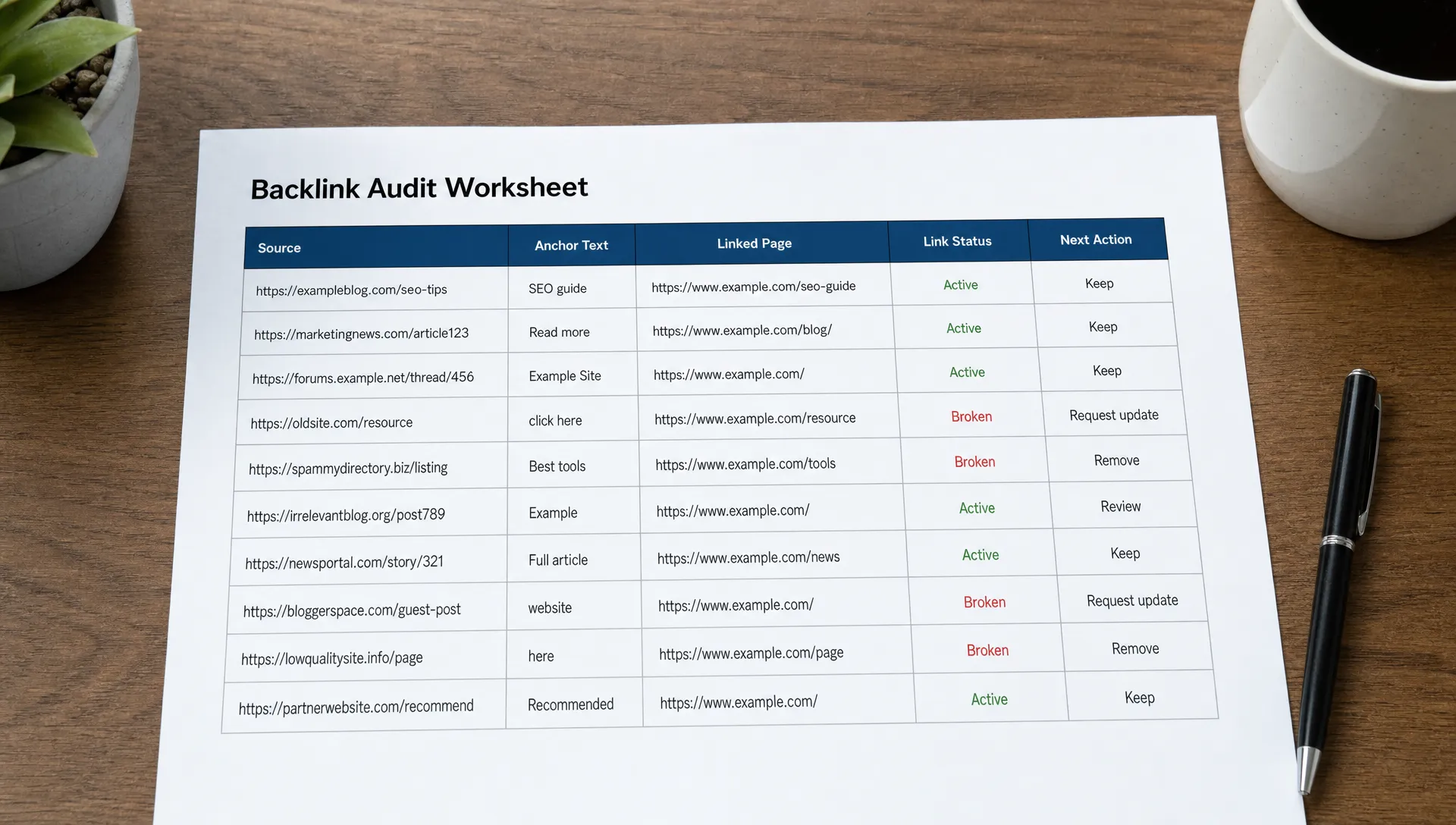
Use a simple spreadsheet structure that supports action, not just reporting.
| Field | Why it matters | Example action |
|---|---|---|
| Referring domain | Shows who is linking to you | Group by publication, partner, directory or spam source |
| Referring page | Reveals the actual linking context | Check whether the page is relevant and indexed |
| Anchor text | Shows how your brand or page is described | Flag over-optimized or misleading anchors |
| Target URL | Shows where equity and traffic land | Improve the linked page or redirect broken URLs |
| Link status | Confirms whether the link is live, lost or redirected | Reclaim valuable lost links |
| Link attribute | Identifies followed, nofollow, sponsored or UGC links | Set realistic expectations for SEO impact |
| Next action | Turns data into workflow | Keep, improve, reclaim, monitor or disavow |
Sort links by what they can tell you
The first real decision after you find backlinks to my website is how to label each link so the export becomes a work queue. Raw backlink lists are noisy. Categories help you understand patterns and prioritize work.
Segment links by source type
Start by grouping links into practical categories: editorial media mentions, directories, partners, customers, review sites, associations, guest content, resource pages, forums, scraper sites and obvious spam. You can add more categories later, but the first pass should be simple enough to complete.
Context matters by business type. A SaaS company might value links from software review sites, integration partners and trade publications. A local service business might care more about city pages, local awards, customer reviews and trade associations. For example, a local contractor such as a fugefirma in København og Nordsjælland would expect a different backlink profile than a global fintech startup, so relevance should be judged against the actual market served.
This is also where brand visibility becomes clearer. If all of your links come from low-context directories, you may have presence but not authority. If respected publications mention your brand in relevant articles, your profile is usually stronger even if the total number of links is lower.
Map links to destination pages
Backlinks do not help every page equally. A link to your homepage supports overall brand authority, but a link to a strong report, service page or case study can also strengthen the specific page buyers discover in search.
Look for three destination patterns: pages with many good links, pages with good links but weak content and important commercial pages with no external support. The second group is often the fastest win. If a trusted site already links to a page, make sure that page is updated, useful and connected to related pages on your site.
Assess quality before you celebrate or panic
It is easy to find backlinks to my website and assume every recognizable domain is good and every strange-looking domain is bad. That is too shallow. Link quality depends on source credibility, topical relevance, editorial context, placement, traffic potential and risk.
A strong link usually appears inside relevant content, uses natural anchor text and points to a page that makes sense for the reader. A weak link may sit in a thin directory, a copied article, a comment section or a page with hundreds of unrelated outbound links.
If you need a deeper evaluation checklist, MediaBoost has a full guide on how to analyze backlinks for quality, relevance and risk. For a quick working model, use this action table.
| Backlink situation | What it usually means | Best next action |
|---|---|---|
| Relevant media mention with a live link | Strong trust and visibility signal | Keep, document and strengthen the linked page |
| Partner or customer link | Relationship-based credibility | Keep and consider reciprocal case study opportunities |
| Good article linking to a broken URL | Lost authority and poor user experience | Redirect or request an updated link |
| Brand mention without a link | Missed referral and SEO opportunity | Politely request a link if context is natural |
| Irrelevant low-quality domain | Usually noise, sometimes risk | Monitor before taking action |
| Pattern of manipulative links | Potential manual action concern | Investigate and consider disavow only if warranted |
Act on strong backlinks first
The most profitable reason to find backlinks to my website is to locate pages that already earned trust and make those pages work harder. Start with your best links, not your worst ones.
If a strong publication links to an old blog post, update the post with current information, clearer examples and stronger internal links. If a respected directory links to your homepage, make sure your homepage communicates what you do, who you serve and why buyers should trust you. If a podcast page, award page or partner profile links to you, check that the destination page has a clear conversion path.
Good backlinks can also guide your content strategy. If your industry report earns links but your product pages do not, build internal bridges from the report to relevant service pages. If journalists keep citing one statistic, expand it into a more complete resource. If customers link to your case studies, create more case studies that are easy to reference.
A backlink is not the end of the story. It is the start of a stronger page, a better internal linking path and a clearer brand signal.
Reclaim value from weak, lost or broken backlinks
Link reclamation is often faster than new outreach because the relationship or mention already exists. Look for lost links from good domains, links pointing to 404 pages and unlinked brand mentions in articles that already discuss your company.
For broken backlinks, the simplest fix is often a 301 redirect from the old URL to the most relevant current page. Do not redirect every old URL to the homepage by default. Relevance matters for users and search engines.
For lost links, check whether the referring page was updated, deleted or moved. If the link was removed during a content refresh, a short, helpful message may recover it. Explain the broken reference or outdated URL and suggest the most relevant replacement. Avoid asking for keyword-stuffed anchor text. A branded or natural descriptive anchor is safer and more credible.
For unlinked mentions, only request a link when it improves the article for readers. If your brand is named as a source, tool, partner or example, a link is reasonable. If the mention is incidental, leave it alone.
Use backlink data to guide future campaigns
When you find backlinks to my website and notice that only one content type earns citations, treat that as market feedback. Your backlink profile shows what the web already finds worth referencing. Build on that instead of guessing.
If your data shows links from industry blogs but not mainstream business publications, you may need a broader story angle. If your links are mostly from directories, you may need original data, expert commentary or customer outcomes that journalists and editors can cite. If competitors earn links from sources that never mention you, compare the stories, assets and credibility signals behind those placements.
This is where digital PR becomes useful. Strong PR campaigns turn company knowledge into assets that others want to reference: survey findings, market commentary, founder insights, trend reports or timely announcements. MediaBoost’s guide on how to earn backlinks through digital PR explains how to build those stories instead of relying only on cold link requests.
Backlink data also supports AI search visibility. Search systems increasingly rely on consistent entity signals across trusted sources. When your brand appears in credible publications with clear context, it becomes easier for both search engines and AI-powered discovery tools to understand who you are associated with.
Clean up risky links with restraint
Some people find backlinks to my website, see spammy domains and rush to disavow everything. That can create more harm than benefit if done without evidence. Search engines are generally good at ignoring a large amount of low-quality web noise. A few strange links do not automatically mean your site is in danger.
Focus on patterns. Risk increases when you see large groups of irrelevant links using manipulative anchors, links from obvious networks, paid links without proper attributes or links created by a campaign you controlled. If you inherited an old SEO program, review historic vendors, anchor text patterns and sudden spikes in referring domains.
Disavow should be a last resort, not a routine cleanup habit. Use it when you have a clear pattern of unnatural links and a reasonable belief that those links could harm your site. Keep records of what you disavowed and why. If you are unsure, get a second review before uploading a file.
In most audits, your time is better spent improving good links, reclaiming lost links and earning better mentions than obsessing over every scraper site.
Put backlink monitoring on a simple schedule
You do not need to find backlinks to my website every morning; you need a repeatable cadence that matches your growth stage. A small business can review backlinks monthly. A funded startup, agency or brand running active PR campaigns may need weekly checks during launch periods.
Set a schedule that tracks both discovery and action.
| Cadence | What to review | Why it helps |
|---|---|---|
| Weekly during campaigns | New media links, live placements and broken URLs | Confirms coverage and catches errors quickly |
| Monthly | New referring domains, lost links and top linked pages | Shows momentum and reclamation opportunities |
| Quarterly | Anchor text, source mix and link risk patterns | Keeps growth natural and aligned with strategy |
| Before major link building | Existing strengths, weak pages and competitor gaps | Prevents wasted outreach and duplicated effort |
Document each meaningful change. Your backlink report should show more than domain counts. Track the links that influenced page improvements, referral traffic, branded search demand, sales conversations or media credibility.
Frequently Asked Questions
What is the easiest way to find backlinks to my website? Start with Google Search Console, then add one independent backlink tool to catch links outside Google’s visible report. Export the data, deduplicate it and review the actual referring pages instead of relying only on authority metrics.
Are all backlinks good for SEO? No. Relevant editorial links, partner links and credible media mentions can support SEO and brand trust. Irrelevant links from spammy pages, link networks or manipulative placements may provide little value and can create risk if they appear in unnatural patterns.
How often should I check my backlinks? Monthly is enough for many businesses. Check weekly when you are running PR, launching a campaign or fixing a technical issue that could affect linked pages. Run a deeper review each quarter.
Should I remove bad backlinks? Do not try to remove every odd-looking link. Focus on clear patterns of manipulative or irrelevant links. Reclaim valuable broken links first, then consider removal or disavow only when there is a credible risk.
Turn backlink discovery into brand visibility
Finding your backlinks is only the first step. The value comes from knowing which links prove authority, which pages deserve improvement and where your brand needs stronger third-party validation.
If your audit shows that you need more credible media mentions, MediaBoost helps brands secure press release distribution and media placements across 500+ trusted publications, with live links, editorial review and proof reports. Use your backlink data as the baseline, then build the kind of visibility that strengthens search, trust and AI discovery over time through MediaBoost’s press release distribution services.