Ecommerce Link Building Ideas That Attract Qualified Buyers
Most ecommerce backlinks never influence revenue because they ignore buyer intent. This guide shows how to earn credible links that support rankings, referrals and trust.

Get featured on 500+ media outlets
Guaranteed placement, no PR experience needed.
Most stores do not need more random links. They need ecommerce link building that reaches people already comparing solutions, researching products or looking for a brand they can trust before they buy. That changes the strategy from “get any backlink possible” to “earn placements where buyer intent, editorial relevance and credibility overlap.”
For online retailers, links are not just ranking signals. They can also act as trust signals, referral paths and third-party proof. A link from a relevant buying guide, trade publication, partner page or product-focused story can support SEO while nudging a potential customer toward your store.
Why ecommerce link building should start with buyer intent
Ecommerce link building works best when the link is connected to a real buying question. A backlink from a generic blog may help a little if the page has authority, but a link from a page about choosing the right running shoes, skincare routine, laptop accessory or home office tool can put your product in front of someone closer to purchase.
Buyer intent also helps you decide which page deserves the link. Category pages, collection pages, comparison pages, educational guides and product-led stories all serve different moments in the journey. Sending every link to the homepage usually wastes context and makes outreach feel less natural.
A simple way to plan is to match the link opportunity with the buyer’s next step:
| Buyer stage | Search behavior | Best link target | Strong link angle |
|---|---|---|---|
| Problem aware | “How to stop foot pain when running” | Educational guide | Expert advice, original tips |
| Solution aware | “Best insoles for flat feet” | Collection page | Buying criteria, product fit |
| Brand comparing | “Brand A vs Brand B” | Comparison page | Transparent feature breakdown |
| Purchase ready | “Discounted ergonomic chair” | Product or offer page | Seasonal relevance, availability |
The goal is not to force commercial pages into every pitch. It is to create pages that deserve citations because they help editors, creators and shoppers explain a decision.
Ecommerce link building ideas that attract buyers, not just links
The strongest ecommerce link building ideas are useful before they are promotional. Editors and site owners link to pages that make their own content better, which means your asset must answer a question, simplify a decision or add proof they cannot easily recreate.
Below are practical ideas that work across physical products, digital products and direct-to-consumer brands.
Publish buying-help content others can cite
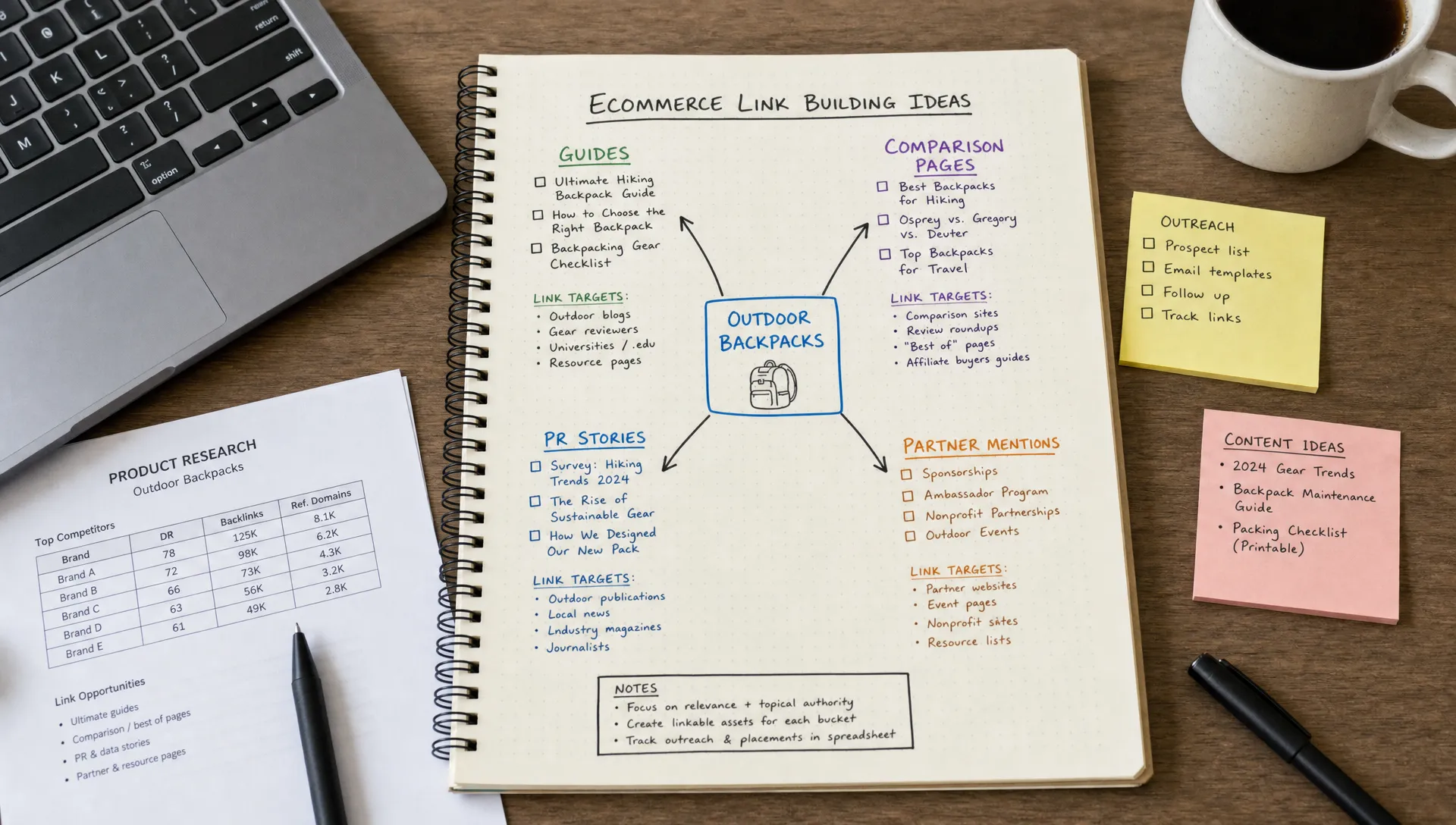
Buying-help content turns your product knowledge into a resource. Instead of writing a thin “best products” post, build an asset that helps shoppers choose correctly. Examples include sizing charts, compatibility guides, material explainers, ingredient glossaries, maintenance guides and comparison frameworks.
A mattress brand could publish a guide to choosing firmness by sleep position. A cookware brand could compare stainless steel, cast iron and ceramic for different cooking styles. A software seller could explain how to evaluate storage cleanup, privacy controls or licensing terms.
This kind of page attracts links because it is not just a sales page. It gives bloggers, journalists, affiliates and niche communities something useful to reference when they discuss a purchase decision.
Turn product expertise into digital PR
Ecommerce link building becomes more powerful when it borrows from digital PR. Your store already has information that can become a story: seasonal demand shifts, customer preferences, regional buying patterns, gift trends, return reasons, price sensitivity or product usage data.
You do not need a huge research department. Even anonymized order trends, survey responses or expert commentary can become a pitch if the insight is timely and specific. A pet brand might discuss rising demand for calming products before fireworks season. A home goods store might show which room upgrades shoppers prioritize before the holidays.
This is where link building, PR and brand trust meet. If you want a broader view of that overlap, MediaBoost’s guide to link building that supports PR, SEO and brand trust explains why modern placements need more than raw domain metrics.
Build comparison pages with editorial discipline
Comparison pages are often high-intent assets, but they can easily become biased sales copy. A better approach is to create honest, structured comparisons that help shoppers make a confident decision.
Use clear criteria such as pricing model, materials, use cases, warranty, compatibility, delivery options or customer support. If a competing product is stronger for a certain buyer, say so. That honesty can make the page more linkable and more persuasive.
For example, a store selling digital utilities could compare cleanup methods, subscription pricing and safety features across different categories of tools. A brand in that space might naturally be mentioned alongside a Mac cleaner app for macOS when an article explains how shoppers compare storage cleanup options, app uninstallers and one-time license models.
Create “best for” collection pages
Generic category pages are hard to pitch because they rarely say anything unique. A “best for” page gives editors and buyers a clearer reason to care. Instead of “men’s jackets,” create collections such as “best lightweight jackets for spring travel” or “best rain jackets for bike commuters.”
These pages can rank for long-tail searches and earn links from niche publishers because they serve a defined audience. They also convert better than broad categories when the shopper’s need is specific.
Good “best for” pages include short selection criteria, product recommendations, use-case notes, care instructions and FAQs. The page should feel like a curated recommendation, not an automated product grid.
Earn links from partners, suppliers and creators
Some of the easiest qualified links come from relationships you already have. Suppliers, manufacturers, distributors, integration partners, retailers, creators, charities, events and wholesale partners may all maintain pages where your brand can be listed naturally.
This is not about swapping links at scale. It is about making sure legitimate business relationships are reflected online. If you stock a supplier’s product, ask whether they have an authorized retailer page. If you sponsor an event, make sure the event page includes a linked brand mention. If you collaborate with a creator, give them a useful landing page or resource they can link to from their review.
Ecommerce link building through partnerships tends to drive more qualified traffic because the audience already understands the context. A link from a cycling blogger to a bike accessories collection is far more relevant than a link from a generic lifestyle roundup with no clear audience fit.
Use seasonal stories without chasing every trend
Seasonal content works because ecommerce demand is often predictable. Back-to-school, Black Friday, Valentine’s Day, summer travel, tax season, wedding season and holiday gifting all create natural editorial windows.
The mistake is pitching the same discount angle every other store is using. Instead, offer useful storylines: what buyers should order early, which gifts are most returned, how to choose size-sensitive products, what to avoid when buying refurbished items or how shoppers can compare quality before a sale.
Plan seasonal outreach at least six to eight weeks before the peak moment. Many editors and bloggers work ahead, especially for gift guides and buying roundups.
What makes an ecommerce backlink worth pursuing
Not every link deserves your time. A qualified backlink sits at the intersection of relevance, editorial quality and audience fit. Domain authority alone is not enough if the placement is buried on a low-quality page or surrounded by unrelated outbound links.
For ecommerce link building, evaluate the page before you evaluate the metric. Ask whether a real shopper could land there and understand why your brand is mentioned. If the answer is no, the link may create noise instead of value.
Use these criteria when prioritizing opportunities:
- Topical relevance: The site, article and surrounding content should relate to your product, customer or use case.
- Editorial context: The link should be part of a useful sentence or recommendation, not a random insertion.
- Audience quality: The publication should reach readers who could plausibly become buyers, partners or brand advocates.
- Anchor naturalness: Branded, URL, product-name and descriptive anchors usually look more credible than repeated exact-match anchors.
- Proof and reporting: You should be able to verify the live URL, link placement, anchor, publication details and status over time.
If you are comparing vendors, MediaBoost’s article on what link building companies should prove before you hire is a useful checklist for separating credible operators from volume-first sellers.
How to build outreach that does not sound spammy
Good outreach starts with the recipient’s page, not your product. Before you pitch, identify the exact reason your brand, guide or data point improves their article. A personalized note that references a specific section will outperform a generic “we have a great resource” email.
Keep the pitch short. Editors receive too many vague requests, so make the value obvious in the first few lines. Mention the asset, explain why it fits their audience and include one suggested context where the link could help.
Ecommerce link building outreach should also avoid over-controlling anchor text. If you insist on a keyword-stuffed anchor, the pitch feels transactional and risky. Give the publisher natural options such as your brand name, product name or a descriptive phrase that matches the sentence.
A practical outreach workflow looks like this:
- Find relevant pages: Search for buying guides, comparison posts, resource pages, unlinked brand mentions, partner pages and outdated recommendations.
- Check the intent: Confirm that the page reaches shoppers or influencers in your category, not just a broad content farm audience.
- Match the asset: Pitch the most useful page, such as a guide, collection, comparison or data story.
- Write a concise note: Explain the fit in plain language and avoid inflated claims.
- Track proof: Record the live URL, anchor text, target page, publication name and status.
For a safer long-term approach, MediaBoost’s SEO backlink building framework breaks down how relevance, editorial value and natural anchors protect growth.
Where press releases fit for ecommerce brands
Press releases are not a replacement for relationship-based outreach, but they can support ecommerce link building when you have a real announcement. Product launches, funding news, major partnerships, marketplace expansion, new research, charitable campaigns and seasonal trend reports can all justify distribution.
The key is to write the release around news value, not a coupon. A credible release explains what changed, who it affects and why the timing matters. It can also give journalists, search engines and AI-powered discovery systems clearer information about your brand.
MediaBoost helps brands distribute press releases and media placements across 500+ publications with done-for-you submissions, editorial review, live links and proof reports. For ecommerce companies that need faster credibility signals around a launch or campaign, this can complement slower organic outreach.
When using PR for links, choose a landing page that matches the story. A product launch release may point to a launch page. A trend report may point to a data asset. A partnership announcement may point to a newsroom or announcement page. Relevance matters more than pushing every placement to a product page.
How to measure qualified buyer impact
Ecommerce link building should be measured beyond link count. A campaign can look successful on paper and still fail commercially if the links do not support rankings, referral traffic or brand trust.
Track a small set of metrics that connect visibility to buying behavior. Organic ranking movement matters, but so do referral sessions, assisted conversions, branded search volume, email signups, product page engagement and the quality of referring domains.
The most useful reporting combines SEO proof with business context:
| Metric | Why it matters | What to watch |
|---|---|---|
| Live placements | Confirms the link exists | URL, status, anchor, target page |
| Referring page relevance | Shows audience fit | Topic, intent, surrounding text |
| Referral traffic | Measures direct visits | Sessions, bounce rate, engagement |
| Assisted conversions | Connects links to revenue | Multi-touch paths, cart activity |
| Branded search lift | Shows trust and awareness | Brand queries, product-name searches |
Do not expect every link to produce immediate sales. Some links strengthen category rankings over time, while others create social proof that helps buyers trust you when they encounter the brand later.
Frequently Asked Questions
What is ecommerce link building? Ecommerce link building is the process of earning backlinks to an online store, product category, guide, comparison page or brand asset from relevant websites that can support SEO, credibility and qualified referral traffic.
Should ecommerce brands build links directly to product pages? Sometimes, but not always. Product pages are useful when the placement is highly relevant, such as a review or buying guide. Educational guides, comparison pages and curated collections are often easier to earn links to because they provide more editorial value.
How many backlinks does an ecommerce store need? There is no universal number. A niche store in a focused category may need fewer high-quality links than a broad retailer competing nationally. Relevance, authority, placement context and consistency matter more than volume alone.
Are press releases useful for ecommerce SEO? Press releases can be useful when they announce real news and include relevant links. They work best as part of a broader strategy that includes digital PR, useful buying content, partner links and ongoing proof reporting.
Build links buyers can actually trust
The best ecommerce links do more than pass authority. They show up where buyers research, compare and validate brands. That means your strategy should start with useful assets, credible stories and placements that make sense to a real reader.
If you are planning a launch, seasonal campaign or credibility push, MediaBoost can help with press release distribution, editorial review, live backlink proof and placements across trusted publications. Focus your next campaign on links that support visibility and buyer confidence, not just another line in a spreadsheet.