Keyword Backlinks: When Anchor Text Helps and Hurts SEO
Anchor text can clarify what a linked page is about, but overusing exact-match phrases can create SEO risk. Learn when keyword-rich backlinks help, when they hurt and how to build a safer link profile.

Get featured on 500+ media outlets
Guaranteed placement, no PR experience needed.
Keyword backlinks can strengthen SEO when the anchor text accurately describes the page being linked to, but they can also create risk when they look forced, repetitive or disconnected from the surrounding content. Search engines use links as signals of discovery, context and trust. Anchor text adds another layer by suggesting what a linked page is about. That does not mean every backlink should use a money keyword. In fact, the safest link profiles usually look varied because real people link in varied ways. A founder might mention your brand name, a journalist might cite a report title, a customer might paste your URL and a niche publisher might use a descriptive phrase. The question is not whether anchor text matters. It does. The better question is when it helps users and search engines understand a page, and when it starts to look like manipulation.
What keyword backlinks really mean in modern SEO
A backlink is a link from one website to another. Anchor text is the clickable text used for that link. When marketers talk about keyword backlinks, they usually mean backlinks where the anchor text includes a phrase they want to rank for, such as “enterprise payroll software,” “organic dog food” or “press release distribution.”
That can be useful in moderation. If a respected industry publication links to a page about supply chain software using descriptive anchor text, the link helps readers know what to expect before they click. It also gives search engines more context about the target page.
Problems start when a backlink profile contains too many identical commercial anchors, especially from weak or irrelevant sites. Natural linking patterns rarely look that clean. If 80 unrelated blogs all link to the same page using the same exact phrase, the pattern says more about link building tactics than editorial trust.
How anchor text helps search engines understand relevance
Google’s SEO Starter Guide has long encouraged descriptive link text because it helps people and search engines understand the linked page. That principle applies to internal links and external backlinks. Strong anchor text is specific enough to set expectations, but not so optimized that it reads like an advertisement.
For example, a link that says “download our report” is less informative than “B2B SaaS pricing benchmark report.” The second version tells the reader what they are getting. If the surrounding article is about SaaS pricing strategy, the context and anchor text reinforce each other.
Keyword backlinks are most helpful when three signals align: the linking page topic, the anchor text and the destination page content. A link about cybersecurity compliance should point to a genuinely relevant cybersecurity compliance resource. If the destination page is a generic homepage with no matching substance, even a well-written anchor cannot fix the mismatch.
This is why quality backlink building starts with assets worth referencing. Data pages, product comparisons, original research, expert commentary, case studies and credible company announcements all give publishers a real reason to link.
When anchor text starts to hurt SEO
Anchor text becomes risky when it appears engineered rather than editorial. Search engines do not evaluate one link in isolation. They look at patterns across referring domains, page topics, link placement, link velocity and anchor variation.
The biggest red flag is repeated exact-match commercial anchor text. If a page earns hundreds of links and most use the same transactional keyword, that profile can look unnatural. A smaller site can trigger the same concern with far fewer links if the pattern is extreme.
Keyword backlinks also hurt when the linking page is irrelevant. A link to a cybersecurity vendor from a recipe blog using a cybersecurity keyword is not just odd, it weakens the credibility of the signal. Relevance does not require both sites to be in the same industry, but the article itself should create a reasonable bridge.
Other risky patterns include sitewide footer links, private blog network links, spun guest posts, thin directories and anchors that are clearly written for bots instead of readers. If a sentence would sound strange to a real person, it is usually a poor anchor choice.
| Anchor pattern | SEO value | Risk level | Example |
|---|---|---|---|
| Branded anchor | High for trust and entity recognition | Low | MediaBoost |
| Descriptive partial match | High when context is relevant | Low to moderate | press release distribution for startups |
| Exact-match commercial anchor | Can help in small doses | Moderate to high | buy press release backlinks |
| Naked URL | Natural profile diversity | Low | www.example.com |
| Generic anchor | Limited context, but natural | Low | learn more |
| Irrelevant exact match | Weak or harmful | High | best CRM software from an unrelated travel post |
A safer anchor text mix for growing brands
There is no universal percentage that makes an anchor profile safe. A local law firm, a national ecommerce brand and a B2B SaaS company will all attract different link patterns. The better approach is to make your backlink profile look like real awareness, not a spreadsheet target.
A healthy mix usually includes brand names, founder names, publication citations, page titles, naked URLs, generic anchors and descriptive partial matches. Exact-match anchors can appear, but they should not dominate the profile.
For keyword backlinks, partial-match wording often does the best job balancing clarity and safety. Instead of forcing “best email automation software” into every placement, a publisher might naturally use “email automation platform for ecommerce teams” or “guide to lifecycle email automation.” These anchors still provide topic context without creating a mechanical footprint.
If you are building links through PR, digital campaigns or editorial outreach, give publishers useful context rather than rigid anchor demands. Media outlets, editors and journalists are more likely to preserve a link when the anchor fits their article. For a broader risk framework, MediaBoost’s guide to safe SEO backlink building explains how relevance and editorial value should lead the process.
Examples of helpful and harmful anchor choices
The easiest way to judge anchor text is to read the full sentence aloud. If the phrase helps the sentence, it is probably a reasonable anchor. If it feels jammed into the copy, it probably creates unnecessary risk.
Imagine a travel publisher writing about quality food options for remote work, sailing or camper trips. In that context, linking to gluten-free ready meals for travelers would make sense because the destination matches the reader’s need and the anchor describes the offering without sounding spammy.
Now compare that with an article about remote work software that suddenly links to the same food site using an unrelated financial keyword. Even if the anchor text contains a valuable search phrase, the link would not help readers. Search engines are increasingly good at spotting that kind of mismatch.
Keyword backlinks work best when the anchor could have been chosen by an editor with no SEO brief. That is a useful test because editorial links are naturally constrained by relevance, sentence flow and reader expectations.
| Scenario | Better anchor | Risky anchor | Why it matters |
|---|---|---|---|
| PR article about funding | company name or funding announcement | best software company | News context favors brand and event anchors |
| Comparison article | project management platform for agencies | buy project management software | Descriptive beats overly transactional |
| Data report citation | annual ecommerce benchmark report | ecommerce SEO agency | The linked asset should match the citation |
| Founder interview | founder name or brand name | cheap backlinks | Personal profiles should not carry forced money anchors |
How to audit your existing anchor text
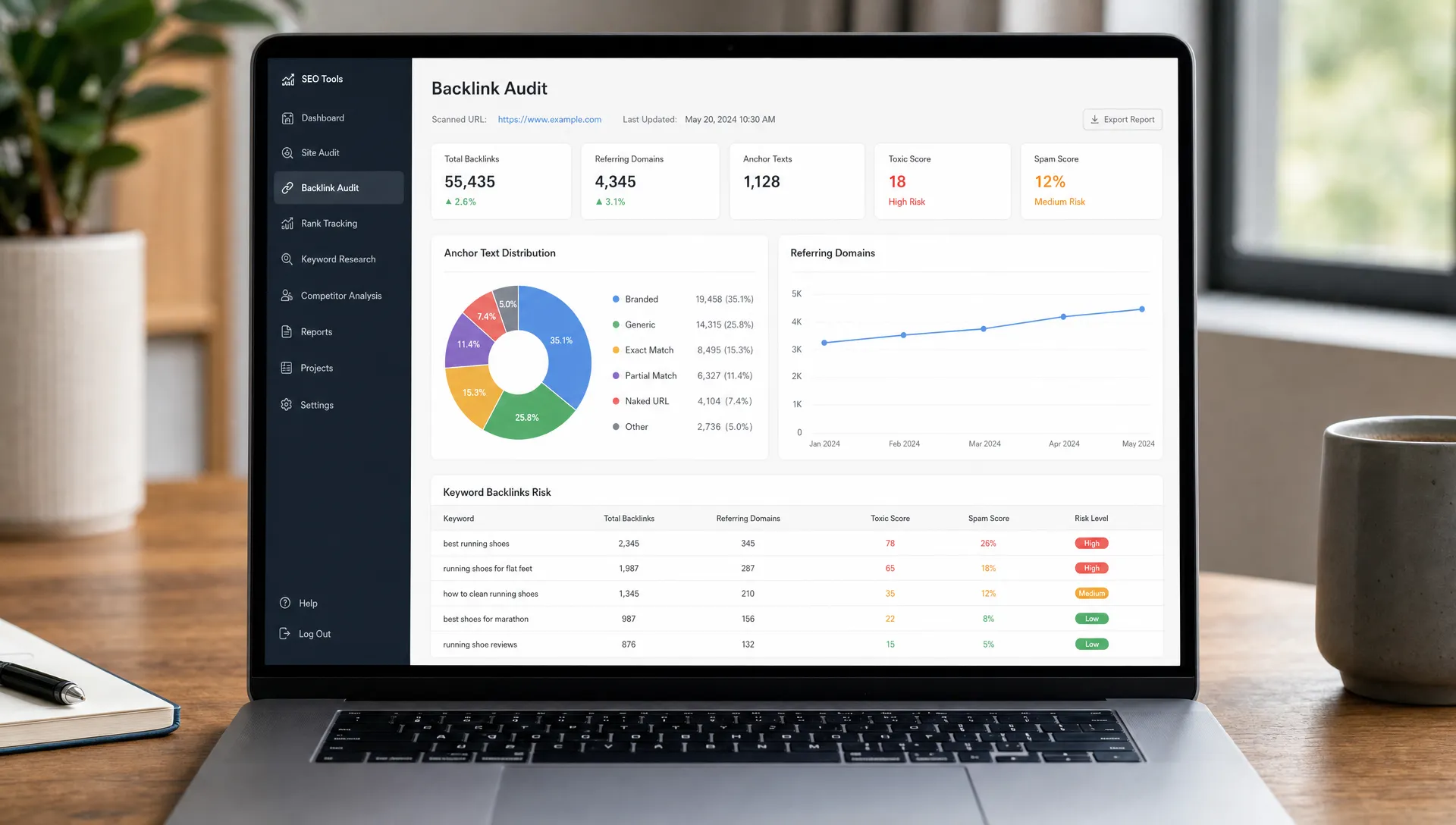
Before building more links, review the anchors you already have. Many brands focus only on domain authority or referring domain count, but anchor distribution often reveals the real risk.
Start by exporting your backlinks from a tool such as Ahrefs, Semrush, Moz or Google Search Console. Group anchors by type: branded, naked URL, generic, partial match, exact match and unrelated. Then review the pages that use your most repeated commercial terms.
The goal is not to delete every keyword-rich link. Some are perfectly natural. The goal is to find patterns that look too concentrated, irrelevant or low quality. If you see the same exact anchor across multiple weak domains, especially from pages with thin content, mark those links for closer review.
Keyword backlinks should also be checked at the page level. A homepage can naturally earn many branded anchors, while a research report may earn title-based anchors. A product page overloaded with exact-match links from unrelated sites deserves more scrutiny. MediaBoost’s article on how to analyze backlinks for quality, relevance and risk gives a deeper checklist for this kind of review.
What to do if your anchor profile looks over-optimized
Do not panic if you find some poor anchors. Most established sites have messy backlink profiles. The right response depends on scale, quality and intent.
If the questionable links come from low-value sites that you never worked with, document them and monitor rankings, traffic and indexing. Search engines often ignore weak links without requiring action. If the links were created through your own past campaigns, stop repeating the tactic and shift future acquisition toward safer anchors.
For severe cases, you may need to contact site owners for removal or use Google’s disavow tool. That step should be handled carefully because disavowing legitimate links can reduce authority. It is usually reserved for clear patterns of manipulative links, manual action recovery or large volumes of toxic placements.
A better long-term fix is dilution through quality. Earn more branded mentions, PR placements, expert citations and content-led links. As trustworthy links grow, old over-optimized anchors become a smaller share of the overall profile.
How press release distribution affects anchor text
Press release distribution can support brand visibility, credibility and discovery when it is used for real news, not artificial anchor stuffing. A press release about a product launch, funding round, executive hire, research report or market expansion gives publishers a clear reason to mention the brand.
For keyword backlinks, press releases should usually prioritize branded anchors, company names, report titles and natural descriptive phrases. That keeps the release credible and reduces the risk of looking over-optimized. A press release that repeats a commercial keyword in every link reads poorly and can undercut the trust the campaign is meant to build.
MediaBoost provides press release distribution and media placement services across 500+ trusted publications, with done-for-you submissions, editorial review, live links and proof reports. The strongest campaigns pair that distribution with newsworthy positioning and restrained anchor text. If AI search visibility is part of your strategy, this article on SEO and backlinks in AI search explains why trusted mentions can matter beyond traditional ranking signals.
Practical anchor text rules you can use today
Anchor text decisions should be simple enough for a team to apply consistently. If writers, PR managers and SEO leads all follow different rules, your backlink profile can become uneven fast.
Use these principles before approving a link campaign:
- Make the anchor useful to the reader before making it useful to SEO.
- Prefer branded, title-based and descriptive anchors for PR placements.
- Use exact-match anchors sparingly and only in highly relevant editorial context.
- Avoid repeating the same commercial anchor across many domains.
- Match the anchor to the destination page, not just the keyword target.
- Review link quality and page relevance before celebrating a new backlink.
Keyword backlinks are not a shortcut around strong content, brand authority or editorial relevance. They are a contextual signal. When the link source, sentence and destination page all make sense together, anchor text can reinforce topical relevance. When those pieces do not fit, the keyword becomes a liability.
Frequently Asked Questions
Are exact-match anchors bad for SEO? Exact-match anchors are not automatically bad. They become risky when they appear too often, come from irrelevant sites or look coordinated across many placements. A small number of natural exact-match links from relevant pages is usually less concerning than a large pattern from low-quality sources.
What is the safest anchor text for backlinks? Branded anchors, page titles, naked URLs and natural descriptive phrases are usually safest. They mirror how journalists, customers and industry writers tend to link when they are not following an SEO script.
How many keyword-rich backlinks are too many? There is no fixed number because risk depends on your niche, site age, total backlink profile and referring domain quality. If exact-match commercial anchors dominate your profile or appear mostly on weak sites, the pattern deserves attention.
Should press releases include keyword anchor text? Press releases can include descriptive links, but they should not be overloaded with commercial anchors. Brand names, announcement titles and relevant resource anchors usually fit press release copy more naturally.
Can bad anchor text cause a penalty? Manipulative anchor text patterns can contribute to ranking suppression or manual action risk, especially when combined with paid links, private blog networks or irrelevant placements. In many cases, search engines may simply ignore weak links, but intentional manipulation is still a bad strategy.
Build links that read naturally and prove authority
The best backlink profiles look earned because they are built around real news, useful resources and credible placements. Anchor text should support that credibility, not fight against it.
If you want media placements that strengthen visibility without relying on risky anchor tactics, MediaBoost can help you distribute press releases across trusted publications, secure live links and receive proof reports for your campaign. Keep the anchor text natural, keep the story newsworthy and let the placement quality do the heavy lifting.