What to Look For in a Reliable Press Release Service
Not all press release providers deliver the same value. Learn how to evaluate outlet quality, guarantees, backlinks, turnaround, reporting, and editorial support before choosing a service.
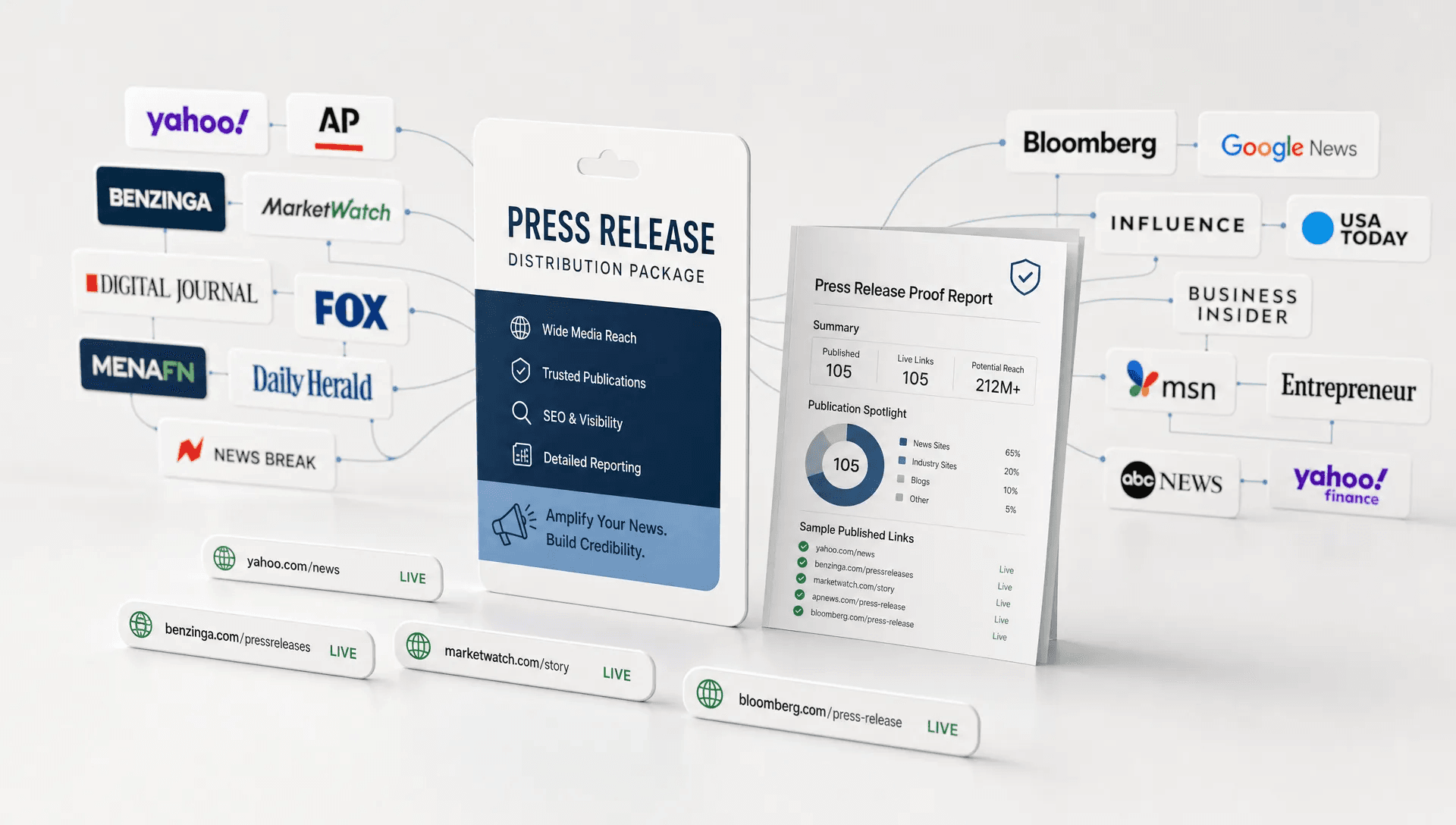
Get featured on 500+ media outlets
Guaranteed placement, no PR experience needed.
Choosing a press release service is not just about finding the biggest outlet list or the lowest price. A reliable provider should help you turn a real announcement into credible media visibility, live placements, usable proof, and long-term brand assets you can repurpose across sales, SEO, investor relations, and AI search visibility.
The challenge is that many press release vendors sound similar on the surface. They promise “premium media,” “guaranteed exposure,” “high-authority backlinks,” and “fast distribution.” Some deliver exactly what they say. Others rely on vague outlet lists, weak syndication, hidden fees, or reports that look impressive but do little for your brand.
If you are evaluating a press release service in 2026, use the criteria below to separate reliable partners from providers that may waste your budget.
Start With the Type of Outcome You Actually Need
Before comparing vendors, clarify what you expect the press release to achieve. Different services are built for different goals, and a provider that works well for one campaign may be a poor fit for another.
For example, a startup announcing a funding round may care most about credibility, investor-facing proof, and visibility on recognizable business publications. An e-commerce brand launching a product may prioritize search visibility, referral credibility, and usable media logos. An agency serving multiple clients may need predictable turnaround, clear reporting, and scalable pricing.
A reliable press release service will not treat all campaigns the same. It should help you match the distribution package to your announcement, industry, geography, and business goal. If a vendor immediately pushes the same package for every use case, that is a sign to ask more questions.
Press release distribution is strongest when it supports a broader communication strategy. The announcement should align with your positioning, audience, and market narrative. If your company is still refining its story, working with a partner focused on brand and go-to-market strategy can help make the press release angle stronger before distribution begins.
Look for Transparent Outlet Quality, Not Just Big Numbers
A large outlet count can be useful, but only if the placements are credible, accessible, and relevant. “500+ outlets” sounds impressive, yet the real question is where your release will appear and what those placements mean for your audience.
Reliable providers should be clear about the types of publications included in their network. They do not need to guarantee every individual publication before submission, since syndication can vary by package and editorial rules. However, they should give you enough information to understand the quality and category of the outlets.
Pay attention to whether the provider mentions:
- Recognizable business, finance, technology, or industry publications
- Live article URLs after publication
- Outlet examples from past campaigns
- Differences between premium, niche, national, and regional placements
- Whether placements are syndicated, editorially reviewed, or manually submitted
The best press release service is not always the one with the longest media list. It is the one that can place your announcement where it adds credibility and where future customers, investors, partners, journalists, and search systems may find it.
Understand What “Guaranteed” Really Means
The word “guaranteed” is common in press release distribution, but it can mean different things. A reliable provider will explain the guarantee clearly.
In most cases, a press release service can guarantee submission, syndication, publication across a defined network, or a minimum number of live placements. It usually cannot guarantee that a journalist will write an original feature story, that a specific newsroom will choose your release, or that your announcement will rank first on Google.
This distinction matters. Guaranteed syndication can still be valuable because it creates proof, visibility, and backlinks across media pages. But it is different from earned editorial coverage, where a reporter independently decides to cover your story.
Here is a practical way to interpret common claims:
| Claim | What to Ask Before Buying |
|---|---|
| “Guaranteed placements” | How many live URLs are guaranteed, and what types of outlets are included? |
| “Premium media coverage” | Are these syndicated press release pages, original editorial articles, or both? |
| “SEO backlinks” | Are links live, indexable, nofollow or follow where applicable, and included in the report? |
| “Fast turnaround” | Does speed include review, submission, publication, and final reporting? |
| “Top-tier outlets” | Which outlet examples are realistic for this package, and are logos approved for use? |
A trustworthy provider will answer these questions plainly. If the explanation feels evasive, keep looking.
Check Whether Editorial Review Is Included
Even a strong distribution network cannot rescue a weak press release. Reliable press release services understand that formatting, tone, structure, and compliance affect pickup.
Editorial review is especially important for small businesses, startups, and founders who are writing their first release. A release that sounds like an advertisement, lacks a clear news angle, or makes unsupported claims may underperform. Worse, it may be rejected by certain distribution channels.
At minimum, editorial review should check for:
- A clear and newsworthy headline
- A concise lead paragraph that explains who, what, when, where, why, and why it matters
- Proper press release formatting
- Non-promotional language
- Accurate company details and contact information
- Quotes that sound credible rather than generic
- Links that support the announcement without looking spammy
If you need help improving the release itself before distribution, this step matters as much as the outlet list. You can also strengthen your draft by following a media-friendly press release structure before sending it to a provider.
Ask for Proof Reports and Live Links
A reliable press release service should not leave you guessing after the release goes out. You should receive a report that shows where your announcement was published and gives you usable links.
Proof reports are valuable because they turn distribution into a measurable business asset. Your team can use them to update investor decks, sales pages, pitch emails, partner outreach, social media posts, and internal reporting.
A strong post-distribution report may include live placement URLs, outlet names, publication dates, backlink details, screenshots, and a summary of total pickup. Some providers also include SEO-focused reporting to help you understand how the release contributes to online authority and discoverability.

Be cautious of vendors that only send a vague “your release was distributed” confirmation. Submission is not the same as publication. A reliable partner should show receipts.
Evaluate Backlink Quality Without Chasing Shortcuts
Backlinks are one reason brands invest in press release distribution, but they should not be the only reason. Search engines have become much better at identifying low-value link schemes, thin syndication, and unnatural anchor patterns.
A reliable press release service will frame backlinks as part of a broader visibility strategy, not as a magic SEO shortcut. Press release links can support credibility, indexing, branded search presence, and digital footprint. They are most valuable when the release is newsworthy, the publication pages are legitimate, and the links point to relevant destinations.
Avoid services that promise unrealistic ranking gains from one press release. Also be careful with providers that encourage exact-match keyword stuffing in anchor text. Natural anchors, branded links, and links to genuinely relevant pages are usually safer and more credible.
If your goal includes search visibility, the release should be written with both readers and search engines in mind. MediaBoost’s guide on writing a press release that ranks on Google explains how structure, keywords, and distribution work together without making the announcement feel forced.
Compare Speed, But Do Not Let Speed Replace Quality
Fast turnaround can be a major advantage, especially for time-sensitive announcements such as product launches, event promotions, funding news, new partnerships, or market responses. Some modern press release services can complete distribution quickly, sometimes within 48 hours depending on the package and review process.
Still, speed should not come at the expense of accuracy. A rushed release with the wrong quote, broken links, outdated boilerplate, or compliance issues can create more problems than it solves.
When evaluating turnaround time, ask what the timeline includes. Does it cover editorial review? Revisions? Submission? Publication? Final proof report? A provider that promises “same-day distribution” but delivers reporting a week later may still be useful, but you should know that upfront.
A reliable service will set expectations clearly and explain what they need from you to avoid delays. Usually, this includes the final approved release, company boilerplate, media contact details, target URL, logo or media assets if needed, and any timing requirements.
Make Sure Pricing Is Clear and Matched to Value
Press release pricing can vary widely depending on distribution reach, outlet quality, geography, industry targeting, writing support, editorial review, speed, and reporting. The lowest-cost option may be enough for basic announcements, but it may not provide the credibility or proof you need. On the other hand, expensive legacy wires may be more than a small brand needs for a simple launch.
A reliable provider should make it easy to understand what is included in each package. If custom pricing is required, the sales process should still be transparent about deliverables, expected placement volume, turnaround, and reporting.
Watch for hidden charges related to word count, images, logos, revisions, expedited delivery, links, or reporting. These are not always bad, but they should be disclosed before you commit.
If you are budgeting for the first time, review current market ranges in this guide to press release costs in 2026. It can help you compare DIY writing, budget distribution, premium wires, and done-for-you services with more context.
Prioritize Industry Relevance
A reliable press release service should understand that a fintech announcement, healthcare partnership, SaaS product launch, restaurant opening, and consumer product release do not all belong in the same distribution strategy.
Industry-specific packaging can improve the relevance of the media network and make the final report more useful. It can also help your announcement reach publications and syndicated channels that make sense for your buyers, investors, or partners.
Ask whether the service can tailor distribution by industry or audience. You do not need hyper-specific targeting for every campaign, but you should avoid one-size-fits-all distribution if your announcement serves a defined market.
Industry relevance also affects the writing. A technical B2B release may need more precise product language, while a consumer announcement may need a clearer benefit-led angle. A good provider will understand the difference.
Consider AI Search Visibility
Press releases now influence more than traditional media pickup. They can also contribute to the public information layer that search engines, answer engines, and AI-powered discovery tools use to understand brands.
This does not mean one press release will automatically make your company appear in AI answers. It means consistent, credible publication across trusted sources can help reinforce your brand’s entity signals over time. Your company name, product category, leadership, locations, partnerships, milestones, and claims become easier to verify when they appear across reputable pages.
For AI visibility, reliability depends on consistency and credibility. Your press release should use accurate company names, consistent boilerplate, clear descriptions, and factual claims. The distribution service should provide live links that your team can reference later.
This is one reason proof reports matter. They give you a record of where your brand information exists across the web, which helps with PR tracking, sales enablement, and future content planning.
Red Flags That Suggest a Press Release Service Is Not Reliable
Some warning signs are easy to miss because they are hidden behind polished sales pages. Before paying, look for these red flags:
- No clear explanation of what is guaranteed
- No sample reports or placement examples
- Overpromising specific rankings, journalist coverage, or viral results
- Vague outlet lists with no publication categories
- No editorial review or quality control
- Heavy emphasis on backlinks with little concern for news value
- Unclear pricing or surprise add-ons
- No live links after publication
- Poor communication before payment
One red flag does not always mean the service is bad, but several together should make you cautious. A good provider should be willing to explain its process in plain language.
A Simple Checklist Before You Choose
Use this quick checklist before selecting a press release service:
| Evaluation Area | What a Reliable Service Provides |
|---|---|
| Outlet quality | Recognizable, relevant, and credible publication options |
| Guarantee | Clear definition of what is guaranteed and what is not |
| Editorial support | Review for structure, clarity, formatting, and compliance |
| Reporting | Live links, placement proof, and publication details |
| SEO value | Natural linking, credible pages, and realistic expectations |
| Speed | Clear turnaround for review, distribution, and reports |
| Pricing | Transparent deliverables and no unclear hidden fees |
| Relevance | Packages or targeting aligned with your industry and goals |
| Support | Responsive communication before and after distribution |
If a provider checks most of these boxes, you are more likely to get useful visibility instead of a report full of low-value placements.
Frequently Asked Questions
What is a press release service? A press release service helps brands distribute announcements to media outlets, news networks, and online publications. Depending on the provider, it may include writing support, editorial review, syndication, live backlinks, and proof reports.
Can a press release service guarantee media coverage? It depends on what the service means by coverage. Many providers can guarantee distribution or syndicated placements, but they usually cannot guarantee original editorial stories written by journalists unless that is part of a separate earned media campaign.
How do I know if a press release service is reliable? Look for transparent deliverables, credible outlet examples, editorial review, clear pricing, live links, proof reports, realistic claims, and responsive support. Avoid providers that promise guaranteed rankings or vague “premium coverage” without details.
Are press releases still useful for SEO in 2026? Yes, when used correctly. Press releases can support branded search visibility, backlinks, entity signals, and discoverability. They work best when the announcement is newsworthy and the distribution network is credible.
How fast can a press release be distributed? Turnaround depends on the provider and package. Some services can complete distribution quickly, often within 48 hours, but you should confirm whether that includes editorial review, publication, and final reporting.
Choose a Service That Gives You Proof, Not Just Promises
A reliable press release service should make your announcement more credible, visible, and useful across multiple channels. That means strong distribution, clear guarantees, editorial quality control, live links, transparent reporting, and realistic expectations.
MediaBoost helps brands get featured across 500+ trusted publications with done-for-you submissions, guaranteed live backlinks, editorial review, SEO proof reports, industry-specific packages, and fast turnaround options. If you want press release distribution that produces tangible proof you can share, cite, and build on, visit MediaBoost to explore the right package for your next announcement.