How to Choose the Best Backlink Provider for Your Brand
A good backlink partner should strengthen credibility, not just inflate metrics. Use this framework to compare providers by relevance, editorial standards, reporting and risk before you commit.

Get featured on 500+ media outlets
Guaranteed placement, no PR experience needed.
Choosing the best backlink provider is not about buying the largest package, chasing the highest domain score or collecting links as fast as possible. For a brand, the right partner should help you earn visibility in places that make sense to your audience, support a credible search footprint and reduce the risk of low-quality placements that can damage trust.
Backlinks still matter because they connect your brand to the wider web. Search engines can use them as signals of reputation and relevance, but customers, journalists, investors and AI answer engines also encounter them as evidence that your company is being mentioned beyond its own website. That makes provider selection a brand decision, not just an SEO procurement task.
What the best backlink provider should do for your brand
A strong provider starts with context. They should want to understand your industry, audience, positioning, competitors, website history and risk tolerance before recommending placements. If every prospect receives the same list of sites and the same anchor text plan, the service is probably built for volume rather than brand fit.
In practical terms, the best backlink provider acts less like a link seller and more like a visibility partner. The work should help your brand appear in relevant editorial environments, build social proof and create a cleaner trail of third-party references that supports both search performance and buyer confidence.
Think in outcomes, not link counts
Before comparing providers, decide what you actually need links to accomplish. A startup may need credibility signals from recognizable publications. A local service brand may need niche and regional relevance. A B2B software company may need links that support key commercial pages, thought leadership assets or category education.
This distinction matters because link quantity alone does not tell you whether a campaign is working. Ten links on irrelevant blogs can be less valuable than one well-placed mention on a trusted industry publication. Your objective should shape the provider, the placement type, the pace of acquisition and the reporting you expect.
Define the link profile your brand actually needs
The best backlink provider will ask about your current backlink profile before selling you a package. A brand with very few referring domains needs a different approach from a company that already has press coverage, partner mentions and historical SEO campaigns. The right path depends on what your backlink profile is missing and what could make it look unnatural.
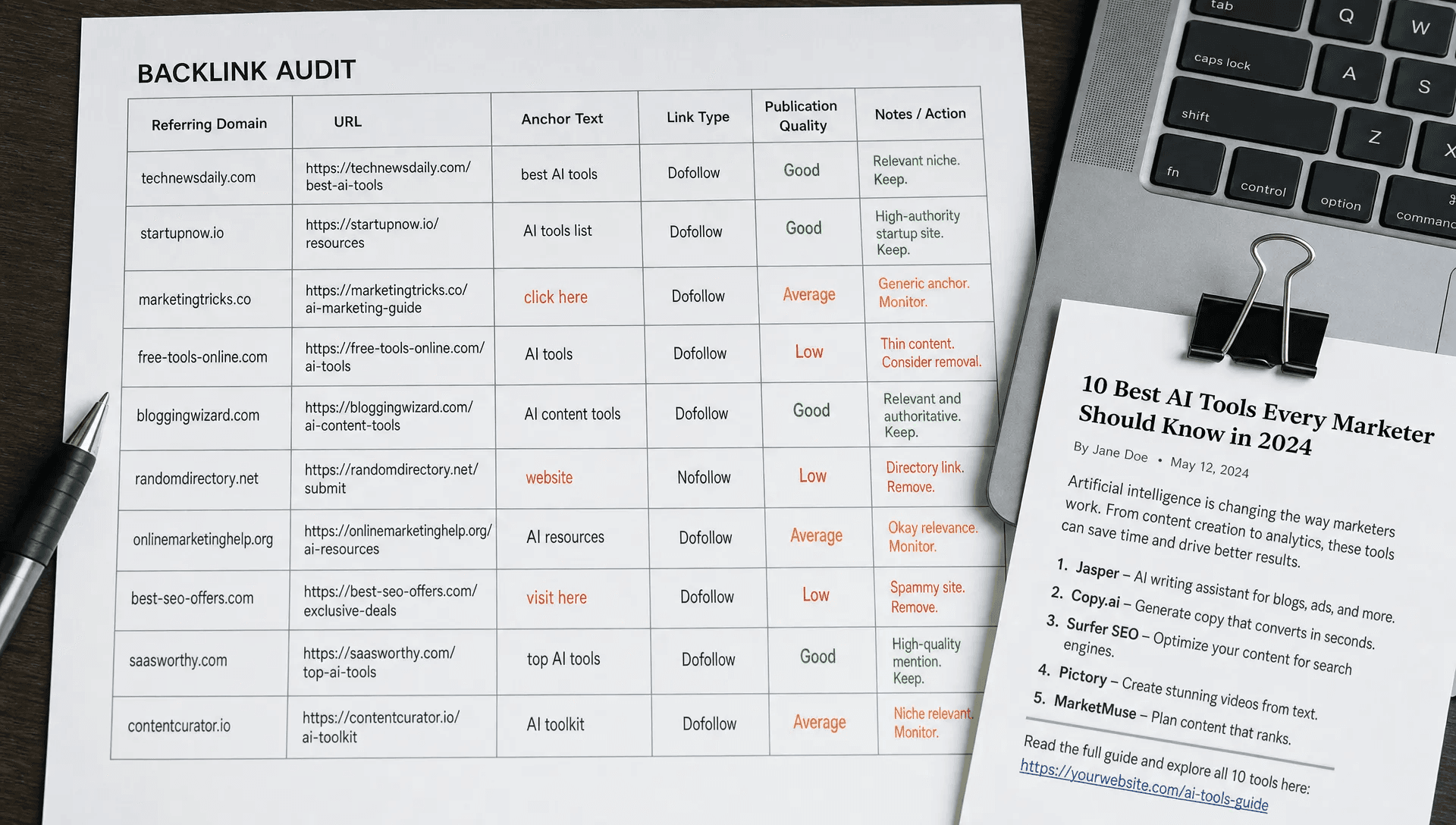
Start by reviewing three areas: relevance, authority diversity and anchor text. Relevance tells you whether links are coming from pages connected to your topic. Authority diversity tells you whether your site is cited by a healthy mix of publications, blogs, directories, partners and industry resources. Anchor text tells you whether links look organic or overly optimized.
Match placements to audience and topic
A good link should make sense if search engines did not exist. If a cybersecurity company appears on a cybersecurity news site, a SaaS operations blog or a business publication covering enterprise technology, the connection is intuitive. If the same company receives links from unrelated coupon sites, expired blogs or generic article farms, the placement may look manufactured.
This is also where brand standards come in. Your company may not want to be published next to thin content, aggressive ads, adult material, gambling content or AI-generated spam. A provider should be able to explain how they screen placements and what types of sites they refuse.
Quality signals to inspect before you pay
A pitch from the best backlink provider should make evaluation easier, not murkier. You should be able to understand where your brand may appear, how content is reviewed, what link attributes are used, what timelines are realistic and what proof you receive after publication.
Many buyers focus first on DA, DR or traffic estimates. Those metrics can help with a quick screen, but they should not drive the entire decision. Third-party authority scores are estimates, not guarantees of business value. Relevance, editorial context, page quality and transparency are often more useful for protecting your brand.
Use general vendor diligence, then adapt it to SEO
The same habits you would use when choosing any supplier apply here: check testimonials, compare pricing, look for signs of professionalism and evaluate the provider's experience. For a non-SEO parallel, this guide to choosing a reliable custom sportswear supplier covers practical checks such as reviews, price comparison, company experience, design variety and online ordering, which translate well into a disciplined vendor evaluation mindset.
For backlink providers, those checks become questions about publication access, editorial review, placement examples, link permanence, reporting quality and compliance with search engine guidelines. If a provider resists basic due diligence, that is useful information.
| Evaluation area | What to ask | Strong signal | Red flag |
|---|---|---|---|
| Topical relevance | Are placements related to my industry or audience? | Clear examples in your niche or adjacent business categories | A generic site list with no topical logic |
| Editorial standards | Who reviews the content before publication? | Human review, clear content guidelines and reasonable publishing requirements | Spun content, duplicate articles or no review process |
| Link context | Where will the link appear on the page? | Natural in-content placement within a relevant article | Footer links, sidebar links or unrelated anchor text |
| Reporting | What proof do I receive? | Live URLs, publication dates, link attributes and placement screenshots when useful | Vague claims without verifiable links |
| Risk control | How do you avoid low-quality networks? | Clear exclusion criteria and willingness to explain process | Guaranteed rankings, PBN language or secretive methods |
| Brand fit | Can you align with our tone and industry? | Custom strategy by sector, audience and goals | Identical campaigns for every client |
The best backlink provider will welcome this level of scrutiny because it separates professional placement work from risky link selling. If a service is legitimate, it should be able to explain its process without revealing private publisher relationships or making exaggerated promises.

Reporting and proof: what you should receive
The best backlink provider should make results easy to verify. At minimum, you should receive the live URL, destination URL, anchor text, publication name, publication date and link attribute where visible. If the provider promised editorial review, media placement or a specific turnaround time, the report should reflect what was delivered.
Reporting is not just a receipt. It helps your team understand which placements support brand credibility, which pages are gaining authority and whether any links need follow-up. If you are not sure how to judge a new placement, use a consistent framework to analyze backlinks for quality, relevance and risk rather than relying on a single authority score.
What a useful backlink report includes
A practical report should include enough detail for marketing, SEO and leadership teams to understand the value of the campaign. It does not need to be overcomplicated, but it should be specific.
- Live placement URLs with publication names
- Target URLs on your website
- Anchor text and surrounding article topic
- Link attribute when available, such as dofollow, nofollow or sponsored
- Publication date and delivery status
- Notes on relevance, outlet type and campaign objective
- Screenshots or proof documents when appropriate
Fast delivery can be useful, especially for launches, funding announcements, reputation campaigns and time-sensitive news. Speed should not come at the expense of editorial quality. A 48-hour turnaround is valuable only if the provider can still maintain review standards and provide clear proof after publication.
Red flags that should make you pause
Even the best backlink provider cannot guarantee rankings, traffic or revenue from a set number of links. Search performance depends on content quality, technical SEO, competition, search intent, site authority, user experience and many other factors. Be cautious when a provider promises a specific ranking position or claims their links are completely risk-free.
Paid link schemes, private blog networks and mass guest post farms can create short-term movement, but they can also leave a footprint that hurts long-term trust. If you are considering paid placements, understand the risks and rules around buying backlinks before you commit.
Common warning signs
Be careful with providers that hide the type of sites they use, push exact-match anchor text for every link or refuse to explain whether placements are editorial, sponsored or partner-based. You should also question unusually cheap packages that promise dozens or hundreds of links, because genuine editorial placement requires research, content work and publisher coordination.
Another warning sign is a provider that ignores your brand guidelines. If they are willing to publish inaccurate claims, overstate your product or place you in irrelevant content, they are treating your brand as link inventory. That is not a good foundation for visibility.
Compare provider models by brand fit
The best backlink provider for one company may be wrong for another. A founder-led startup, an agency managing many clients, an ecommerce brand and a regulated professional services firm all have different needs. The provider model should match your goals, budget, timeline and compliance expectations.
| Provider model | Best for | Main advantage | Watch out for |
|---|---|---|---|
| Manual outreach | Niche relevance and relationship-led campaigns | Highly customized targeting | Slow timelines and uncertain response rates |
| Digital PR | Newsworthy stories, data campaigns and brand awareness | Strong editorial upside | Requires a compelling angle and no placement guarantee |
| Press release distribution | Announcements, credibility signals and broad media presence | Fast publication and scalable visibility | Content must be newsworthy and accurately written |
| Guest post placement | Educational content and topical link acquisition | Can target specific subject areas | Quality varies widely by publisher and network |
| Low-cost bulk links | Usually not a good brand strategy | Cheap upfront | High risk of irrelevant or low-quality placements |
For brands that need predictable media visibility, press release distribution can be a useful part of the mix. It works best when there is a real announcement, useful company update or timely story. It should not replace deeper editorial PR, content strategy or organic relationship building, but it can help establish public proof across recognizable outlets.
How MediaBoost fits into the decision
For teams that need credibility at speed, the best backlink provider may be one that combines media placement, editorial review and clear proof after publication. MediaBoost focuses on press release distribution and media placement across 500+ trusted publications, with guaranteed submissions, live backlinks, industry-specific packages and proof reports.
This kind of service is especially relevant when your brand needs visible third-party validation for a launch, partnership, funding milestone, product announcement or reputation-building campaign. MediaBoost also emphasizes fast delivery, often within 48 hours, along with done-for-you submissions and editorial review.
That does not mean every brand should use the same package. A good campaign should still match your industry, message, target pages and risk tolerance. If you need agency volume or a tailored campaign structure, custom pricing and industry-specific options can be more useful than a one-size-fits-all link bundle.
Questions to ask before choosing a provider
Before you call any company the best backlink provider, ask direct questions that reveal how they think about quality and brand protection. The goal is not to interrogate the sales team. It is to see whether their answers show process maturity.
- What types of publications do you use for brands in our industry?
- Do you provide live URLs and proof reports after publication?
- How do you handle editorial review and factual accuracy?
- Can we approve content before it is submitted?
- What link attributes should we expect and why?
- How do you avoid irrelevant sites, expired domains or private blog networks?
- What happens if a link is removed shortly after publication?
- How do you choose anchor text for branded, commercial and informational pages?
- Can you support launches or announcements with tight timelines?
The answers should be specific enough to compare providers fairly. If a provider relies only on authority scores, vague publisher claims or pressure tactics, keep looking.
Frequently Asked Questions
What makes a backlink provider good for a brand? A good provider balances relevance, editorial standards, reporting transparency and risk control. The links should support how your brand wants to be seen, not just increase a metric in an SEO tool.
How many backlinks does my brand need? There is no universal number. A newer site may need foundational credibility, while an established brand may need higher-quality mentions in relevant publications. Start with competitive analysis, content priorities and your current backlink profile.
Should I choose the provider with the highest DA or DR sites? Not automatically. Authority metrics can be useful screening tools, but they do not prove relevance, page quality or brand safety. A lower-authority but highly relevant industry publication can be more valuable than a high-score generic site.
Are guaranteed backlinks safe? Guaranteed delivery can be legitimate when it refers to a transparent placement process, clear reporting and appropriate link attributes. It becomes risky when a provider guarantees rankings, hides the source network or uses manipulative anchor text at scale.
How can I measure backlink campaign success? Track live placements, referral traffic, branded search movement, ranking changes for supported pages, indexation, media proof and the quality of publications mentioning your brand. For PR-driven campaigns, credibility and sales enablement value can matter as much as direct traffic.
Build a backlink strategy your brand can stand behind
The best backlink provider should make your brand more visible, more credible and easier to trust. That requires more than link volume. It requires relevant placements, careful editorial handling, transparent reporting and a process that respects your reputation.
If your team wants guaranteed media placements, live backlinks and proof reports without managing publisher submissions in-house, MediaBoost can help you turn a credible announcement into broader brand visibility across trusted publications.