How to Choose the Best Link Building Services in 2026
Not every backlink package deserves your budget. Learn how to compare link building services in 2026 by relevance, editorial standards, reporting, risk controls and the kind of authority your brand actually needs.

Get featured on 500+ media outlets
Guaranteed placement, no PR experience needed.
Choosing a link building partner in 2026 is less about buying a set number of backlinks and more about deciding who you trust to represent your brand across the web. Search engines are better at detecting manipulative patterns, AI search systems lean on trusted sources and buyers increasingly validate companies by looking for third-party credibility before they book a demo or make a purchase.
That means the best link building services are not the cheapest packages with the biggest link counts. They are the services that can earn or secure placements on relevant, credible websites while giving you clear proof of what was published, where it appeared and why it supports your business goals.
Below is a practical framework for evaluating providers, avoiding risky shortcuts and choosing a link building service that can support SEO, brand visibility and trust in 2026.
What “Best” Means for Link Building Services in 2026
A strong link building service should help your brand become more findable and more credible, not just more linked. In 2026, that requires a mix of publication quality, topical relevance, editorial standards and transparent reporting.
The old checklist was often simple: domain authority, link count and price. Those signals still appear in vendor sales decks, but they are not enough. A high-metric website can still be irrelevant, low quality or filled with paid guest posts. A smaller publication can be valuable if it has a real audience in your niche and the article makes sense in context.
The best providers focus on four outcomes:
- Relevant mentions that fit your industry, geography and audience
- Links placed in content that reads naturally and passes an editorial review
- Proof that placements are live, accessible and tied to agreed deliverables
- A strategy that supports long-term brand authority rather than short-term ranking spikes
This matters even more as AI-powered search reshapes discovery. Large language models and AI answer engines often rely on recognizable, repeated signals from reputable sources. Backlinks are not the only signal, but quality mentions across trusted publications can reinforce your brand’s authority footprint. If AI visibility is part of your goal, it is worth understanding how quality backlinks shape brand visibility in the AI era before you compare vendors.
Start With the Job You Need Links to Do
Before you evaluate any link building services, define the business outcome. Different providers are built for different jobs, and a mismatch is one of the fastest ways to waste budget.
If your main goal is SEO authority, you need relevant placements that strengthen the topical relationship between your site and your target search terms. A provider should be able to explain why a publication, article topic and anchor choice make sense for your pages.
If your goal is brand credibility, publication quality and recognizability may matter more than raw link metrics. A startup announcing funding, an agency building social proof or a B2B company entering a new market may benefit from being featured across media outlets that prospects already trust.
If your goal is referral traffic, ask about audience fit. Many link building campaigns generate little direct traffic because the sites exist mostly for SEO placement. That is not automatically disqualifying, but it should not be sold as a demand generation channel unless the provider can show examples.
If your goal is AI search visibility, your campaign should prioritize consistent brand information, trusted sources and content that clearly describes what your company does. AI systems need clear entity signals. Scattered links from unrelated sites are less helpful than coherent mentions across credible publications.
Compare the Main Link Building Service Models
Not every service uses the same method. Some rely on manual outreach, some use digital PR, some distribute press releases and some place sponsored or contributed articles. Each can be useful when applied correctly.
| Service model | Best for | What to watch |
|---|---|---|
| Digital PR | Data stories, expert commentary, newsworthy campaigns and brand authority | Results can be unpredictable and timelines are often longer |
| Manual outreach | Niche relevance, resource pages, partnerships and editorial placements | Quality depends heavily on the outreach team and publication vetting |
| Guest posting or contributed content | Topical authority and controlled messaging | Low-quality contributor networks can create risk |
| Press release distribution | Announcements, credibility, media coverage and brand/entity visibility | Weak news angles or irrelevant networks reduce value |
| Link reclamation | Recovering links from unlinked mentions, broken URLs or old coverage | Limited by existing brand awareness and past coverage |
| Agency or reseller packages | Scaled fulfillment for agencies and multi-brand campaigns | Reporting must be clear enough to verify every placement |
Press release-led campaigns deserve special attention. They can be valuable when the announcement is real, timely and distributed through credible outlets. They become risky when they are treated as a way to push keyword-stuffed anchor text into thin syndicated content. If you are considering that route, read this breakdown of when press release link building is smart SEO versus a risky tactic before you commit.
Evaluate Relevance Before Metrics
Relevance is the first quality filter. A backlink from a strong website in your industry can do more for trust than a higher-metric link from a generic site that covers every topic under the sun.
Look at three types of relevance: topic, audience and geography. Topic relevance means the publication or article genuinely relates to your industry. Audience relevance means the readers could plausibly care about your offer. Geography matters if you sell in specific markets, especially for local services, regulated industries or regional launches.
In specialized sectors, relevance often sits in the details. A provider promoting a blockchain infrastructure brand should understand the difference between exchanges, wallets, hosting and operators such as a crypto mining and ASIC infrastructure provider, rather than pitching every story as generic crypto news.
A good provider should be able to explain why each placement category is appropriate. “High DA” is not an explanation. Ask them to show sample publications, sample article topics and the criteria they use to reject sites.
Check Editorial Standards and Content Quality
Links placed inside weak content can make your brand look careless. Before buying, review examples of recently published placements from the provider. Do the articles have a clear angle? Are they written for readers or just for search engines? Are brands inserted naturally or forced into unrelated paragraphs?
Editorial review is a major differentiator. A link building service that includes human review can catch factual issues, awkward anchor text and thin content before anything goes live. This is especially important for finance, health, legal, technology and B2B topics where inaccurate language can damage credibility.
Ask whether you can review the content before publication. Some providers allow approval, some allow limited edits and some do not provide content visibility until after placement. None of those models is automatically wrong, but you should know what level of control you are buying.
Understand What Is Actually Guaranteed
Guarantees are common in link building, but they vary widely. A responsible provider may guarantee deliverables such as a number of live placements, publication categories, turnaround time or proof reports. Be cautious when a provider guarantees rankings, exact traffic gains or permanent links forever.
Search rankings depend on many variables outside a vendor’s control, including your site quality, technical SEO, content depth, competition and search engine updates. A provider can influence link acquisition, but they cannot ethically promise a specific ranking outcome.
A useful guarantee should answer practical questions:
- How many placements or links are included?
- Are links live and publicly accessible?
- What link attributes might be used, such as nofollow, sponsored or other labels?
- Will you receive URLs and screenshots or a formal proof report?
- What happens if a placement is rejected, delayed or removed shortly after publication?
For example, MediaBoost’s model focuses on press release distribution and media placements across 500+ outlets, with guaranteed live backlinks, done-for-you submissions, editorial review and proof reports. That type of guarantee is tied to visible deliverables, not vague promises about instant ranking results.
Review the Reporting Before You Buy
Reporting is where many link building services reveal their quality. If a provider cannot show you what a finished report looks like, assume the campaign will be hard to verify.
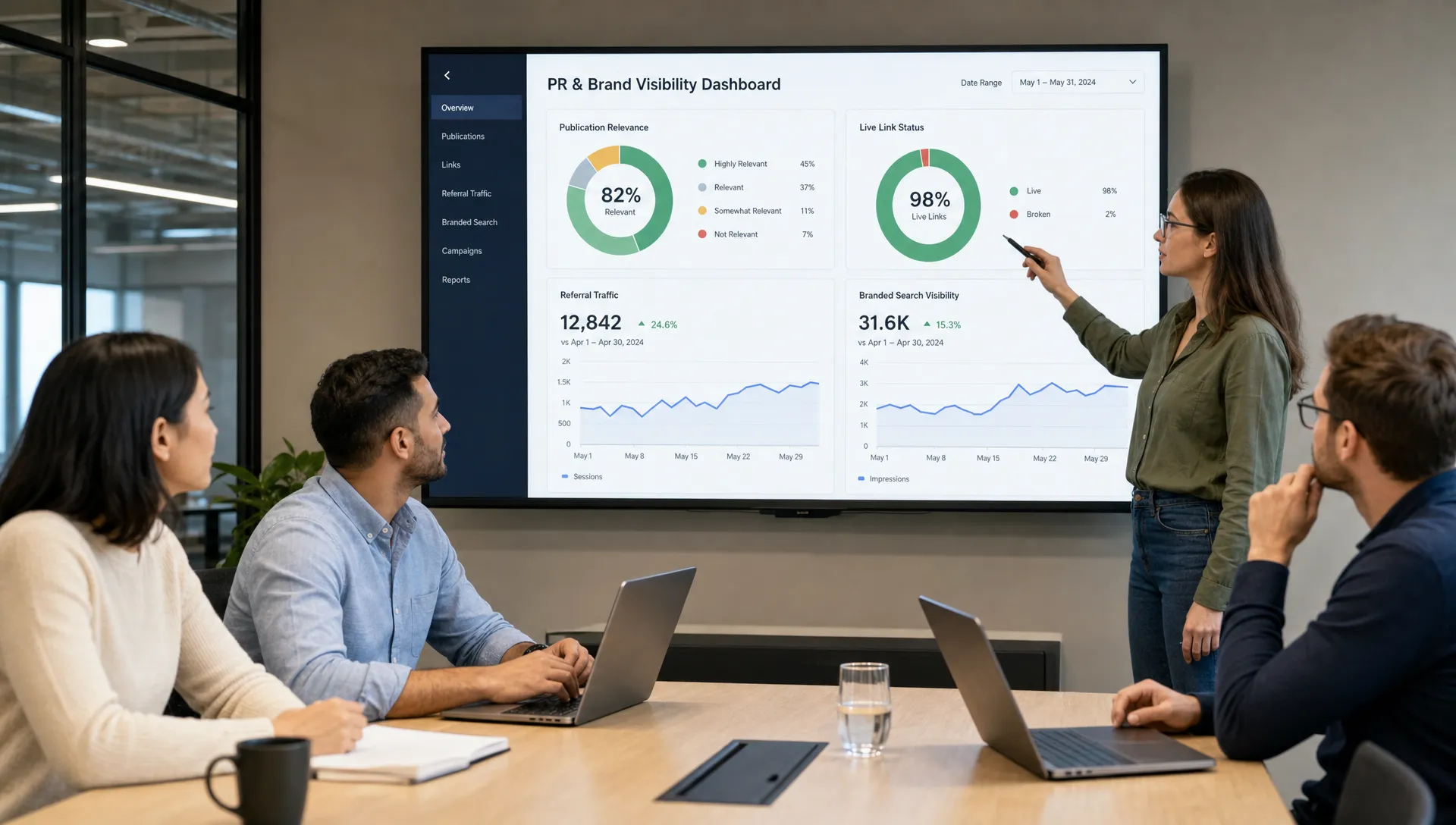
A strong report should include live URLs, publication names, dates, anchor text, destination URLs and any available notes about link attributes. For PR-style campaigns, it should also make it easy to confirm which outlets picked up the release and where the live links appear.
SEO proof reports are not just administrative paperwork. They help your team evaluate whether the campaign matched the brief, support internal reporting and build a historical record of brand mentions. They also make it easier to compare one vendor against another over time.
| Reporting item | Why it matters | Green flag |
|---|---|---|
| Live URLs | Confirms that placements exist | Each URL is accessible without special login |
| Publication names | Helps assess quality and relevance | Outlets match the agreed market or industry |
| Anchor and destination | Shows how your brand was linked | Anchor text appears natural in context |
| Publication date | Supports campaign tracking | Dates align with the promised timeline |
| Link attribute notes | Clarifies SEO expectations | Provider is transparent about nofollow, sponsored or other attributes |
| Proof summary | Makes stakeholder reporting easier | Report is organized and easy to audit |
If the vendor only sends a spreadsheet with domain metrics and no live proof, keep looking.
Watch for Risk Signals
Some link building services can create more risk than value. Google’s public spam policies have long warned against links intended to manipulate rankings, especially when they involve schemes, automated placement or unnatural anchor patterns. You do not need to avoid every paid service, but you do need to avoid services that leave obvious footprints.
Be cautious if you see these signs:
- Very large backlink counts for unusually low prices
- Guaranteed rankings for competitive keywords
- Heavy use of exact-match commercial anchor text
- No sample placements or no willingness to show previous work
- Sites with thin content, unrelated categories and obvious paid-post footprints
- Private blog networks presented as “exclusive publisher relationships”
- No editorial review, no proof report and no clear replacement policy
Risk is not only about penalties. Low-quality links can also waste crawl attention, dilute brand perception and make your company look less credible when prospects research you.
Ask Better Vendor Questions
A sales call should give you more than a package menu. Use it to understand the provider’s process, quality control and fit for your business.
Ask these questions before signing:
- Which industries do you serve most often?
- How do you decide whether a publication is relevant?
- Can I see examples of live placements and proof reports?
- Do you write the content, edit our content or distribute what we provide?
- Is editorial review included?
- What types of anchors do you recommend for our campaign?
- What is the realistic timeline from kickoff to live links?
- What happens if a link is removed or an outlet does not publish?
- Are packages tailored by industry, geography or campaign goal?
The answers should be specific. If every question leads back to “we have high-authority sites,” the provider may be selling inventory rather than strategy.
Match the Service to Your Funnel Stage
A link building service that is perfect for one company may be wrong for another. The right choice depends on where your brand is in the market.
Early-stage companies often need credibility and discoverability. A PR-led placement strategy can help establish a broader footprint when there is a legitimate launch, partnership, product update or milestone to share.
Growth-stage companies may need topical authority around specific service pages or product categories. They usually benefit from a mix of digital PR, relevant editorial placements and content that supports existing SEO clusters.
Established brands may need reputation reinforcement, market expansion or AI visibility. For them, consistency across trusted publications and accurate brand messaging can be just as important as acquiring new referring domains.
Agencies have a different set of concerns. They need repeatable delivery, clear reporting, industry-specific packages and pricing that can support client margins. If you are buying on behalf of clients, prioritize proof, turnaround and communication as much as publication quality.
Where MediaBoost Fits in a 2026 Link Building Strategy
MediaBoost is best understood as a PR-led link building and media placement option for brands that want guaranteed visibility across trusted publications. Its services are built around distribution to 500+ media outlets, guaranteed live backlinks, editorial review, done-for-you submissions and proof reports.
This type of service can be a strong fit when you have something legitimate to announce or position, such as a company launch, executive appointment, product release, funding update, partnership, market expansion or industry insight. It can also help brands build social proof by appearing across recognizable publication networks and creating a clearer online footprint for search engines and AI systems.
It is not a replacement for every SEO activity. You still need a technically sound website, useful content, clear service pages and a realistic keyword strategy. But when those foundations are in place, media placements can add credibility signals that are difficult to create through on-site content alone.
A Simple Decision Framework
Use this framework when comparing link building services side by side.
| Decision factor | Strong provider | Weak provider |
|---|---|---|
| Strategy | Starts with your goals, audience and industry | Starts with a generic link package |
| Relevance | Explains publication and topic fit | Talks only about domain metrics |
| Content | Uses editorial review and natural brand context | Publishes thin, generic or awkward content |
| Guarantees | Guarantees clear deliverables and proof | Guarantees rankings or vague authority gains |
| Reporting | Provides live URLs and organized proof | Sends limited data with little verification |
| Risk control | Uses natural anchors and avoids obvious schemes | Pushes exact-match anchors and bulk links |
| Timeline | Sets realistic expectations | Promises instant SEO impact |
The best choice is usually the provider with the clearest process, not the loudest promise. If a service can explain how it selects placements, how it reviews content and how it proves delivery, you are in a stronger position to judge value.
Frequently Asked Questions
Are link building services still worth it in 2026? Yes, if they focus on relevant, credible placements and transparent reporting. Low-quality bulk links are less useful and can create reputational or SEO risk.
What should a link building service guarantee? A responsible service can guarantee deliverables such as live placements, publication categories, turnaround time and proof reports. Be cautious with any provider that guarantees specific rankings or traffic increases.
How many backlinks do I need? There is no universal number. A local business in a low-competition niche may need far fewer quality links than a national brand competing in software, finance or ecommerce. Relevance and authority matter more than volume.
Are press releases good for link building? Press releases can support link building when they are newsworthy, professionally written and distributed through credible outlets. They become risky when used only to force keyword-rich links into low-value syndicated content.
What is a safe anchor text strategy? Safe anchor strategies usually emphasize branded anchors, natural phrases and URLs. Exact-match commercial anchors should be used carefully and only where they genuinely fit the content.
How quickly should I expect results? Some services can deliver live links quickly, especially through media distribution, but SEO impact usually takes longer. Expect to measure delivery first, then track authority, visibility and traffic trends over time.
Choose a Link Building Partner You Can Verify
The best link building services in 2026 combine relevance, editorial quality, transparent guarantees and proof you can audit. They do not ask you to trust a black box. They show you where your brand appeared, how it was positioned and why those placements support your larger visibility goals.
If you want a PR-led approach with guaranteed live backlinks, editorial review, done-for-you submissions and proof reports, MediaBoost can help you build authority across trusted publications while keeping delivery clear and measurable.