Press Release Link Building: Smart SEO or Risky Tactic?
Press release link building is not automatically spam and it is not a magic ranking shortcut. This guide explains when it supports SEO, where it creates risk and how to use media distribution without chasing manipulative links.
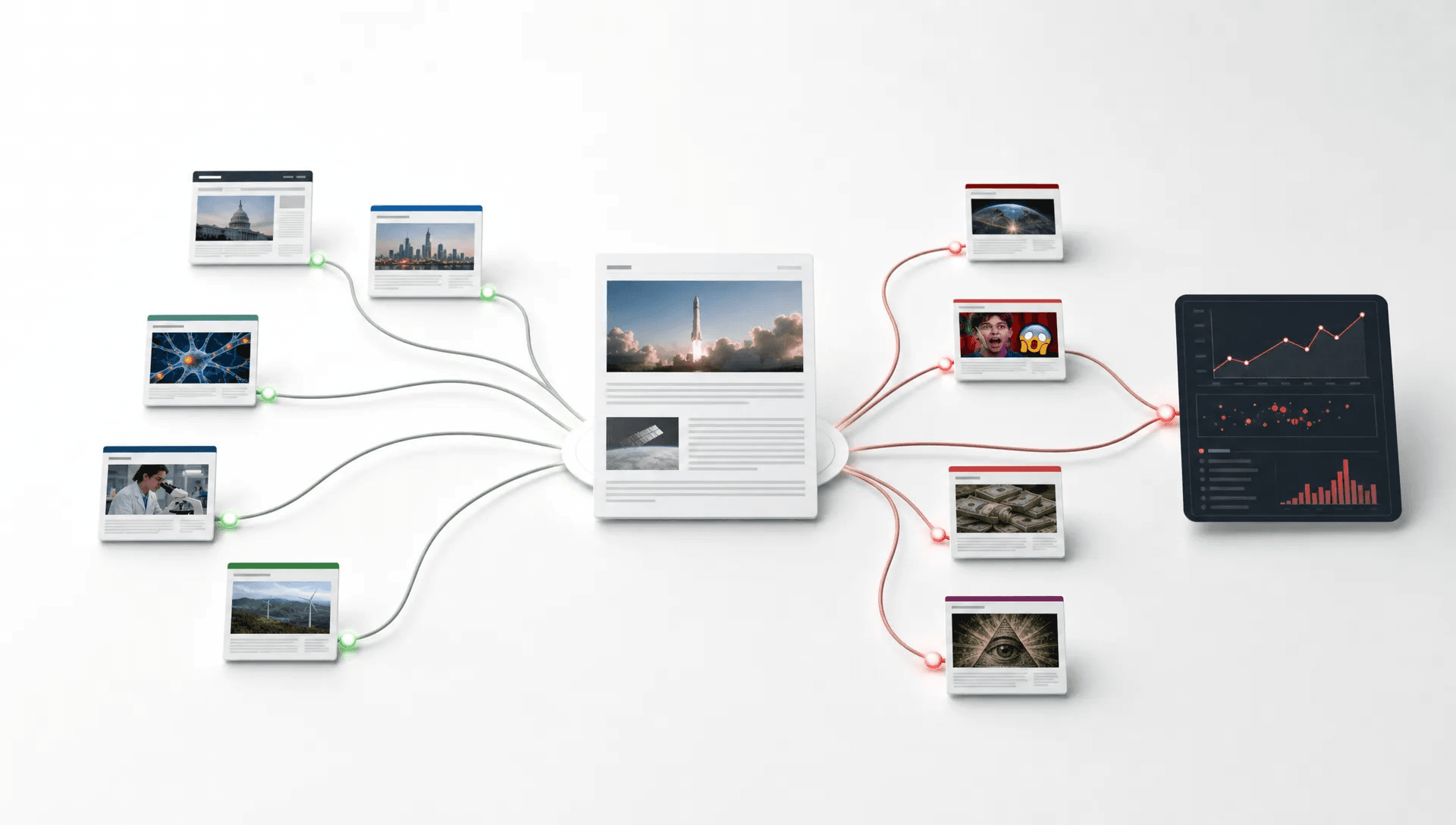
Get featured on 500+ media outlets
Guaranteed placement, no PR experience needed.
Press release link building sits in an uncomfortable place for many SEO teams. On one side, a well-distributed announcement can earn indexed coverage, branded mentions, referral traffic and links from recognizable publications. On the other, mass-syndicated releases have been abused for years as a shortcut to manipulate rankings.
So is press release link building smart SEO or a risky tactic? The honest answer is that it depends on the intent, execution and expectations behind the campaign.
If the goal is to manufacture ranking signals with keyword-stuffed anchors across hundreds of syndicated pages, the risk is real. If the goal is to publish legitimate company news, support branded search, create credible proof points and make your business easier to discover across search and AI answer engines, press releases can still play a useful role in 2026.
What press release link building really means
Press release link building is the practice of using press release distribution to generate live links from media outlets, news syndication networks or industry publications. A brand publishes an announcement, distributes it through a network and receives placements where the release appears with one or more links back to a company page.
That sounds simple, but the SEO value is often misunderstood. Many press release placements are syndicated, meaning the same or similar content appears across multiple outlets. Many links may be nofollow, sponsored, redirected or attached to pages that do not pass meaningful PageRank. That does not make them useless, but it does mean they should not be treated the same as an editorial backlink earned from a journalist who independently covered your company.
The value of press release links is usually indirect. They can help search engines discover new brand information, strengthen branded search results, provide third-party validation, support entity recognition and create assets your sales or investor relations team can reference. They can also lead to secondary coverage if the announcement is genuinely newsworthy.
For a broader breakdown of this distinction, MediaBoost has a separate guide on whether press releases help SEO, including why the strongest value is often visibility and credibility rather than raw link equity.
Why press release link building became controversial
The controversy comes from how press releases were used in older SEO playbooks. Brands and agencies would publish thin announcements with exact-match anchor text such as best accounting software, luxury real estate agent or buy crypto wallet. The same anchor would then appear across dozens or hundreds of syndicated pages.
That pattern is easy to spot. It is not a natural editorial endorsement. It is a distributed link footprint.
Google's link spam policies make the risk clear: links intended to manipulate search rankings can be treated as spam. Google has also historically called out optimized anchor text in distributed articles or press releases as a problematic link pattern.
This does not mean every press release link is dangerous. It means press releases should not be used as a disguised paid link scheme. The difference between smart and risky is usually visible in the release itself: the news value, anchor text, destination page, outlet relevance and frequency of distribution.
Smart SEO vs risky tactic: the practical difference
A safe press release strategy starts with communication value, then lets SEO benefits follow. A risky strategy starts with ranking manipulation, then tries to hide it inside a press release.
| Factor | Smart use | Risky use |
|---|---|---|
| Primary goal | Announce real news and build credibility | Manufacture backlinks at scale |
| News value | Launch, funding, partnership, report, award or executive milestone | Generic promotional copy with no clear update |
| Anchor text | Brand name, URL-style wording or natural descriptive text | Repeated exact-match commercial keywords |
| Link destination | Homepage, press room, report, product update or relevant resource | Thin money page created only to capture link equity |
| Distribution quality | Relevant outlets, editorial review and placement proof | Low-quality syndication with no transparency |
| Measurement | Indexed coverage, branded search lift, referral traffic and secondary pickup | Counting links only, regardless of quality or context |
The table shows why the tactic cannot be judged in isolation. The same distribution method can be useful or risky depending on whether the release is a legitimate news asset or a link building disguise.
When press release link building is smart
Press release link building is most defensible when a company has something real to announce. Search engines and readers both respond better to specificity. A new funding round, market expansion, product release, acquisition, research report, certification, major partnership or event announcement gives the distribution a reason to exist.
It is also useful when you want more control over branded search results. A new company, product or executive may have a thin search footprint. Indexed media placements can help fill that gap with consistent descriptions, publication dates and third-party sources. This matters for buyers who search your brand before booking a demo, journalists checking credibility and investors looking for signals outside your own website.
Press releases can also support entity SEO. Search engines need to understand who a brand is, what it does, which topics it belongs to and which sources mention it. Consistent coverage across trusted publications can reinforce those connections, especially when the release uses clear brand language rather than vague marketing claims.
The smartest teams also use the release as a distribution layer for a stronger owned asset. For example, instead of linking to a generic service page, they publish a data report, case study, landing page or press kit on their site. The press release announces the news, while the owned asset gives readers and search engines deeper context.
Where it becomes risky
Press release link building becomes risky when links are the only reason the announcement exists. If there is no real news, the copy tends to become padded, repetitive and over-optimized. That is exactly the kind of footprint search engines are built to ignore or discount.
Risk also rises when every release uses the same commercial anchor text. A brand name anchor is normal. A descriptive anchor such as the company report on retail payments can make sense if it points to an actual report. But repeating a keyword like best payroll software across hundreds of placements is not subtle.
Frequency can create another warning sign. A company that publishes one or two meaningful releases per quarter looks different from a company pushing weekly pseudo-announcements with nearly identical wording. Distribution volume does not compensate for weak news value.
Finally, the promise matters. Any provider that frames press release syndication as a guaranteed ranking boost is overselling the tactic. Guaranteed live placements, publication proof and reporting can be legitimate service features. Guaranteed Google ranking gains from syndicated links are a different claim.
If you are planning a campaign, it is worth reviewing common press release distribution mistakes that waste budget, especially the mistake of chasing reach without relevance.
A safer framework for using press releases in SEO
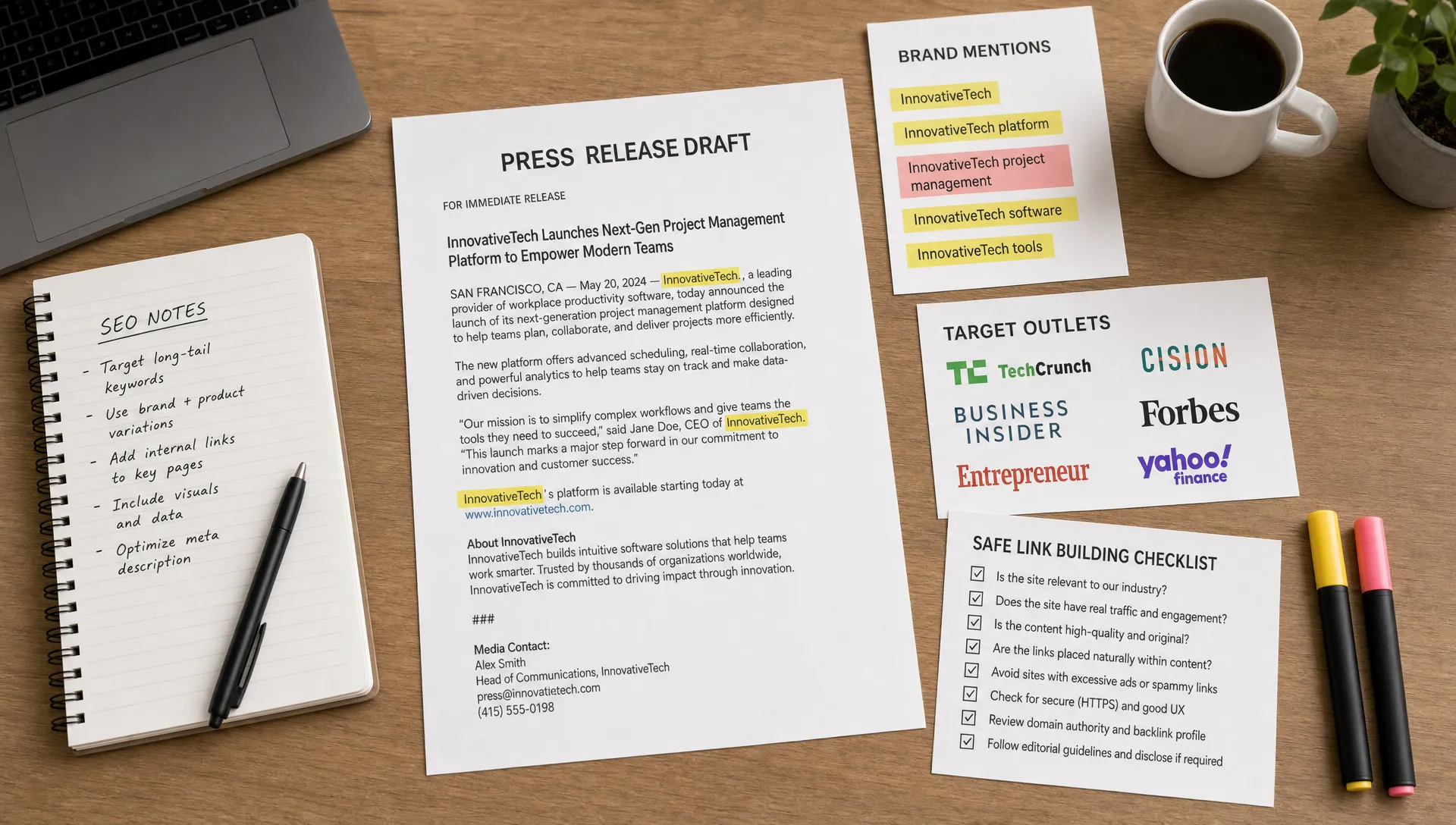
A safe approach does not remove links from press releases. It makes the links proportionate, useful and clearly tied to the announcement.
- Start with a real announcement: Before choosing outlets or anchors, define the news. If you cannot explain why the announcement matters to customers, investors, partners or your industry, it is not ready for distribution.
- Use one primary destination link: Link to the most relevant page for the news, such as a launch page, report, press room, event page or company homepage. Avoid adding several links just because you can.
- Keep anchor text natural: Use your brand name, the name of the report or a plain descriptive phrase. Do not force exact-match commercial keywords into the copy.
- Write for readers first: The release should answer who, what, when, where, why and why it matters. Strong quotes, clear facts and concise context are more valuable than inflated promotional language.
- Choose quality controls over raw volume: Distribution is more useful when it includes editorial review, relevant categories, live link proof and transparent reporting.
- Build an owned follow-up asset: A press release should not carry the entire SEO burden. Support it with a blog post, resource page, report or newsroom entry that can rank and convert on your own domain.
- Measure more than backlinks: Track referral traffic, indexed placements, branded search impressions, assisted conversions, journalist pickup and sales team usage.
This framework keeps the release inside a legitimate PR strategy. It still supports SEO, but it does not depend on manipulating link equity from syndicated pages.
How press release links fit into AI search in 2026
AI search has changed the way brands think about visibility. Buyers may ask tools for vendor recommendations, company summaries or market comparisons before they ever click a traditional result. That raises a new question: can press release distribution help a brand appear more consistently in AI-generated answers?
There is no guaranteed formula. AI systems vary in how they retrieve, summarize and cite information. Still, a broader and more consistent public footprint can help reduce ambiguity around your brand. When reputable pages describe your company in clear terms, mention your category and connect your name to specific products or milestones, that information may become easier for search and AI systems to interpret.
This is not a reason to publish low-quality releases at scale. AI visibility depends on clarity, consistency and source quality. A concise release about a real product launch is more useful than ten vague releases saying the company is excited to announce continued innovation.
For companies looking beyond PR into AI readiness, automation and operational adoption, teams that provide custom web and AI solutions can help connect external visibility work with the internal systems needed to use AI well.
How to evaluate a press release link building provider
Not all distribution services are equal. Some focus on transparent media placement and reporting. Others sell inflated outlet counts with little regard for quality, relevance or compliance.
Use the following criteria before choosing a provider.
| Evaluation point | Good sign | Warning sign |
|---|---|---|
| Placement transparency | Clear examples of outlets and proof reports | Vague claims with no sample reporting |
| Editorial process | Review for formatting, clarity and compliance | Anything submitted without quality control |
| Link policy | Natural anchors and realistic expectations | Promises of ranking gains from dofollow links |
| Industry relevance | Packages or targeting by sector | One generic blast for every company |
| Turnaround | Fast delivery with review included | Speed that sacrifices accuracy or approval |
| Reporting | Live links, publication status and SEO proof | A spreadsheet of unverified URLs only |
A provider can guarantee distribution mechanics, such as submission, live links or reports, without promising ranking outcomes. That is the line you want to preserve.
What to measure after distribution
A press release campaign should be judged like a visibility campaign, not just a backlink count. Some of the best outcomes will show up in branded demand, sales enablement and trust signals rather than immediate keyword movement.
| Metric | Why it matters | Where to check |
|---|---|---|
| Indexed placements | Confirms coverage can be discovered in search | Google search operators and provider reports |
| Branded search impressions | Shows whether more people are searching your name | Google Search Console |
| Referral traffic | Reveals whether placements send qualified visitors | GA4 or analytics platform |
| Secondary coverage | Indicates journalists or blogs picked up the story independently | Media monitoring and manual search |
| Anchor profile | Helps confirm links look natural | SEO tools and proof reports |
| Sales usage | Shows whether the coverage helps buyers trust the brand | CRM notes, sales calls and proposal assets |
Do not expect every release to move rankings by itself. A release about a minor update may mostly support credibility. A release tied to original research may earn citations and secondary links for months. The stronger the underlying asset, the more measurable the SEO upside becomes.
Best practices for anchor text and links
Anchor text is where many press release campaigns go wrong. The safest rule is simple: if the anchor would look strange to a reader, it probably looks strange to a search engine.
Brand anchors are usually the safest option. A link on the company name makes sense because the release is about the company. Report names, product names and event names can also work when they are the subject of the announcement.
Commercial keyword anchors should be used rarely, if at all. A press release is not the place to force phrases like cheapest CRM platform or best link building agency. Those anchors make the distribution look like an SEO tactic rather than a news announcement.
The number of links also matters. One useful link is often better than three weak ones. If you need more than one, each should have a clear reader purpose. For example, one link might point to the main announcement page and another to a downloadable research report. If a link exists only to push PageRank, remove it.
So, is press release link building worth it?
Yes, press release link building can be worth it when it is part of a broader PR and SEO strategy. It is not a replacement for content, technical SEO, digital PR, partnerships or editorial outreach. It is a credibility and distribution layer that can support all of those efforts.
The best use cases are announcements that deserve a public record. Product launches, funding news, research reports, partnerships, events and market expansions can all benefit from structured distribution. These campaigns help create a discoverable footprint, give prospects third-party validation and support branded search.
The risky version is different. It treats press releases as a loophole for mass backlink creation. It uses thin content, exact-match anchors and inflated promises. That approach may produce a large report full of links, but it is unlikely to create durable SEO value.
The smart question is not whether press release link building works in the abstract. The better question is whether your announcement deserves coverage, whether the links help readers and whether the campaign would still make business sense if Google ignored every syndicated link.
If the answer is yes, you are using press releases the right way.
Frequently Asked Questions
Is press release link building against Google guidelines? No, publishing press releases is not against Google guidelines. The risk comes from using press releases to manipulate rankings with paid or syndicated links, especially through exact-match anchor text and low-quality distribution.
Do press release backlinks pass SEO value? Some may pass limited value, but many are nofollow, sponsored or heavily syndicated. The more reliable value is usually indirect: branded visibility, indexed coverage, referral traffic, entity signals and potential secondary pickup.
How many links should a press release include? One primary link is often enough. If you include more, each link should serve a clear reader purpose and point to a genuinely relevant page.
What anchor text should I use in a press release? Use brand names, product names, report titles or natural descriptive phrases. Avoid repeated exact-match commercial keywords because they create a manipulative footprint.
Can press releases help with AI search visibility? They can support AI visibility indirectly by creating consistent, public information about your brand across trusted sources. They do not guarantee inclusion in AI answers, but they can strengthen your overall digital footprint.
Build press release links without treating them like a shortcut
Press release link building works best when the release is real news, the links are natural and the reporting is transparent. MediaBoost helps brands distribute announcements across 500+ media outlets with done-for-you submissions, editorial review, guaranteed live links and proof reports, often with a 48 hour turnaround.
If you want media placements that support credibility, SEO and AI visibility without relying on manipulative tactics, explore MediaBoost press release distribution.