How to Find Your Competitors’ Best Backlinks
Competitor backlink research should reveal more than a list of referring domains. This guide shows how to spot the links worth pursuing, filter out noise and turn proven competitor placements into a practical acquisition plan.
Get featured on 500+ media outlets
Guaranteed placement, no PR experience needed.
Finding competitor backlinks is easy. Finding the ones that actually explain why a competitor ranks, earns trust or gets mentioned by AI search systems takes more judgment.
Most backlink tools can export thousands of referring domains in minutes. The problem is that many of those links are old, irrelevant, syndicated, paid-looking, spammy or impossible to replicate. If your goal is to find backlinks of competitors, the useful question is not “who links to them?” It is “which links are helping them, and what would it take for us to earn something similar?”
This guide walks through a practical process for identifying your competitors’ best backlinks, scoring them and turning the research into a safer link acquisition plan.
What counts as a “best” competitor backlink?
A competitor’s best backlink is not always the link with the highest domain authority score. Third-party authority metrics are helpful, but they are estimates. A backlink becomes valuable when it combines relevance, editorial context, visibility and reasonable acquisition potential.
A strong competitor backlink usually has several of these traits:
- It comes from a site that is topically relevant to the competitor’s industry or audience.
- It appears in editorial content, not a random footer, profile page or low-quality directory.
- It points to a page that matters, such as a product page, guide, study, comparison page or press announcement.
- It uses natural anchor text rather than repetitive exact-match keywords.
- It sits on a page that may receive search traffic, referral traffic or brand visibility.
- It looks earned, cited or editorially reviewed rather than automatically generated.
The best backlinks are also explainable. If you cannot tell why the linking site mentioned your competitor, the link is hard to replicate. If the reason is clear, such as a journalist quote, original data, customer story, local sponsorship, podcast appearance or expert guide, you can build a strategy around it.
Start with the right competitors
Many teams make backlink research harder by choosing the wrong competitors. Your business competitors are not always your SEO competitors. A company might compete with you for customers but not rank for the same keywords. Another site might never sell the same product as you but outrank you for every informational query that matters.
Build a short list using three competitor types.
First, identify direct business competitors. These are brands your sales team, customers or market research already names. Their backlink profiles show how similar companies build authority in your niche.
Second, identify search competitors. Search your priority keywords and collect the domains that consistently appear in the top results. These may include publishers, review sites, marketplaces, blogs, directories and niche media outlets.
Third, identify page-level competitors. A competitor may not outrank your whole site, but one of their guides, landing pages or reports may dominate a high-value topic. Page-level backlink analysis is often more useful than domain-level analysis because it shows which assets attract links.
For example, if you were analyzing a local healthcare niche, you would not only compare dental clinics against other clinics. You might also review local news sites, suburb guides, health directories and service-specific pages. A site positioned around a cosmetic dentist in Gold Coast search, for instance, would be compared against both local practice websites and broader pages ranking for cosmetic dentistry queries in the same market.
That distinction matters. Domain competitors help you understand market authority. Page competitors help you understand linkable content.
Pull backlink data from more than one source when possible
No backlink database is complete. Ahrefs, Semrush, Moz, Majestic and similar platforms crawl the web differently, refresh indexes at different speeds and classify links in different ways. If the campaign matters, compare exports from at least two tools. If you only have access to one tool, you can still get useful insight, but treat the data as directional rather than perfect.
For each competitor, export referring domains and backlinks. Referring domains matter because 100 links from one weak site rarely carry the same value as 10 links from 10 relevant publications. Backlinks matter because the exact page, placement and anchor text reveal why the link exists.
Capture these fields in your spreadsheet:
| Field | Why it matters |
|---|---|
| Referring domain | Shows who is linking to the competitor |
| Linking page URL | Reveals the specific context of the link |
| Target page URL | Shows which competitor asset attracted the link |
| Anchor text | Helps you understand how the competitor is being referenced |
| Link attribute | Separates followed, nofollow, sponsored and UGC links |
| First seen date | Helps identify recent campaigns or evergreen assets |
| Estimated traffic | Suggests whether the linking page has visibility |
| Topical relevance | Helps separate useful links from irrelevant noise |
| Placement type | Classifies the link as PR, resource, directory, guest post, partner page or another format |
Before building new links, it also helps to understand your own baseline. MediaBoost’s guide to auditing your own backlink profile before you build new links explains what to check in Ahrefs so you do not chase competitor links without knowing your current strengths and risks.
Separate domain-level signals from page-level signals
A competitor’s domain-level backlink profile tells you how established the brand is. A competitor’s page-level backlink profile tells you why a specific URL ranks or earns attention.
Use domain-level analysis to answer broad questions. Which publications mention several competitors? Which industry associations, directories, podcasts or partner ecosystems appear often? Are your competitors relying on digital PR, affiliate partnerships, guest content, local citations or niche communities?
Use page-level analysis to answer tactical questions. Which guides earned links? Which studies were cited? Which product pages picked up mentions? Which press releases were syndicated? Which comparison pages attracted links from review sites or buying guides?
If one competitor ranks with a weak page but a strong domain, you may need broader authority building. If another competitor ranks because one specific asset earned links from relevant publications, you may be able to compete by creating a better asset and promoting it well.
Filter out low-value and risky links
A large export will include links that are not worth pursuing. Some may be harmless but irrelevant. Others may signal tactics you should avoid.
Remove or de-prioritize links that fall into these patterns:
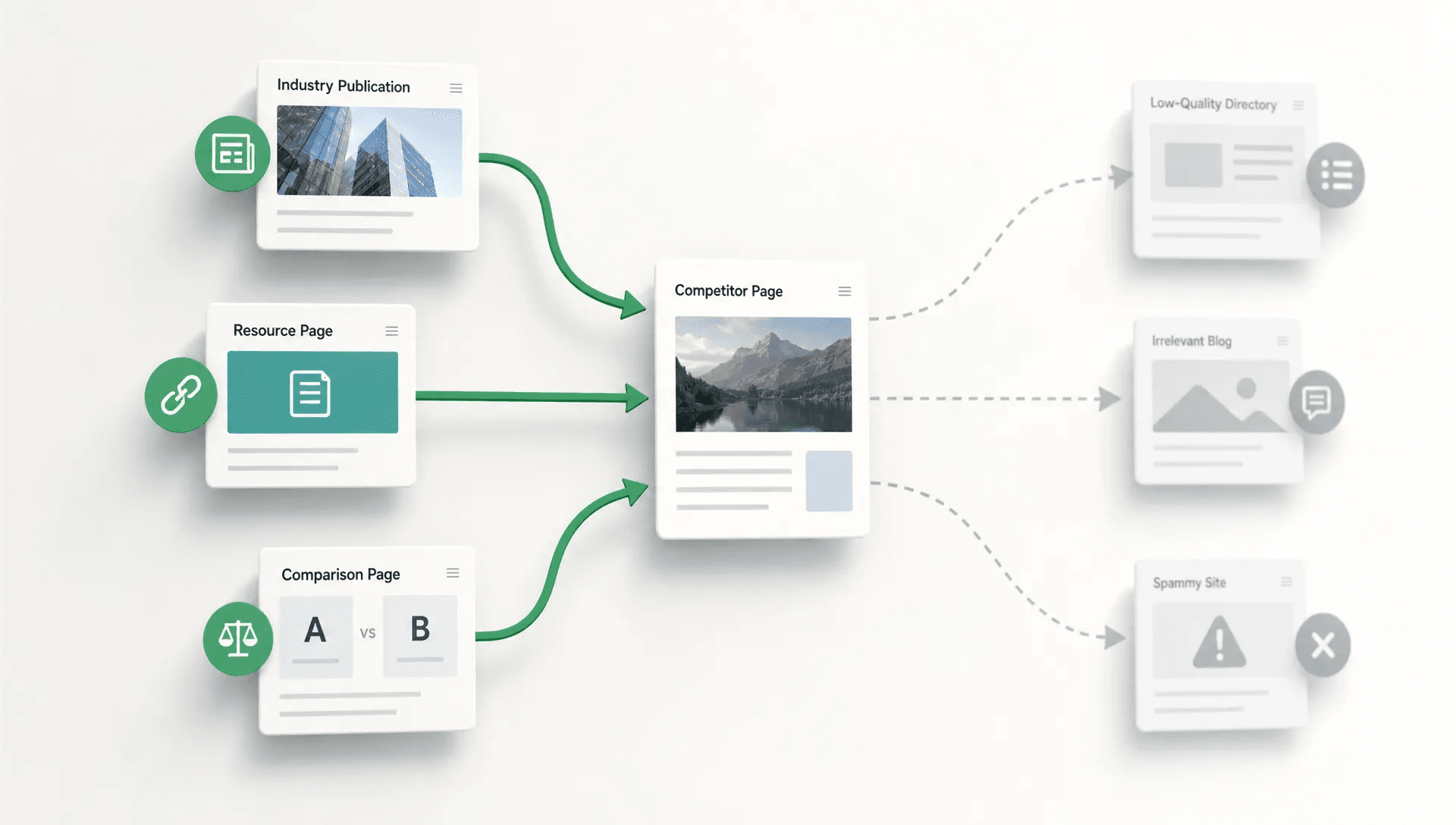
- Scraper pages that copy content without editorial value.
- Auto-generated directories with thin pages and no real audience.
- Sitewide footer or sidebar links unrelated to the content.
- Comment spam, forum profile links or mass-created user pages.
- Irrelevant foreign-language sites with no connection to the brand or market.
- Pages with obvious paid link footprints or unnatural anchor patterns.
This is not about being overly cautious. It is about focusing effort where it can create compounding value. Google’s spam policies for web search specifically warn against link practices intended to manipulate rankings. Competitor research should help you find legitimate opportunities, not copy shortcuts that could create long-term risk.

Look for patterns across multiple competitors
One competitor backlink can be an accident. A pattern across several competitors is a clue.
Sort your spreadsheet by referring domain and look for sites that link to two or more competitors. These are often the most practical opportunities because the publication, directory or resource page already covers your category. If they mention competitors but not you, the gap may be fixable with a stronger pitch, better asset or updated brand information.
Then sort by target page type. You might discover that competitors earn links to salary reports, statistics pages, local guides, funding announcements, product comparisons, free tools or original research. These patterns tell you what your market naturally cites.
Also review anchor text patterns. Natural anchors often include brand names, page titles, quoted phrases or descriptive references. If many valuable links use phrases like “annual report,” “industry benchmark,” “expert commentary” or “local guide,” that tells you what the linking sites found useful.
Classify the best competitor backlinks by acquisition type
Once you remove noise, group the remaining links by how they were likely earned. This turns a spreadsheet into a campaign plan.
Common high-value competitor backlink types include:
- Digital PR links: Mentions in news articles, trade publications, market commentary, founder stories or data-led reports.
- Resource page links: Inclusion in curated lists, educational resources, local guides or professional toolkits.
- Review and comparison links: Mentions on buyer guides, “best of” pages, software comparison articles or niche recommendation sites.
- Partner and customer links: Links from integrations, suppliers, clients, case studies or ecosystem pages.
- Podcast and interview links: Show notes, expert roundups and media profiles that cite the brand or founder.
- Local and industry citations: Chamber of commerce pages, niche directories, professional associations and regional publications.
Do not assume every link type is equally useful for your business. A SaaS company may get more value from comparison pages and integration partners. A medical, legal or finance brand may need stronger editorial credibility and stricter relevance. A local service business may benefit from local press, professional associations and city-specific resources.
If a competitor’s strongest links come from media mentions, read MediaBoost’s guide on earning backlinks through digital PR before you start pitching. The goal is not to ask journalists for links. It is to give them something credible enough to reference.
Reverse engineer why the link was earned
This is the most important step. Open the linking page and read the surrounding content. The link’s value is in the reason it exists.
Ask these questions for each promising backlink:
- Was the competitor cited as a source, example or expert?
- Did the link point to original data, a tool, a quote, a press release or a product page?
- Was the article timely, such as a funding announcement, launch or industry trend?
- Did the competitor provide a unique angle the publication could not easily find elsewhere?
- Is the linking site likely to update the article or publish similar pieces again?
A competitor backlink from a journalist article may have come from a press pitch, an expert quote platform, an original survey or a prior relationship. A resource page link may have been earned because the competitor had a genuinely useful guide. A comparison page mention may be tied to affiliate partnerships, brand demand or strong category positioning.
When you know the likely reason, you can choose the right response. Sometimes the answer is outreach. Sometimes it is creating a better asset. Sometimes it is a press release. Sometimes it is building a page that deserves to be cited.
Score backlink opportunities before outreach
Not every competitor backlink deserves your time. Create a simple scoring model so your team can prioritize consistently.
| Scoring factor | What to look for | Score guide |
|---|---|---|
| Relevance | The linking site and page match your audience, niche or location | 1 means weak fit, 5 means highly relevant |
| Authority | The site has real editorial standards, reputation or industry trust | 1 means low trust, 5 means strong trust |
| Visibility | The linking page appears likely to receive search or referral traffic | 1 means hidden page, 5 means visible page |
| Link context | The link appears naturally in useful content | 1 means boilerplate, 5 means strong editorial context |
| Replicability | You can reasonably earn a similar mention with the right asset or pitch | 1 means unlikely, 5 means realistic |
| Risk | The opportunity appears compliant, transparent and brand-safe | 1 means risky, 5 means low-risk |
Prioritize links with strong relevance, strong context and realistic replicability. A highly authoritative link that you cannot influence may be worth noting, but it should not dominate your action plan. A moderately authoritative niche publication that regularly covers your topic may be more valuable because you can actually earn coverage there.
Turn competitor backlinks into a link acquisition plan
Competitor backlink research is only useful if it changes what you do next. After scoring, organize your opportunities into a 30 to 90 day plan.
Start with quick credibility gaps. These include legitimate directories, association pages, partner listings and local citations where competitors are listed and your brand is missing. These are not always the most powerful links, but they help establish completeness and trust.
Next, identify content gaps. If competitors earn links to statistics pages, calculators, templates, research reports or guides, decide whether you can create a stronger version. Stronger does not always mean longer. It may mean fresher data, clearer visuals, expert commentary or a more useful format.
Then build media opportunities. If competitors are repeatedly featured in industry outlets, map those publications to relevant announcements, data stories, executive commentary or market insights. This is where press release distribution and digital PR can turn backlink research into broader visibility.
For brands that want predictable media exposure, MediaBoost provides press release distribution and media placement services across 500+ trusted publications, with done-for-you submissions, editorial review, live links and proof reports. That kind of distribution works best when it is guided by competitor research, not used as a generic blast.
Finally, track outcomes. Record which opportunities you pursued, which pitches earned responses, which placements went live and which pages gained visibility over time. Backlink strategy improves when every campaign feeds the next one.
Common mistakes when analyzing competitor backlinks
One common mistake is copying competitors too literally. If a competitor has a questionable link, that does not make it safe. If they have a strong link from a publication, that does not mean you should pitch the same publication with a thin copy of their angle.
Another mistake is focusing only on domain authority. A lower-authority niche site with the right audience can be more valuable than a broad, high-score site with no topical connection. Search engines, buyers and AI systems all rely on contextual signals. Relevance matters.
A third mistake is ignoring nofollow links. Nofollow links may not pass ranking signals in the same way as followed links, but they can still create referral traffic, brand exposure and secondary links. A nofollow mention in a respected publication can lead to followed links from blogs, newsletters or industry resources that cite the original story.
Finally, many teams stop after the export. The spreadsheet is not the strategy. The strategy comes from interpreting why the links exist and deciding what your brand can credibly earn.
For a broader view of why backlink quality matters beyond traditional rankings, see MediaBoost’s article on how quality backlinks affect brand visibility in AI search. Competitor link research is increasingly about being discoverable in more places than the classic search results page.
Frequently Asked Questions
What is the best tool to find competitor backlinks? Ahrefs, Semrush, Moz, Majestic and similar tools can all help. The best option depends on your budget, workflow and market. For important campaigns, compare data from more than one tool because no backlink index is complete.
How do I know if a competitor backlink is worth pursuing? Look at relevance, editorial context, visibility, link placement, risk and replicability. A link is worth pursuing when it comes from a credible site, appears in a natural context and has a clear reason you can match or improve on.
Should I copy every backlink my competitor has? No. Competitor backlink research should reveal opportunities, not give you a list to copy blindly. Skip spammy, irrelevant or manipulative links and focus on placements that make sense for your brand.
How often should I check competitor backlinks? For most growing brands, a quarterly review is enough. If you operate in a highly competitive niche or run active PR campaigns, monthly checks can help you spot new media placements, content assets and outreach opportunities faster.
Can press releases help me earn competitor-style backlinks? Yes, when the release is newsworthy and distributed to relevant outlets. Press releases work best when tied to a real announcement, useful data, market insight or brand milestone, then supported with proof reports and follow-up promotion.
Build better links from competitor insight
The point of competitor backlink analysis is not to chase every link your rivals have. It is to understand what your market rewards, which publications shape trust and what assets deserve attention.
Use backlink tools to collect the data, but use judgment to choose the opportunities. Prioritize relevant editorial placements, build assets that answer real market questions and turn competitor patterns into campaigns your brand can own.
If you want help turning a press-worthy angle into live media placements, MediaBoost can support your next campaign with industry-specific distribution, editorial review, guaranteed live links and proof reports, often within 48 hours.