How to Pick a PR Company That Can Actually Deliver
Not every PR company sells the same outcome. Learn how to verify deliverables, spot red flags, compare proposals, and choose a partner that turns announcements into credible media visibility.
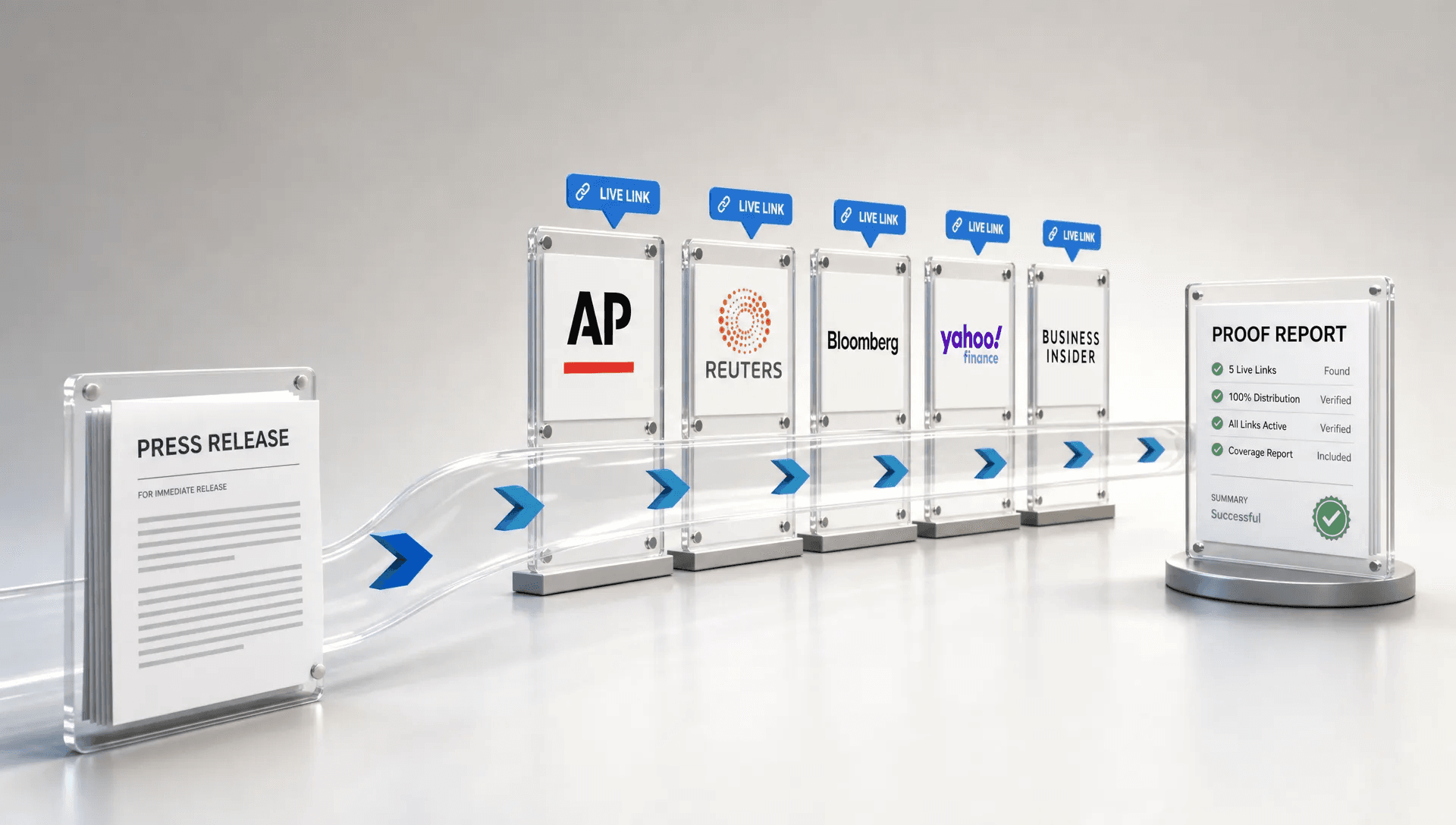
Get featured on 500+ media outlets
Guaranteed placement, no PR experience needed.
A good PR company can turn a real announcement into credibility, visibility, search presence, and momentum. A weak one can turn the same announcement into a vague invoice, a few vanity screenshots, and a month of waiting for results that never become clear.
The difference is not always obvious from a polished website. Most providers use similar language: media relationships, guaranteed reach, premium outlets, thought leadership, brand awareness, earned media. The key is to separate firms that sell activity from firms that can define, document, and deliver outcomes.
This guide gives you a practical way to evaluate a PR company before you sign. It is written for founders, marketing teams, small business owners, and agencies that need media exposure without wasting budget on unclear promises.
Start by defining what “deliver” means
Before comparing vendors, decide what success should look like for your campaign. “We want PR” is too broad. A crisis communications firm, a press release distribution partner, a full-service agency, and a media placement provider may all call themselves a PR company, but they do very different things.
For one brand, delivery may mean a fast press release launch with live links across reputable publications. For another, it may mean journalist relationships, founder interviews, podcast bookings, analyst mentions, or long-term reputation work. A PR partner can only be judged fairly if the desired outcome is specific.
| Goal | What strong delivery looks like | What weak delivery looks like |
|---|---|---|
| Brand credibility | Live media mentions, recognizable outlet names, usable proof for sales and investors | Generic “reach” numbers with no links or screenshots |
| Search visibility | Indexed placements, clean reporting, relevant anchor context, brand mentions across trusted sites | Low-quality links, unclear domains, inflated SEO claims |
| Product launch awareness | Timely distribution, message consistency, clear announcement angle | A delayed campaign that misses the news window |
| Founder authority | Quotes, interviews, bylines, podcasts, or niche trade coverage | Mass pitching with no relevance to the founder’s expertise |
| Reputation management | Message strategy, stakeholder planning, careful response timing | Reactive statements with no risk review |
A company that actually delivers will help you define these expectations early. If they rush straight to pricing without clarifying the outcome, that is a warning sign.
Know which kind of PR company you need
One of the most common hiring mistakes is choosing the wrong type of provider. A traditional agency may be excellent at strategy but slow for a simple announcement. A distribution service may be fast and efficient, but it will not replace a senior communications advisor during a sensitive reputation issue.
If you are still deciding whether you need a broad agency relationship or a more focused service, this breakdown of what PR agencies do and when to hire one is a useful place to start.
Here is a simple way to compare the main options.
| Type of PR partner | Best for | Ask about |
|---|---|---|
| Full-service PR agency | Ongoing brand strategy, media relations, executive positioning, crisis support | Retainer scope, senior team access, pitch volume, reporting cadence |
| Press release distribution partner | Launches, funding announcements, product updates, credibility assets | Outlet list, live link proof, turnaround time, editorial review |
| Niche media relations specialist | Trade press, analyst relations, specific industry reporters | Reporter relationships, past coverage in your category, pitch examples |
| Performance PR or placement provider | Guaranteed submissions, measurable media proof, fast execution | What is guaranteed, what is not, publication quality, reporting details |
| Fractional PR consultant | Early-stage strategy, messaging, founder coaching | Hours included, deliverables, hands-on execution level |
The right choice depends on your campaign stage. A startup announcing a funding round may need fast distribution plus a sharp founder quote. A B2B company entering a new market may need trade coverage and executive thought leadership. An agency serving multiple clients may need reliable white-label fulfillment and proof reports.
Check whether the offer is specific or vague
Vague PR offers usually sound impressive at first. They may promise “national exposure,” “premium media visibility,” or “journalist access.” Those phrases are not automatically bad, but they need to be translated into concrete deliverables.
A PR company that can deliver should be able to answer these questions clearly:
- What exact deliverables are included?
- Which placements, submissions, or services are guaranteed?
- What depends on editorial acceptance or journalist interest?
- How long will the campaign take?
- What will the final report include?
- Who writes or edits the press release?
- Will you receive live URLs?
- Are revisions included before distribution?
The best providers do not hide the difference between guaranteed distribution, syndicated placements, earned editorial coverage, and paid media. They explain the mechanics plainly, because transparency builds trust.
This distinction matters. No ethical PR company can guarantee that an independent journalist will write a favorable feature article unless there is a paid, sponsored, or controlled placement arrangement. However, a company can guarantee defined distribution actions, submissions, live links, proof reports, or placement packages if that is how the service is structured.
Evaluate the outlets, not just the number of placements
“500 placements” sounds better than “50 placements,” but volume alone does not prove value. A smaller set of relevant, credible outlets can often do more for your brand than a long list of unknown sites with little audience trust.
Look at the outlet mix through three lenses: credibility, relevance, and usability. Credibility means the publication is recognizable or trusted by the audience you care about. Relevance means the outlet makes sense for your industry, geography, and announcement. Usability means you can actually use the placement in sales decks, investor updates, social proof, search results, or AI visibility efforts.
For a deeper evaluation framework, see this guide on choosing media outlets that build real brand trust. It is especially helpful if you are comparing outlet lists that look similar on the surface.
A credible PR partner should welcome outlet-level questions. If the company refuses to show sample reports, past placement examples, or a representative publication list, proceed carefully.
Ask how they handle strategy before distribution
Even the best distribution network cannot save a weak story. A good PR company should challenge your angle, sharpen your headline, and help frame the announcement in a way that makes sense to readers.
For example, “Company launches new platform” is not usually a strong story by itself. “Company launches platform to help regional clinics reduce patient scheduling delays” is more specific. It includes a market, a problem, and a reason the audience should care.
When reviewing a PR company, ask how they improve the story before it goes out. Do they provide editorial review? Do they rewrite confusing sections? Do they help with quotes, boilerplate, and headline clarity? Do they understand the difference between a sales page and a press release?
Strong PR execution usually starts with strong editorial judgment. If the provider treats the press release as a formality, your campaign may underperform even if the distribution is technically completed.
Make proof reporting non-negotiable
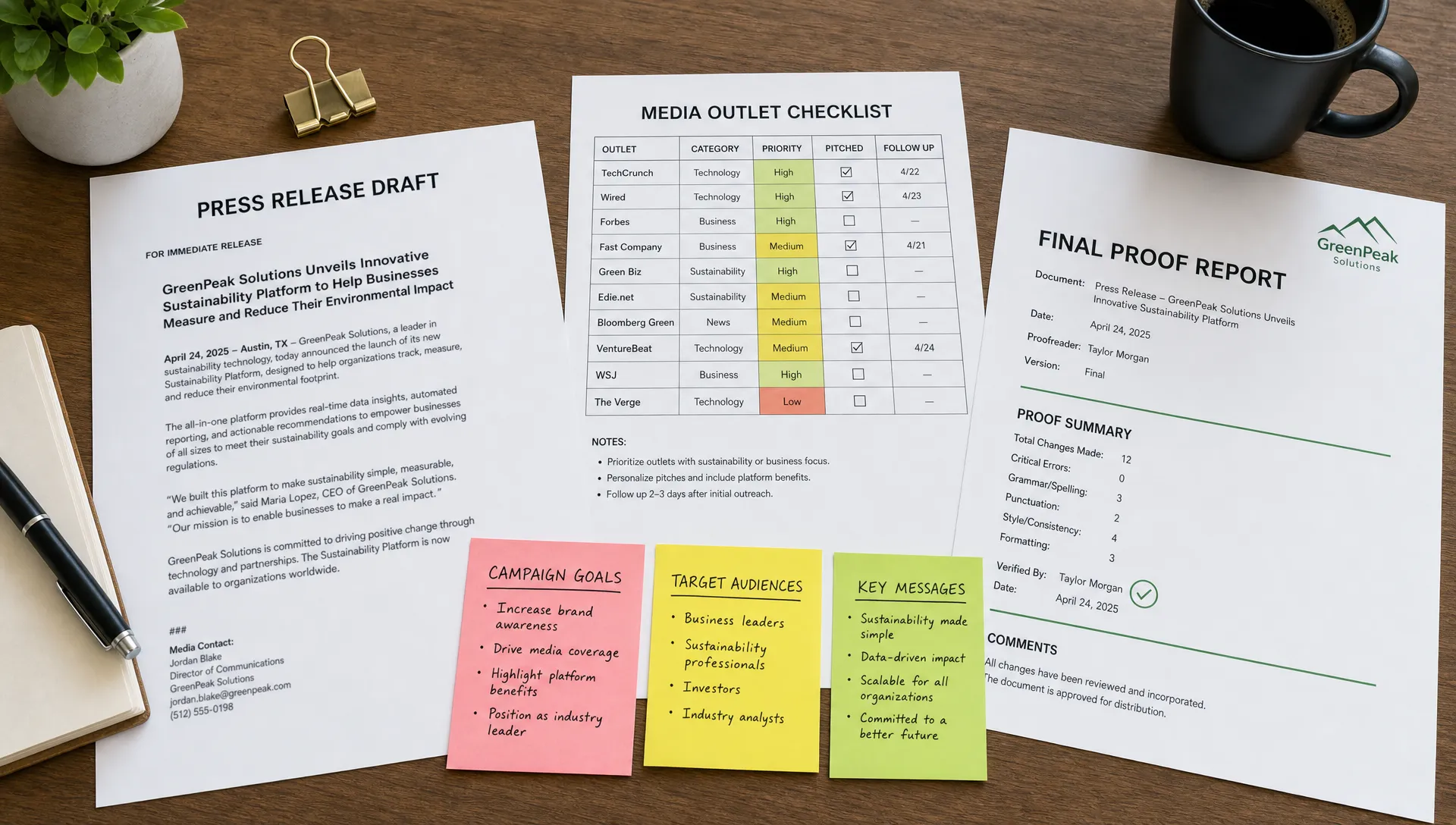
A PR campaign should not end with “we sent it out.” You need documentation that shows what happened, where your brand appeared, and which assets are live.
A useful report should include live URLs, publication names, dates, screenshots or proof of publication, and a clear summary of deliverables completed. If SEO is part of the value proposition, the report should also make it easy to review link destinations and publication quality.
Be cautious with any provider that only reports impressions or potential reach. These numbers can be useful context, but they are often estimates. They should not replace concrete proof.
The same applies to AI visibility. In 2026, brands increasingly care about appearing across trusted sources that AI search tools may reference. That is a valid strategic goal, but it should still be discussed responsibly. A PR company should talk about strengthening your broader public web presence, not promise guaranteed inclusion in every AI-generated answer.
Understand their approach to backlinks and SEO
Many brands hire PR companies partly because media placements can support search visibility. That is reasonable, but it is important to understand what kind of SEO value is being promised.
Press release placements can help your brand appear across indexed pages, create third-party credibility, and give sales teams proof assets. They may also include backlinks, depending on the publication and package. However, no PR company should imply that backlinks alone will magically rank your website for competitive keywords.
Search engines evaluate links in context, and Google’s spam policies warn against manipulative link practices. The safest approach is to treat PR as a credibility and visibility channel first, with SEO benefits as part of a broader strategy.
When you review a PR proposal, ask whether links are dofollow or nofollow where applicable, whether the brand name is included naturally, whether URLs are permanent or subject to publisher changes, and whether the company provides post-campaign proof. A serious provider will answer without overpromising.
Ask how they use AI in the PR process
AI can be useful in PR workflows. It can help brainstorm angles, summarize background material, create first drafts, and check formatting. But it should not replace editorial review, strategic thinking, or factual verification.
This is especially important because AI-written copy can sound polished while still being generic, inaccurate, or off-brand. Some tools are even marketed around rewriting AI text to avoid detection, including resources such as AI rewriting and detector-focused toolkits. Whether or not your team uses tools like these, their existence is a reminder to ask your PR company about writing standards, disclosure practices, plagiarism checks, and human review.
A trustworthy PR partner should be comfortable explaining how AI is used, who approves final copy, and how facts are verified. If the answer is vague, ask for a sample draft or editing workflow before committing.
Compare proposals with a scoring system
If you are reviewing multiple vendors, do not rely on gut feeling alone. Create a simple scorecard and compare each PR company against the same criteria.
| Evaluation factor | Why it matters | Score from 1 to 5 |
|---|---|---|
| Clarity of deliverables | Prevents confusion about what is actually included | |
| Outlet quality | Determines whether placements build trust | |
| Industry fit | Improves relevance and message accuracy | |
| Editorial support | Helps turn an announcement into a real story | |
| Proof reporting | Makes results verifiable | |
| Timeline reliability | Protects launches, funding news, and campaign windows | |
| Pricing transparency | Reduces surprise costs | |
| Strategic honesty | Shows whether the provider explains limits clearly |
A high score does not always mean the company is the cheapest or the biggest. It means the proposal is specific, credible, and aligned with your goal.
You can also compare focused distribution partners against broader services. If you are evaluating press release distribution specifically, this overview of the best press release distribution services for 2026 can help you understand how modern options differ from legacy wire services.
Watch for red flags before you sign
Some warning signs are obvious, such as no contract, no examples, or pressure to pay immediately. Others are more subtle.
| Red flag | Why it matters | Better alternative |
|---|---|---|
| “Guaranteed Forbes feature” with no explanation | True editorial coverage cannot usually be guaranteed this way | Ask whether it is sponsored, syndicated, contributed, or earned |
| No sample reports | You cannot verify what final proof will look like | Request anonymized examples or a report template |
| Only talks about reach | Reach estimates do not prove publication | Ask for live links and outlet names |
| No editorial process | Weak copy reduces pickup and credibility | Look for review, revisions, and message guidance |
| Unrealistic SEO promises | Rankings depend on many factors beyond PR | Ask for realistic visibility and link documentation |
| No industry understanding | Messaging may feel generic or misplaced | Ask for relevant campaign examples |
The biggest red flag is not ambition. It is lack of specificity. Good PR companies can explain what they control, what they influence, and what no provider can honestly guarantee.
Look for evidence of operational reliability
PR often runs on deadlines. Product launches, funding announcements, event promotions, hiring news, market reports, and partnership announcements all have timing constraints. A PR company that misses the window can reduce the impact of an otherwise strong story.
Ask about turnaround time, approval steps, revision deadlines, and who owns final signoff. If you need a fast campaign, confirm whether the company has a defined process for intake, drafting, editorial review, distribution, and reporting.
Operational reliability also matters for agencies. If you are serving clients, you need a partner that can provide consistent fulfillment, clean reporting, and predictable communication. Custom pricing, repeatable workflows, and clear proof reports can matter as much as the outlet list.
Where MediaBoost fits
MediaBoost is built for brands and agencies that want fast, placement-focused press release distribution across a large network of trusted publications. The service offers done-for-you submissions, editorial review, guaranteed live backlinks, proof reports, industry-specific packages, and distribution across 500+ media outlets. Campaigns can often be completed within 48 hours, depending on the package and submission requirements.
That makes MediaBoost a fit when your goal is to build credibility, create third-party proof, support brand visibility, and strengthen your presence across search and AI discovery surfaces. It is especially useful for announcements where you need clear deliverables, live links, and post-campaign documentation rather than a vague promise of “buzz.”
As with any PR investment, the best results start with a real story. A strong announcement, clear message, relevant audience, and credible distribution plan work together.
Frequently Asked Questions
How do I know if a PR company is legitimate? Look for clear deliverables, sample reports, transparent timelines, real placement examples, and direct answers about what is guaranteed. A legitimate provider will explain both the benefits and the limits of its service.
Should I choose a PR agency or a press release distribution company? Choose a PR agency if you need ongoing strategy, media relationships, crisis support, or executive positioning. Choose a distribution company if you need a faster, more defined campaign with live placements, press release support, and proof reporting.
Can a PR company guarantee media coverage? It depends on the type of coverage. A company can guarantee specific distribution actions, submissions, live links, or placement packages if those are part of its service. Independent earned editorial coverage is usually not something any ethical provider can fully guarantee.
What should a PR report include? A strong PR report should include live URLs, publication names, placement dates, screenshots or proof of publication, and a summary of completed deliverables. If SEO or backlinks are included, link details should be easy to review.
How much should I care about outlet quantity? Quantity matters only if the outlets are credible and relevant. A large number of weak placements may be less valuable than fewer placements in publications your customers, investors, or partners recognize.
What is the biggest mistake companies make when hiring PR help? The biggest mistake is buying vague exposure instead of defined outcomes. Before hiring, decide whether you need credibility assets, journalist outreach, distribution, thought leadership, SEO support, or reputation strategy.
Choose a PR partner that can prove the work
The right PR company will not ask you to rely on hope. It will clarify the goal, improve the message, define deliverables, set a timeline, and show proof when the campaign is complete.
If you want a faster, more transparent way to turn your announcement into media visibility, MediaBoost can help you distribute your press release across 500+ outlets with editorial review, guaranteed live backlinks, and proof reports tailored to your campaign.