When You Need an Official Press Release and What to Say
An official press release works best when your news needs authority, accuracy, and reach. Learn when to publish one, what to say, and how to avoid vague or overly promotional messaging.
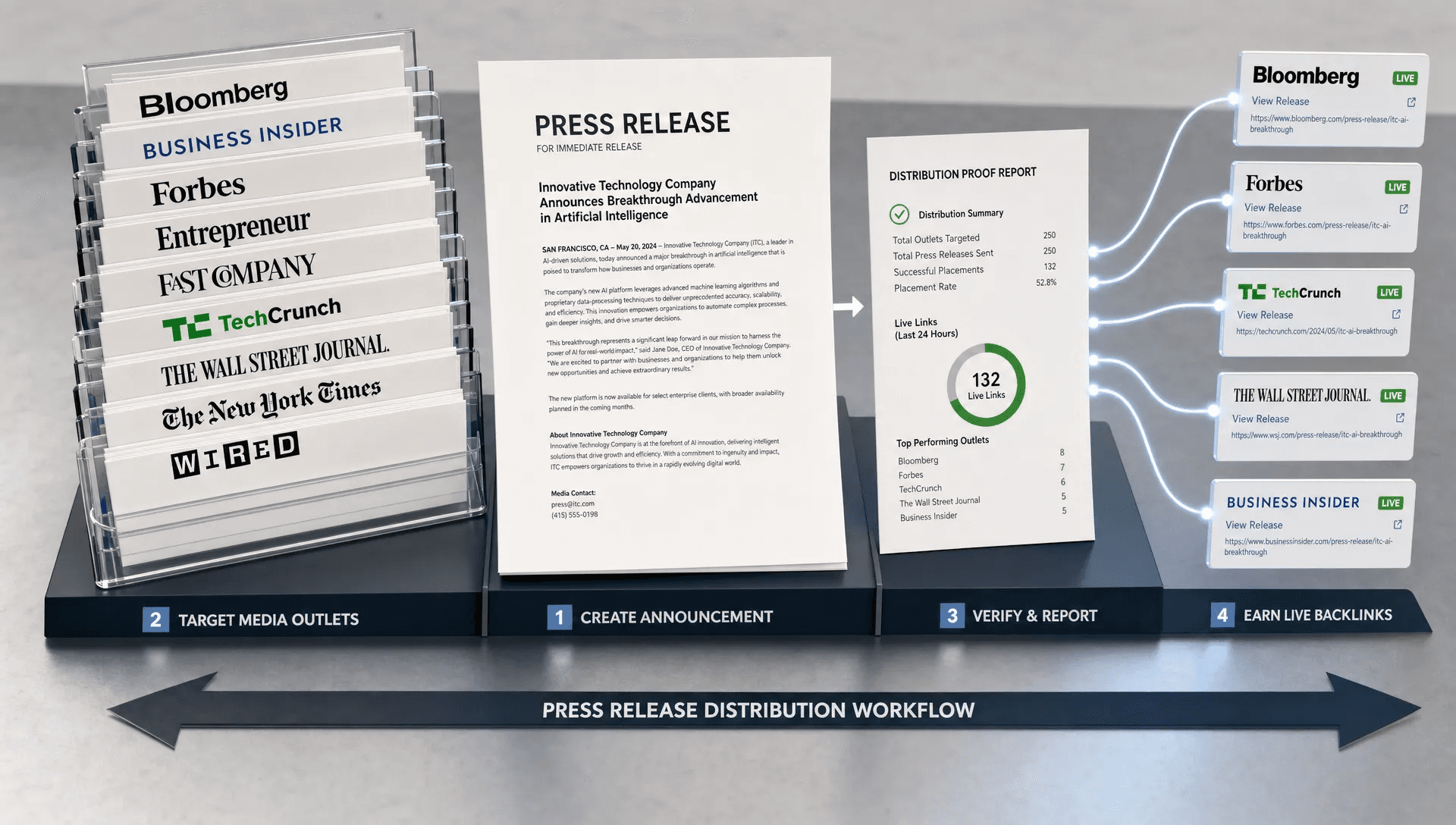
Get featured on 500+ media outlets
Guaranteed placement, no PR experience needed.
An official press release is not just a “more formal” version of a social post. It is a public record of company news, written for journalists, search engines, investors, partners, customers, and anyone else who needs a clear source of truth.
That distinction matters. If you publish a press release for every small update, people stop paying attention. If you skip one when the news is material, sensitive, or credibility-building, you miss an opportunity to control the narrative and create a discoverable record.
The goal is simple: use an official press release when your news needs authority, context, and distribution beyond your owned channels. Then say only what is clear, verifiable, and useful.
What makes a press release “official”?
An official press release is a company-approved announcement that follows a recognizable news format. It usually includes a headline, dateline, lead paragraph, body copy, quote, boilerplate, media contact, and relevant links or supporting details.
Unlike a blog post, it is not primarily educational. Unlike an ad, it should not read like a sales pitch. Unlike a casual LinkedIn update, it should be structured so media outlets and third-party platforms can republish or reference it with confidence.
If you need a refresher on the standard components, MediaBoost’s guide to what a press release is explains the core parts in plain English.
The word “official” does not mean stiff or overloaded with corporate language. It means the announcement is authorized, attributable, and accurate. Readers should be able to understand what happened, why it matters, who is involved, and where to go for more information.
When you need an official press release
You need an official press release when the news has external relevance. In other words, someone outside your company has a reason to care, verify, share, cite, or act on it.
A good test is to ask: “Would this announcement help a journalist, customer, investor, partner, or searcher understand a meaningful change in our business?” If the answer is yes, a press release may be the right format.
Use one for company milestones with public relevance
A milestone can justify a press release when it signals traction, credibility, expansion, or market momentum. Examples include a major customer win, a geographic expansion, a significant user or revenue milestone, a new leadership appointment, or the opening of a new location.
The key is to connect the milestone to a broader implication. “We turned five years old” is usually not enough. “We expanded into three new markets after reaching 100,000 customers” is much stronger because it communicates growth and market validation.
Use one for product launches and major feature releases
An official press release is useful when a new product, service, or feature solves a clear market problem, introduces a differentiated capability, or creates a new option for a specific audience.
Avoid turning the release into a feature dump. Instead, explain who the launch helps, what changed, why it matters now, and how customers can access it. If the release is technical, include one short plain-English explanation before adding deeper details.
Use one for partnerships, acquisitions, and funding
Partnerships, acquisitions, funding rounds, and strategic alliances often deserve official documentation because multiple stakeholders may be involved. These announcements can affect customers, investors, employees, vendors, and the market’s perception of your company.
In these cases, precision matters. Confirm names, dates, deal descriptions, quotes, and any claims with all parties before distribution. If financial terms are not disclosed, say so directly instead of implying more than you can share.
Use one for events, research, reports, and awards
A press release can help promote a major event, summarize original research, announce a new industry report, or publicize a meaningful award. These releases work best when they offer details that media and readers can use, not just a celebratory statement.
For research, include methodology basics and the most newsworthy findings. For events, include date, location, agenda highlights, speaker names if confirmed, and registration information. For awards, explain the awarding organization and why the recognition matters.
Use one for corrections, crisis updates, or sensitive public statements
Sometimes a press release is necessary because silence creates more risk than clarity. If your company needs to correct misinformation, address an incident, clarify a policy change, communicate a leadership transition, or respond to a public issue, an official statement can create a reliable reference point.
This type of release should be factual, restrained, and reviewed carefully. Avoid speculation. Avoid defensive language. If legal, regulatory, HR, or customer data issues are involved, get the right internal or external review before publishing.
When you probably do not need one
Not every announcement needs an official press release. If the update is minor, purely internal, highly promotional, or only relevant to your existing followers, another channel may work better.
A social post may be enough for a small product improvement. A customer email may be better for account-specific changes. A blog post may be stronger for thought leadership, tutorials, or long-form education. A direct media pitch may be more appropriate when you have an exclusive story for a specific journalist.
Here is a practical way to decide:
| Situation | Use an official press release? | Better alternative if not |
|---|---|---|
| Major product launch | Yes | Blog post can support it |
| Small UI improvement | Usually no | Changelog or customer email |
| Funding round | Yes | Investor update can supplement it |
| New blog article | No | Social post or newsletter |
| Strategic partnership | Usually yes | Joint customer story can support it |
| Crisis statement | Often yes | Legal statement may also be needed |
| Internal promotion | Sometimes | Internal memo or LinkedIn post |
| Original industry report | Yes | Gated report landing page can support it |
The question is not “Can we write a press release about this?” You can write one about almost anything. The better question is “Will an official press release make this news clearer, more credible, and more discoverable?”
What to say in an official press release
The best press releases are specific, concise, and grounded in facts. They do not try to say everything. They say the right things in the right order.
Start with the audience. A journalist wants the news angle fast. A customer wants to know what changes for them. A partner wants accuracy. A search engine or AI answer engine needs clear entities, context, and relationships. A future buyer wants social proof that your company is active and credible.
At minimum, your release should answer six questions:
- Who is making the announcement?
- What exactly happened or is launching?
- When did it happen or when will it happen?
- Where is it available or relevant?
- Why does it matter to the market or audience?
- How can readers learn more, attend, buy, contact, or verify details?
Once those answers are clear, build the release around one central message. A press release should not contain five competing angles. If you are launching a product, do not also try to announce a rebrand, a hiring campaign, and a new podcast in the same release unless they are directly connected.

How to shape the message by announcement type
Different announcements require different emphasis. The structure stays similar, but what you choose to highlight should change based on the reason for the release.
Product or service launch
Lead with the problem and the outcome. Readers need to know what is new, who it is for, and why it is useful.
A strong product launch release might say: “The new platform helps independent retailers centralize online and in-store inventory, reducing manual updates and improving product availability across sales channels.”
That is stronger than: “We are excited to announce our innovative new platform.” Excitement is not news. A clear benefit is.
Partnership announcement
Lead with the shared purpose. Explain what the partnership enables that neither party could do as effectively alone.
Good partnership language includes the names of both organizations, the audience served, the scope of collaboration, and any confirmed availability details. Keep the claims realistic. If the partnership is early, do not imply market dominance before results exist.
Funding announcement
Lead with the amount if it is public, the round type, the lead investor if approved, and what the funding will support. Then add a short explanation of traction or market demand.
Avoid vague claims like “This funding will help us revolutionize the industry.” Instead, say whether the capital will support hiring, product development, geographic expansion, research, customer support, or go-to-market efforts.
Legal, licensing, or IP-related announcement
If your announcement involves intellectual property, licensing, enforcement, or rights management, clarity and review are especially important. Make sure your public statement does not overstate ownership, accuse without support, or reveal sensitive strategy.
For example, a music rights holder announcing a licensing initiative should be able to explain what rights are involved, how partners can engage, and what evidence supports the opportunity. Teams that need to monitor use, preserve evidence, or unlock licensing revenue may want to coordinate their announcement with tools and workflows from Third Chair for IP enforcement and licensing before going public.
Crisis, correction, or public clarification
Lead with the fact that matters most. Acknowledge what you can confirm, explain what action is being taken, and provide a reliable point of contact.
Do not bury the issue under branding language. Do not speculate about unknowns. Do not use humor. In sensitive announcements, tone is part of the message.
What not to say
A press release loses credibility when it sounds inflated, vague, or self-congratulatory. Journalists and readers are quick to spot unsupported claims.
Avoid phrases like “game-changing,” “world-class,” “revolutionary,” and “industry-leading” unless you can substantiate them with evidence. If you claim to be the first, fastest, largest, or most trusted, be prepared to prove it.
Also avoid quotes that say nothing. A quote should add perspective, not repeat the headline. Instead of “We are thrilled to launch this product,” use the quote to explain the customer problem, strategic reason, or market shift behind the announcement.
For example, a stronger executive quote might be: “Small healthcare practices are being asked to manage more patient communication with fewer administrative resources. This launch gives them a simpler way to automate routine updates while keeping staff focused on care.”
A simple official press release structure
You do not need to reinvent the format. Standard structure exists because it helps editors and readers understand the announcement quickly.
| Section | Purpose | What to include |
|---|---|---|
| Headline | Communicate the news | Company name, action, clear outcome |
| Subheadline | Add context | Audience, market, or benefit |
| Dateline | Establish time and place | City, state, date |
| Lead paragraph | Answer the essentials | Who, what, when, where, why |
| Body | Explain the significance | Details, proof points, background |
| Quote | Add human perspective | Executive, partner, customer, or expert insight |
| Boilerplate | Identify the company | Short company description and website |
| Media contact | Enable follow-up | Name, email, phone, or press contact |
If you want to refine the structure before sending, review these press release formatting rules to make sure your announcement looks credible and media-ready.
How much detail should you include?
Aim for enough detail to remove confusion, not so much that the release becomes a brochure. Many effective press releases land between 400 and 700 words, though complex announcements may need more.
Include facts that help someone verify or understand the news. Useful details often include dates, locations, names, product availability, pricing if public, customer segments, data points, partner roles, and links to supporting pages.
Leave out internal backstory, jargon, roadmap promises, unapproved financial claims, and anything you would not want quoted publicly. A press release can travel far beyond your intended audience, especially once it appears on media sites, in search results, or in AI-generated summaries.
Before you publish, run this credibility check
A short review can prevent most press release problems. Before distribution, ask these questions:
- Is the news clear in the first sentence?
- Can every factual claim be verified?
- Have all names, titles, dates, and links been checked?
- Does the quote add real context?
- Is the tone informative rather than promotional?
- Has legal, investor, partner, or compliance review happened where needed?
- Is there a clear next step for readers or media?
This is also the moment to decide where the release should go. Some brands pitch journalists directly. Others use a distribution partner to secure broader visibility, live links, and reporting. If you are comparing options, this guide on where to send and submit a press release can help you choose the right path.
Turning the release into visibility
An official press release is only useful if people can find it. Publishing it on your website is a start, but distribution can extend its reach across media outlets, search results, and third-party pages that reinforce credibility.
That broader footprint matters for brand trust. When prospects search your company, media mentions can support social proof. When partners evaluate you, a clean release archive can show momentum. When AI search systems summarize companies and industries, consistent public information across reputable sources can help shape what gets surfaced.
MediaBoost helps brands distribute press releases across 500+ media outlets with done-for-you submissions, editorial review, guaranteed live backlinks, and proof reports. For teams that need to move quickly, packages can often be completed within 48 hours.
Frequently Asked Questions
What is an official press release? An official press release is an authorized public announcement from a company or organization, written in a standard news format and intended for media, search, stakeholders, and public reference.
When should a small business send an official press release? A small business should send one for news with external relevance, such as a launch, funding round, partnership, expansion, major event, original report, award, or important public statement.
What should I include in an official press release? Include a clear headline, dateline, strong lead paragraph, supporting details, a meaningful quote, company boilerplate, media contact, and a clear next step for readers.
Can a press release be too promotional? Yes. A press release should inform first. Promotional language, vague claims, and exaggerated adjectives can reduce trust and make the announcement less attractive to journalists and readers.
How fast can a press release be distributed? Timing depends on writing, review, approvals, and distribution method. MediaBoost offers press release distribution packages that can often be completed within 48 hours.
Make your official announcement count
The right press release can give your news a credible public record, stronger search visibility, and third-party validation. The wrong one can feel like noise.
Before you publish, make sure the announcement is truly newsworthy, the message is specific, and the claims are accurate. Then choose a distribution path that helps the release reach the audiences that matter.
If you want guaranteed placements, live backlinks, editorial review, and proof reports, MediaBoost can help you turn an official press release into measurable brand visibility.