Best Press Release Channels for Fast Brand Visibility
The fastest PR wins come from using the right channels together, not chasing outlet count alone. Learn how to combine syndication, niche media, owned channels and partners for credible brand visibility.
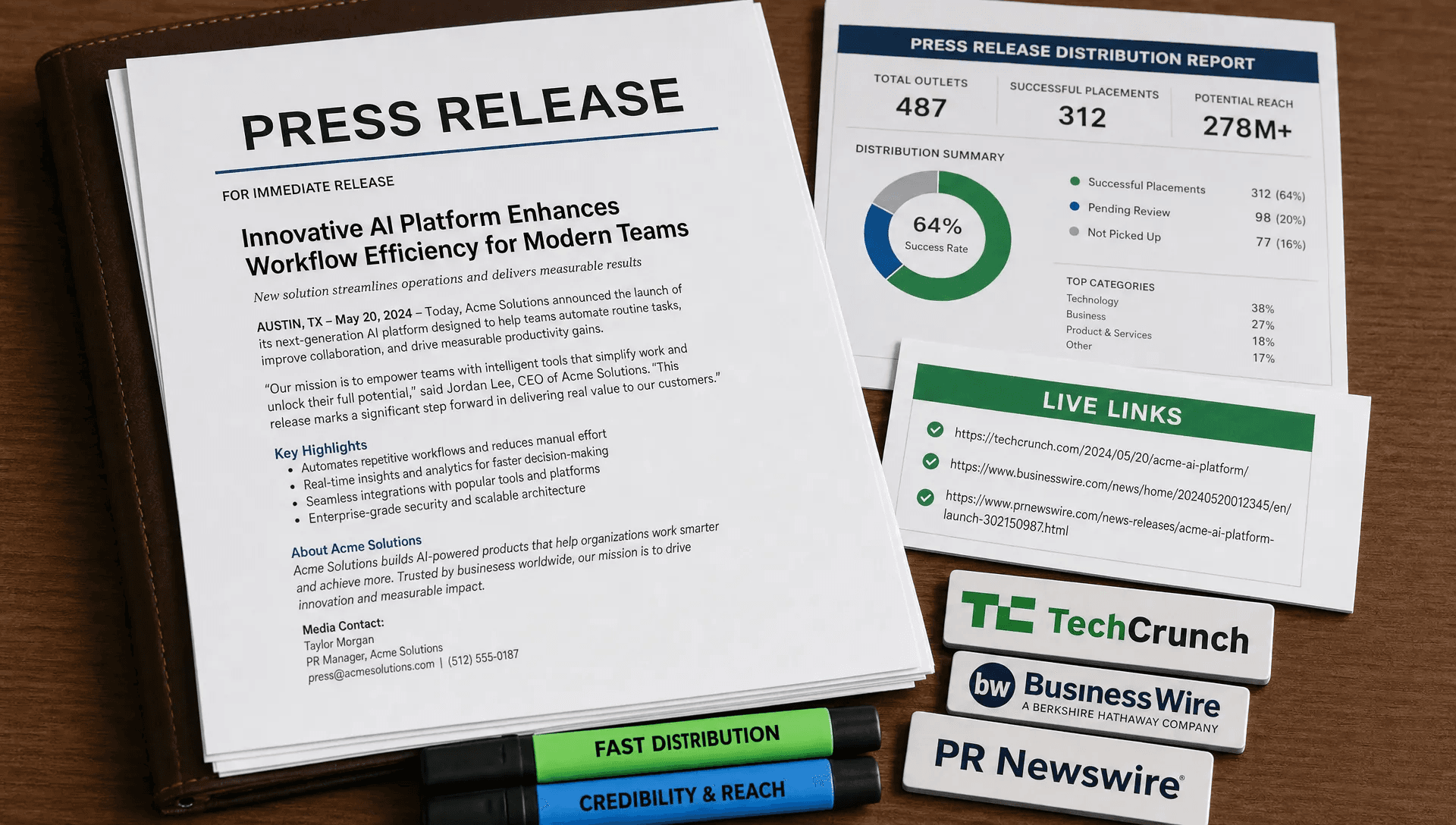
Get featured on 500+ media outlets
Guaranteed placement, no PR experience needed.
Fast brand visibility does not usually come from one press release channel. It comes from using the right mix of channels for the moment: broad syndication for reach, niche outlets for relevance, direct media outreach for credibility and owned channels for conversion.
For startups, e-commerce brands, agencies, SaaS companies and local service businesses, the best question is not simply “Where can we send this press release?” It is “Which channels can make the right people see, trust and remember this announcement quickly?”
The answer depends on your audience, your announcement type and how much proof you need after publication. Below is a practical breakdown of the best press release channels for fast brand visibility, plus how to combine them without wasting budget on irrelevant reach.
What makes a press release channel “fast”?
A fast channel is not just one that publishes quickly. It should help your announcement become visible where buyers, partners, journalists, investors or search engines can actually find it.
For most brands, speed has four parts:
- Time to publication: How quickly the release can go live after approval.
- Distribution breadth: How many relevant outlets, databases or platforms can pick it up.
- Trust signal strength: Whether the placement appears on credible publications, industry sites or recognized media brands.
- Search discoverability: Whether the release creates indexable pages, live links and branded search results.
A post on your own blog may go live instantly, but it will not carry the same third-party credibility as a respected publication. A premium wire can distribute broadly, but a niche trade outlet may bring more qualified attention. The best strategy balances both.
1. Press release syndication networks
Press release syndication networks are the classic fast-visibility channel. They distribute your announcement to media sites, financial portals, news aggregators and sometimes industry-specific feeds.
This channel is useful when your goal is to create a quick footprint across search results and trusted news environments. It is especially strong for product launches, funding announcements, partnerships, executive hires, research reports, events and brand milestones.
The main advantage is speed at scale. Instead of pitching one journalist at a time, syndication can place your release across many outlets within a short window. For brands that need social proof fast, this matters because sales teams, investors, partners and prospects can see that the announcement exists beyond your own website.
The drawback is that syndication alone does not guarantee deep editorial coverage. Many placements are republished releases rather than journalist-written articles. That is not a problem if your goal is fast visibility and proof, but it should be paired with other channels if you want interviews, feature stories or expert commentary.
If you are comparing vendors, focus less on the largest claimed number of outlets and more on verified placements, live links, proof reports, turnaround time and outlet relevance. MediaBoost, for example, focuses on distribution across 500+ trusted publications with guaranteed live backlinks, editorial review and proof reporting.
2. Industry-specific media outlets
Industry-specific media outlets are often more valuable than general news sites for reaching buyers who understand your category. A cybersecurity release belongs in a different media environment than a beauty product launch, fintech partnership or restaurant expansion.
This channel works best when your announcement has clear relevance to a defined audience. Trade publications, professional newsletters, association sites and niche business media can help you reach readers who already care about the problem your brand solves.
The visibility may look smaller on paper, but it is often more useful. A mention in a credible logistics outlet can matter more to a supply chain startup than a generic placement on a broad news site. An article in a regional business publication can carry more trust for a local service provider than a national outlet with no geographic connection.
This is why industry mapping should happen before distribution. If you are not sure how to build that list, MediaBoost has a practical guide on how to find press outlets that match your industry.
3. Direct journalist and editor outreach
Direct outreach is slower than syndication, but it can create the highest-quality visibility when done well. Instead of sending your release into a distribution system, you pitch selected journalists, editors, podcast hosts or newsletter writers who cover your specific topic.
This channel is best for announcements with a strong editorial angle. A funding announcement may interest startup reporters if it includes market context. A product launch may work if it solves a timely problem. A survey or data report can perform well because journalists often need credible numbers and expert interpretation.
Direct outreach requires more preparation. You need a tight subject line, a clear reason the journalist’s audience would care and a press release that gets to the point quickly. A weak release will not become interesting just because it lands in a journalist’s inbox.
For fast visibility, direct outreach should usually run alongside syndication, not replace it. Syndication gives you immediate published proof, while journalist outreach gives you the chance to earn deeper coverage.
4. Owned media channels
Owned media includes your website, blog, newsroom, email list, social profiles, investor updates and customer community. These channels are the easiest to control and the fastest to publish on, which makes them essential even when you use paid distribution.
Owned media does three things for a press release campaign. First, it gives readers a canonical place to learn more. Second, it helps your sales and customer-facing teams share the announcement. Third, it supports branded search because your own site can rank alongside third-party placements.
A press release should not live only on external sites. Publish it in your newsroom or blog, add a short summary for social, include it in your newsletter and create a sales-friendly version your team can send to prospects.
The mistake is treating owned media as a replacement for external distribution. Your own channels help convert attention, but third-party placements help create credibility. Both are needed if you want fast visibility that feels trustworthy.
5. Search and AI visibility channels
Search visibility is no longer limited to traditional blue links. Buyers now discover brands through search engines, AI answer engines, browser assistants and industry comparison content. Press releases can support that visibility by creating clear, indexable information about your brand, offer and announcement.
This does not mean a press release will automatically make your site rank for competitive keywords. It means that distributed announcements can strengthen your brand’s footprint across the web, especially for branded searches, executive names, product names, partnership terms and news-driven queries.
For AI visibility, consistency matters. If the same factual information about your company appears across trusted pages, it becomes easier for discovery systems to understand who you are and what you do. That is one reason proof reports, live links and credible media placements are becoming more important for PR campaigns.

6. Regional and local business media
Regional media is one of the most underrated press release channels for fast brand visibility. Local business journals, city publications, chamber of commerce newsletters and regional trade sites can be highly effective when geography matters to your offer.
This channel works especially well for store openings, local hiring, regional expansion, new facilities, community initiatives, public sector contracts and service launches tied to a specific market.
It also helps businesses that serve specialized regions. For example, a managed IT and cloud provider in the Caribbean market, such as AITEC’s IT services for Antilles-Guyane, would likely benefit from a channel mix that includes regional business media, technology outlets and local trust-building content rather than only broad national syndication.
Regional visibility can also support sales conversations. When prospects see coverage in outlets they recognize, the trust signal is immediate and practical.
7. Partner, investor and customer channels
Some of the fastest visibility comes from people who already have a reason to share your news. Partners, investors, customers, affiliates, accelerators, vendors and community organizations can extend the reach of a press release in a way that feels natural.
This channel is most useful for partnership announcements, case studies, joint research, integrations, awards and customer milestones. If another organization is part of the story, coordinate messaging before launch so both sides publish and share at the same time.
Partner channels can include email newsletters, LinkedIn posts, community forums, partner directories and customer resource hubs. These mentions may not always look like formal media coverage, but they often reach highly qualified audiences.
The key is preparation. Give partners a short press release summary, approved quote, suggested social copy and a link to the published announcement. When you remove friction, more people share.
Best press release channels by goal
Different channels move at different speeds and create different types of trust. Use the table below to match your goal with the right mix.
| Visibility goal | Best channels | Why it works |
|---|---|---|
| Fast broad awareness | Syndication networks, owned media, social channels | Creates quick publication volume and branded search footprint |
| Industry credibility | Trade publications, niche newsletters, direct journalist outreach | Reaches readers who understand the category and care about the problem |
| Local trust | Regional media, business associations, local partner channels | Builds credibility in the markets where buyers recognize the outlets |
| Sales enablement | Guaranteed placements, proof reports, website newsroom | Gives sales teams links they can use in follow-ups and proposals |
| AI and search visibility | Indexed placements, consistent brand mentions, live backlinks | Helps discovery systems connect your brand with verified information |
| Deeper editorial coverage | Journalist outreach, expert commentary, data-led pitches | Creates opportunities for interviews, quotes and feature stories |
How to choose the right channel mix
A good distribution plan starts with the announcement, not the channel. A product launch, funding round, executive hire and research report all need different routes to visibility.
For a time-sensitive announcement, prioritize syndication and owned media first. You can then run targeted journalist outreach after the release is live, using published placements as supporting proof.
For a credibility-driven announcement, such as a new partnership or enterprise customer win, combine guaranteed placements with direct outreach to industry outlets. Buyers often need to see both volume and relevance before they treat the news as meaningful.
For a local or regional announcement, do not rely only on national distribution. Add regional publications, chambers of commerce, local business newsletters and partner sharing. A smaller outlet may have more influence if it reaches the exact market you want.
For e-commerce brands, the channel mix usually depends on product category, seasonality and social proof needs. A launch around a new consumer product may benefit from broad syndication, niche product media and retail-focused placements. MediaBoost’s e-commerce press release distribution page explains how coverage and backlinks can support credibility for online stores.
A practical 48-hour visibility plan
If you need fast brand visibility, treat the campaign like a coordinated launch rather than a single upload.
In the first phase, finalize the release and make sure the news angle is clear. The headline should say what happened, who is involved and why it matters. If the announcement is too vague, even strong channels will underperform. MediaBoost’s guide on how to write a press release that gets picked up fast is a useful checklist before distribution.
Next, publish the release through your distribution channel and prepare your owned media assets. Your newsroom post, social copy, email blurb and sales enablement note should all point to the same core message.
Once placements start going live, collect proof. Save URLs, screenshots, outlet names and publication dates. A proof report is useful for executives, sales teams, investors, clients and agency customers who need documentation that the campaign delivered.
Finally, repurpose the announcement. One release can become a LinkedIn post, founder commentary, customer email, website banner, investor update and short sales follow-up. Distribution gets the news live, but repurposing helps people actually notice it.
Mistakes that slow down visibility
Many press release campaigns fail because the channel is asked to fix a weak announcement. Distribution can amplify news, but it cannot turn a generic update into a compelling story.
The most common mistake is choosing the biggest outlet count without asking whether the outlets matter. A smaller set of relevant publications often creates more useful visibility than a huge list of unrelated sites.
Another mistake is waiting until the day of launch to build supporting assets. If your website has no newsroom post, your sales team has no link and your social copy is not ready, you lose momentum just as placements start appearing.
Brands also waste time when they treat press releases as one-off events. The best visibility compounds. Each release adds another set of search results, backlinks, media mentions and trust signals that support the next campaign.
Frequently Asked Questions
What are the best press release channels for fast visibility? The fastest channels are press release syndication networks, owned media, social channels and partner sharing. For stronger credibility, combine them with industry-specific outlets, regional media and direct journalist outreach.
Is press release syndication better than journalist outreach? They serve different purposes. Syndication is better for fast publication volume and proof, while journalist outreach is better for deeper editorial coverage. Many brands get the best results by using both.
How quickly can a press release create visibility? A well-prepared release can start generating visibility within 24 to 48 hours through syndication and owned channels. Journalist coverage may take longer because it depends on editorial interest and timing.
Do press release channels help SEO? They can support SEO by creating indexable brand mentions, live backlinks and branded search results. They should be part of a broader strategy that also includes strong website content, relevant landing pages and consistent messaging.
How many channels should one press release use? Most campaigns need at least three: a distribution network, your owned channels and one targeted channel such as industry media, regional outlets or partner sharing. The exact mix depends on the announcement and audience.
Build visibility faster with the right distribution mix
The best press release channels work together. Syndication gives your announcement reach, niche media adds relevance, owned channels help convert attention and partner channels extend trust through existing relationships.
If your brand needs guaranteed placements, live links and proof reports across trusted publications, MediaBoost can help you turn a single announcement into a fast, credible visibility campaign. Choose the right channel mix before launch, then use every placement as a building block for search, sales and brand authority.