How to Build a Media Outlets List That Gets Results
A strong media list is not about collecting as many outlets as possible. It is about matching your story to the publications, beats, and audiences most likely to care, respond, and publish.

Get featured on 500+ media outlets
Guaranteed placement, no PR experience needed.
A media list should not be a spreadsheet full of random publication names. It should be a focused outreach asset that helps you reach the right editors, journalists, producers, newsletters, and distribution channels with a story they are likely to care about.
That distinction matters. A large list can make a campaign feel more serious, but a relevant list is what gets replies, pickups, backlinks, investor attention, customer trust, and long term brand visibility. If your press release is strong but your targeting is weak, the campaign will still underperform.
Below is a practical framework for building a media outlets list that gets results, whether you are preparing a product launch, funding announcement, local expansion, expert commentary campaign, or brand credibility push.
Start With the Result You Want From Coverage
Before you add a single outlet to your list, define what a successful campaign looks like. Different goals require different outlets.
If your goal is SEO, you will care about live links, indexed pages, topical relevance, and publication authority. If your goal is investor trust, you may prioritize business, finance, startup, and industry outlets. If your goal is sales, you may need publications your buyers already read, even if they are smaller than national media brands.
A useful media outlets list begins with one primary goal:
- Build brand credibility with recognizable publication logos
- Earn referral traffic from niche audiences
- Support SEO through relevant live backlinks
- Announce a company milestone to investors and partners
- Reach local customers in a specific city or region
- Establish founders or executives as expert sources
This goal becomes your filter. Without it, every publication looks tempting, and your list becomes bloated.
Define Your Real Audience, Not Just Your Industry
Many companies build lists around broad categories like technology, retail, healthcare, finance, or lifestyle. That is a start, but it is rarely specific enough.
A better approach is to define your audience by the story angle and the reader profile. For example, a B2B SaaS company launching an AI feature may need outlets covering enterprise productivity, automation, HR technology, small business operations, and AI adoption. A consumer wellness brand may need health editors, lifestyle publications, local business journals, and ecommerce trend writers.
Think in terms of audience overlap. Who would find the announcement useful, timely, or surprising? Which publications already serve that audience? Which journalists have covered similar themes in the last 90 days?
This is where niche mapping helps. A sports ecommerce retailer, for instance, would not stop at “shopping” or “fashion”; a store like Fabbrica Ski Sises would map sportswear, ski equipment, family retail, seasonal travel, local business, and outdoor lifestyle outlets.
The more precise the audience, the more persuasive your outreach becomes.
Separate Outlet Types by Function
Not every media outlet plays the same role in a campaign. Some create credibility. Some drive discovery. Some influence buyers. Some help with search visibility. Your list should include a smart mix, not one undifferentiated column of names.
| Outlet type | Best for | What to check before adding |
|---|---|---|
| National business media | Brand credibility, investor trust, broad visibility | Does the outlet cover your company stage, sector, or announcement type? |
| Trade publications | Qualified industry attention, buyer trust | Are readers your actual customers, partners, or peers? |
| Local and regional media | Community awareness, hiring, local expansion | Is there a clear geographic connection? |
| Startup and founder outlets | Funding, product launches, founder stories | Do they feature companies at your size and stage? |
| Consumer lifestyle media | Product discovery, trends, seasonal campaigns | Does your story fit their editorial calendar? |
| Newsletters and blogs | Niche engagement, expert audiences | Is the audience active and relevant? |
| Press release distribution networks | Scale, proof of publication, fast visibility | Do they provide live links and reporting? |
This structure prevents a common mistake: judging every outlet by the same metric. A small trade publication can outperform a large general outlet if it reaches the exact audience you need.
Research Recent Coverage Before Adding an Outlet
A media outlet belongs on your list only if it has recently covered topics connected to your story. A publication that covered your industry five years ago may not be relevant today.
Review recent articles and look for patterns. Notice the topics, company types, sources, formats, and tone. Are they publishing quick news briefs, founder interviews, product reviews, trend analysis, or contributed expert commentary? Do they link to company websites? Do they mention press releases? Do they cover small brands, or only market leaders?
If you want a deeper editorial perspective, MediaBoost has a helpful guide on how news media outlets decide which stories to publish, which explains why audience value and timing often matter more than company enthusiasm.
A good rule is simple: if you cannot find at least two recent examples showing why your story fits, the outlet probably does not belong in your top tier.
Build a List With Useful Fields, Not Just Names
A media outlets list becomes valuable when it helps you act quickly and personalize intelligently. A spreadsheet with “Outlet,” “URL,” and “Email” is not enough.
Use fields that support decision making:
- Outlet name
- Website URL
- Primary beat or section
- Audience type
- Geographic focus
- Relevant journalist or editor
- Contact method
- Recent related article
- Why this outlet is a fit
- Preferred story format
- Priority tier
- Outreach status
- Follow up date
- Result or placement link
The most important field is “why this outlet is a fit.” If you cannot explain the fit in one sentence, the outlet is probably too broad or poorly researched.
This field also makes outreach easier. Instead of sending a generic pitch, you can reference the outlet’s recent coverage and connect your announcement to what its readers already care about.
Prioritize With a Simple Scoring System
Once you have a draft list, score each outlet. This keeps your campaign focused and prevents you from spending too much time on low probability targets.
| Score factor | Question to ask | Rating guidance |
|---|---|---|
| Audience fit | Does the outlet reach the people we need to influence? | 1 is weak fit, 5 is exact fit |
| Topic fit | Has it covered this topic recently? | 1 is no evidence, 5 is repeated coverage |
| Credibility value | Would a placement help build trust? | 1 is low impact, 5 is high trust signal |
| Link value | Does the outlet publish live links or indexed articles? | 1 is unlikely, 5 is likely or confirmed |
| Accessibility | Is there a clear contact path or submission process? | 1 is hard to reach, 5 is clear path |
| Timing fit | Is the story timely for this outlet now? | 1 is weak timing, 5 is strong timing |
You do not need a complex system. Add the scores, sort the list, and focus your best personalization on the highest scoring outlets.
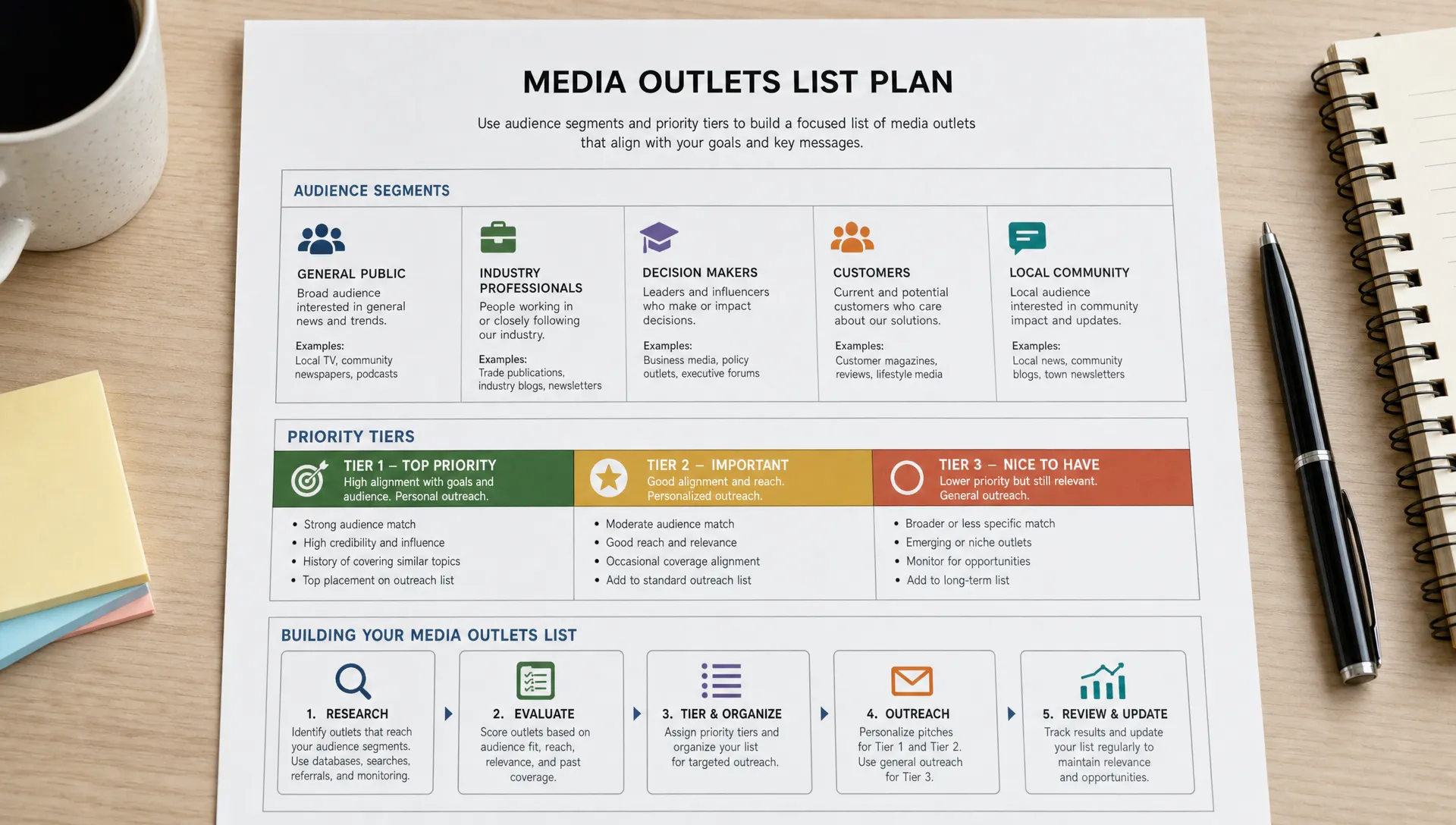
A strong list usually has three tiers. Tier 1 contains the most strategic outlets and deserves manual personalization. Tier 2 includes relevant outlets that can receive semi personalized outreach. Tier 3 includes broader distribution targets that may still provide visibility, backlinks, or proof of publication.
Match the Outlet to the Right Story Angle
One story can have several angles. The same announcement may be framed differently for business, industry, local, and consumer media.
For example, a company announcing a new product could pitch:
- A business outlet on growth, funding, hiring, or market opportunity
- A trade publication on the problem the product solves for the industry
- A local outlet on the company’s regional roots or economic impact
- A consumer outlet on how the product changes everyday behavior
- A founder focused outlet on the origin story behind the launch
This is where many campaigns fail. Brands send one press release to every outlet and expect each editor to discover the relevance. Strong outreach does the editorial work upfront.
If your release itself needs improvement, use a resource like MediaBoost’s guide on how to write a press release that gets picked up fast before you start pitching. A better list cannot fully compensate for a weak angle.
Verify Contacts and Submission Paths
Outdated contacts hurt deliverability and waste time. Before launching, verify every contact path. Check author pages, mastheads, submission pages, LinkedIn profiles, newsroom instructions, and recent bylines.
Avoid scraping emails blindly or blasting addresses that may no longer be active. Even if a message technically sends, it may not reach the right person. Worse, a high bounce rate can damage your sending reputation.
When no direct journalist contact is available, look for official submission forms, newsroom tips addresses, contributor guidelines, or editorial calendars. Some outlets prefer structured submissions over personal pitches. Respecting that process can increase your odds of consideration.
Also note whether the outlet accepts press releases, expert commentary, product news, guest articles, event announcements, or only independently reported stories. A mismatch here can make even a relevant outlet unresponsive.
Balance Manual Outreach With Distribution
Manual outreach and press release distribution are not the same, but they work well together.
Manual outreach is best for high value journalists, niche publications, relationship building, and custom story angles. Distribution is useful when you need scale, speed, guaranteed submissions, live links, and proof that coverage exists across multiple publications.
For many brands, the best approach is hybrid. Build a focused Tier 1 and Tier 2 media outlets list for tailored outreach, then use distribution to broaden visibility and support credibility signals.
MediaBoost helps brands get press release placements across 500+ trusted publications, with done-for-you submissions, editorial review, live links, and proof reports. That can be especially useful when your team needs fast visibility while still maintaining a targeted outreach strategy for priority outlets.
The key is not to treat distribution as a replacement for strategy. Use it as part of a broader media plan that connects your announcement, audience, outlets, and measurement.
Keep the List Clean After Every Campaign
A media list is not a one time asset. It should improve after every campaign.
After outreach, update your spreadsheet with what happened. Track opens if your outreach platform supports it, but prioritize real outcomes: replies, requests for more information, published coverage, declined pitches, bounced emails, and no responses.
Add notes that will help future campaigns. If a journalist says they only cover funding rounds above a certain size, note it. If an editor prefers embargoed news, note it. If a publication publishes your release with a live link, save the placement URL.
Over time, your list becomes a private intelligence asset. It shows which outlets are responsive, which story angles work, and where your brand has existing credibility.
Avoid the Most Common Media List Mistakes
The biggest mistake is confusing volume with quality. A list of 2,000 irrelevant contacts is not more valuable than 75 carefully selected outlets with clear fit.
Other common problems include adding outlets without checking recent coverage, pitching the wrong section, ignoring local or trade media, using one generic angle for every recipient, and failing to track results after launch.
Another frequent issue is choosing outlets only because they have recognizable names. Brand trust matters, but relevance matters too. MediaBoost’s article on how to choose media outlets that build real brand trust offers a useful way to evaluate outlet quality beyond surface level popularity.
A results driven list is not built around vanity. It is built around fit, timing, credibility, and measurable outcomes.
A Practical Workflow for Building Your List
If you want a repeatable process, use this workflow for your next campaign.
First, write a one sentence campaign goal. Then define the audience you need to influence. Next, create categories of outlets based on function, such as trade, local, business, consumer, and distribution. Research recent coverage and add only outlets with clear relevance. Score each outlet, assign priority tiers, verify contact paths, and adapt your pitch angle for each tier.
After launch, record every result. Keep placements, live links, editor feedback, and notes. Then remove poor fit outlets and promote responsive outlets to a higher tier for future campaigns.
This process takes more time than downloading a generic list, but it produces a media asset that gets stronger with every announcement.
Frequently Asked Questions
How many outlets should be in a media outlets list? It depends on your goal and industry. A focused campaign might include 50 to 150 well researched outlets, while a broader launch may combine a smaller priority list with large scale distribution. Quality and relevance matter more than raw count.
What is the most important information to include in a media list? Include the outlet name, relevant beat, audience, contact path, recent related coverage, priority tier, and a clear reason the outlet fits your story. The “why this fits” note is often the most useful field.
Should I contact journalists or use press release distribution? Use both when appropriate. Contact journalists for highly relevant, personalized opportunities. Use distribution when you need scale, speed, live links, proof reports, and broader visibility across trusted publications.
How often should I update my media outlets list? Update it before every campaign and immediately after outreach. Journalists change beats, publications adjust coverage priorities, and contact details become outdated quickly.
Can a small niche outlet be more valuable than a national publication? Yes. If the niche outlet reaches your exact buyers, partners, or industry peers, it may generate more qualified trust and engagement than a larger outlet with a general audience.
Turn Your Media List Into Real Coverage
Building a media outlets list is only useful if it leads to action. The goal is not to collect names. The goal is to match the right story with the right outlets, then measure what happens.
If you want to combine targeted media planning with scalable press release visibility, MediaBoost can help you get featured across 500+ trusted publications with done-for-you submissions, editorial review, live links, and proof reports. A better list gives your outreach direction, and the right distribution partner helps turn that direction into published results.