How News Media Outlets Decide Which Stories to Publish
Editors do not publish stories because a brand wants attention. They publish stories because an audience has a reason to care. This guide explains how newsrooms evaluate pitches, press releases, timing, proof, and outlet fit.
Get featured on 500+ media outlets
Guaranteed placement, no PR experience needed.
Every story a brand wants to publish competes with a crowded news cycle, limited editorial time, and a simple question: why should this audience care right now?
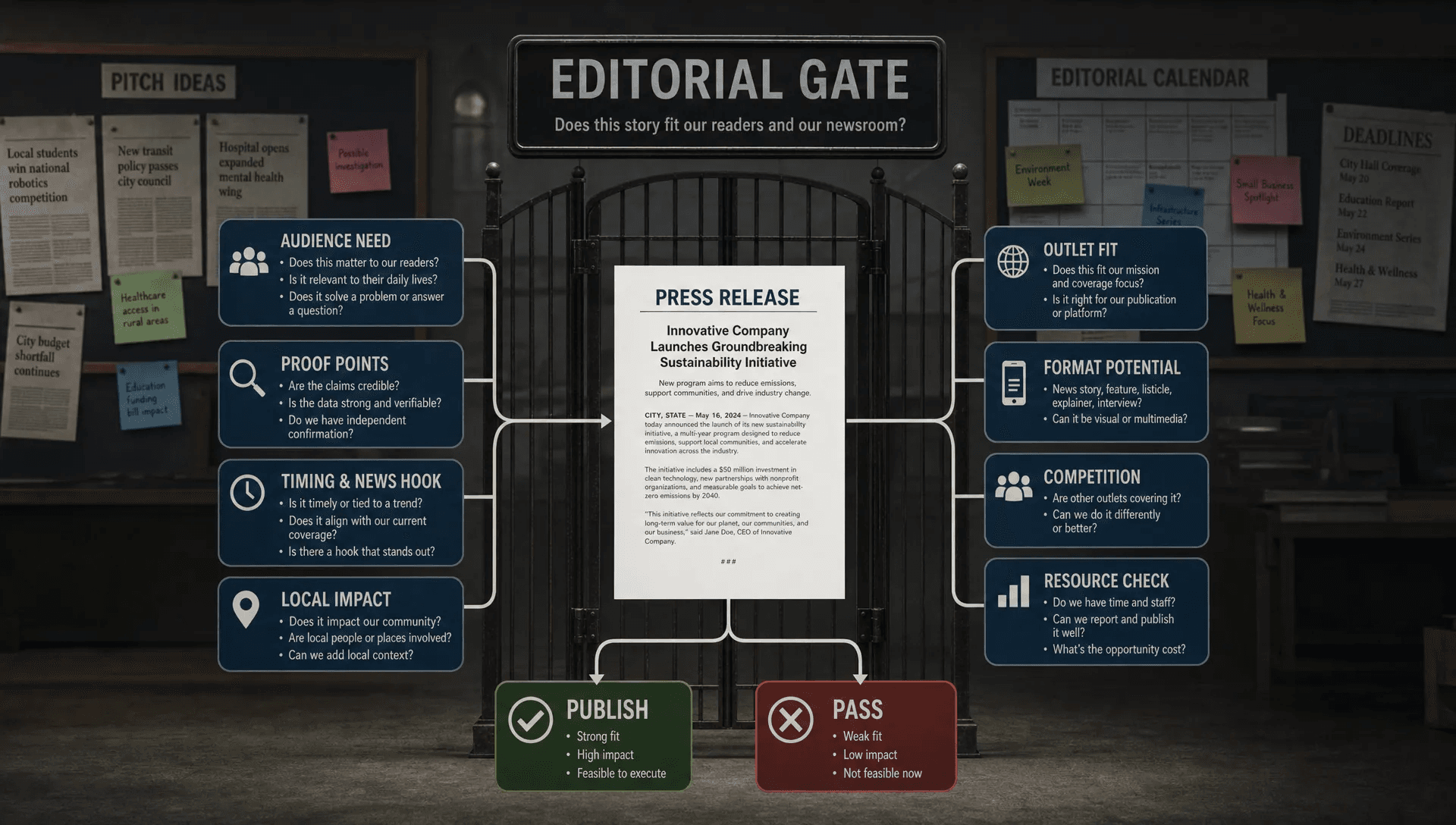
That is the core of how news media outlets decide what to publish. Editors are not only looking for announcements. They are looking for relevance, proof, timing, clarity, and a reason their readers, viewers, or listeners will find the story useful.
For founders, marketers, PR teams, and agencies, understanding that decision process changes everything. It helps you stop treating media coverage as a volume game and start shaping stories that fit real editorial criteria.
The main filter: audience value
Newsrooms exist to serve an audience. That audience might be local residents, investors, technology buyers, small business owners, healthcare professionals, parents, policy insiders, or consumers looking for lifestyle trends.
Before an editor asks whether your company is impressive, they ask whether the story has value for that specific audience. A funding announcement may matter to a business publication if it signals market momentum. The same announcement may mean very little to a local lifestyle outlet unless it creates jobs, affects the community, or introduces something unusually relevant to readers.
This is why the same press release can be accepted by one outlet, ignored by another, and rewritten by a third. Different news media outlets apply different standards because their audiences have different needs.
A story becomes publishable when the audience benefit is clear. That benefit may be information, context, warning, inspiration, entertainment, practical advice, or proof of a larger trend.
The newsworthiness signals editors look for
Editors rarely make decisions based on one factor. They weigh several signals together. A story does not need to satisfy every news value, but it should have more than one strong reason to exist.
| Newsworthiness factor | What editors are asking | Strong example | Weak example |
|---|---|---|---|
| Timeliness | Why is this relevant now? | A new law affects how small businesses file taxes this quarter | A company shares a general opinion with no current hook |
| Impact | How many people are affected, and how strongly? | A new tool reduces a common operational cost for thousands of users | A minor internal software update |
| Proximity | Is this close to the outlet’s audience by geography, industry, or interest? | A local manufacturer expands and hires 120 workers | A national announcement with no local connection |
| Prominence | Are recognizable people, companies, or institutions involved? | A partnership with a known university or public company | A quote from an unknown internal team member only |
| Novelty | Is there something unusual, first, rare, or surprising? | A startup introduces a new category of product with verified demand | A brand launches another standard feature |
| Conflict or tension | Is there a meaningful challenge, debate, or change? | New data shows consumers are rejecting a long-standing industry norm | A purely promotional claim that everything is going well |
| Human interest | Is there a person, journey, or emotional stake? | A founder solves a problem after experiencing it firsthand | A faceless company announcement with no story |
The best media pitches often combine these signals. For example, a healthcare startup launching a product is a company update. A healthcare startup launching a product after new patient data reveals a growing care gap is a stronger story. Add credible experts, patient context, and clear timing, and the pitch becomes far easier for an editor to evaluate.
What happens before a story is approved
The decision process varies by outlet size and format. At a small trade publication, one editor may review a pitch and decide quickly. At a national outlet, a story may pass through multiple layers, including an assignment editor, section editor, copy editor, legal reviewer, audience editor, and sometimes standards or fact-checking teams.
Still, the basic newsroom workflow is usually similar.
First, someone screens the pitch or press release. This person looks for relevance, credibility, and a clear angle. If the story feels generic, exaggerated, or mismatched to the outlet, it may never move forward.
Next, the editor considers whether the outlet has covered the topic recently. If the story repeats something already published, it needs a new angle. Fresh data, a local connection, a strong interview, or a clear industry shift can make the difference.
Then comes verification. Journalists and editors need to know whether the claims can be supported. They may look for independent data, customer examples, company background, expert quotes, public filings, product details, or access to a spokesperson.
Finally, the outlet considers format and resources. Some stories become short briefs. Others become Q&A articles, feature stories, syndicated press release placements, product roundups, or newsletter mentions. A good pitch makes it easy for the outlet to choose the right format.
Professional newsrooms also work within ethical standards. The Society of Professional Journalists Code of Ethics emphasizes principles such as accuracy, independence, transparency, and accountability. Brands that understand these expectations are more likely to provide clear, verifiable information instead of hype.
Why many brand announcements get rejected
Rejection does not always mean the company is unimportant. Often, it means the story was framed poorly.
Many brands lead with what they want to say: we launched, we hired, we raised, we won, we expanded. Editors are looking for what changed for the audience. If that change is not obvious in the headline, lead, or first few sentences, the pitch becomes easy to skip.
Common reasons editors pass on a story include:
- The announcement is too promotional and not news-driven.
- The audience connection is unclear.
- The timing feels arbitrary.
- The claims are broad but unsupported.
- The pitch is sent to the wrong editor or outlet category.
- The story lacks quotes, data, images, or spokesperson access.
- The release buries the most important point too far down.
This is why structure matters. A press release should make the news angle obvious fast, then support it with proof. If you are building the release from scratch, MediaBoost’s guide on how to write a press release that gets picked up fast explains how to shape the headline, lead, and supporting details around editor expectations.
Outlet type changes the publishing decision
Not all media coverage is judged the same way. A business outlet, a local newspaper, a trade journal, and a lifestyle site may all publish legitimate news, but each looks for a different kind of fit.
| Outlet type | What they usually value | What brands should emphasize |
|---|---|---|
| Business and finance outlets | Market movement, funding, growth, leadership, partnerships, investor relevance | Metrics, strategic context, market size, executive quotes |
| Trade publications | Industry specificity, technical depth, practitioner value | Use cases, expert commentary, niche trends, operational impact |
| Local media | Community impact, jobs, events, local people, regional relevance | Local connection, economic impact, human stories |
| Consumer lifestyle outlets | Trends, products, design, culture, personal benefit | Visuals, seasonal relevance, practical takeaways |
| Technology outlets | Innovation, adoption, differentiation, founder insight | Product uniqueness, data, integrations, competitive context |
| Broadcast media | Visuals, urgency, human emotion, simple explainers | Demonstrations, spokespeople, strong visuals, local availability |
A common mistake is sending the same pitch everywhere. Editors can tell when a release was written for no one in particular. A better approach is to adapt the angle without changing the facts.
For instance, an ecommerce brand in home design could pitch a generic product announcement, but a more publishable angle would connect the product to a broader design trend, such as the demand for customizable lighting in homes with unusual ceiling heights. A brand like designer lighting retailer BUYnBLUE would have a stronger media angle if the pitch focused on craftsmanship, customization, room-specific design choices, and how consumer expectations are changing in modern interiors, not simply on the fact that lamps are available for purchase.
That distinction matters. Newsrooms publish stories, not catalog pages.

How editors judge credibility
Credibility is one of the biggest deciding factors. Editors are risking their publication’s trust every time they publish a claim. If your announcement sounds inflated, vague, or impossible to verify, it becomes a liability.
Strong credibility signals include specific numbers, named partners, named executives, real customer use cases, independent research, product screenshots, professional images, and clear contact information. Weak signals include buzzwords, anonymous praise, unsupported superlatives, and phrases like revolutionary or game-changing with no evidence.
Editors also look at whether a brand appears prepared. A complete media package saves time and reduces friction. It can include the press release, company fact sheet, executive bios, approved quotes, high-quality images, logo files, data points, and spokesperson contact details. If you want to make that process easier for journalists, review what to include in a media package for journalists before outreach begins.
The easier it is to verify and package your story, the more publishable it becomes.
How brands can improve their odds of getting published
You cannot control every newsroom decision, but you can control the quality of your story, targeting, assets, and follow-up.
Lead with the change, not the company
A company launch is not automatically news. A change in the market, customer behavior, regulation, access, cost, design, safety, or technology is more likely to be news.
Instead of starting with the brand, start with the shift. What is different now? Who is affected? Why does it matter? What can the reader learn from this announcement?
A clear framing might be: small retailers are adopting faster fulfillment tools as customer expectations tighten. The company announcement then becomes proof of that wider trend.
Make the timing obvious
Editors need a reason to publish now instead of next month. Timing can come from a launch date, report release, funding close, seasonal trend, event, policy change, partnership, milestone, or breaking industry conversation.
If there is no time hook, create context without manufacturing urgency. For example, release original survey data, publish a benchmark report, connect the announcement to an upcoming event, or tie it to a documented trend.
Provide evidence that supports the angle
A pitch gets stronger when it includes facts an editor can use. Evidence does not have to be complicated, but it should be specific.
Useful proof points include:
- Revenue, growth, adoption, or usage metrics that can be publicly shared.
- Customer outcomes, case studies, or testimonials with permission.
- Survey results, industry data, or expert analysis.
- Product availability, pricing context, or launch details when relevant.
- Images, charts, screenshots, or demo access for visual stories.
If you cannot share sensitive metrics, give directional context. For example, say the company expanded from one region to five, added enterprise customers in a specific sector, or reduced onboarding time for users by a measurable percentage if that claim is accurate and approved.
Target outlets with intention
Publishing in the right outlet is more valuable than appearing in a long list of irrelevant places. A niche trade publication can build more trust with buyers than a broad outlet that does not match your market.
Before outreach, evaluate each outlet by audience fit, editorial credibility, topic history, authority, and the kind of stories it actually publishes. MediaBoost’s article on choosing media outlets that build real brand trust offers a useful framework for separating meaningful coverage from empty reach.
Respect the difference between earned coverage and distribution
Earned editorial coverage means a journalist or editor independently decides the story is worth covering. Press release distribution means the release is submitted or published across participating outlets, newswires, or media networks according to the service model.
Both can be valuable, but they serve different purposes. Earned media is powerful for narrative depth and third-party validation. Distribution is useful for visibility, official announcements, live links, search presence, proof of publication, and broad market awareness.
The strongest PR strategy often uses both. A brand may distribute an official announcement for visibility while also pitching a sharper, customized angle to selected journalists.
What editors wish brands understood
Editors are not trying to make PR difficult. They are managing limited space, audience trust, and time. Most receive far more pitches than they can use.
Brands that make the editor’s job easier stand out. That means writing clearly, avoiding exaggeration, responding quickly, providing usable assets, and understanding the outlet before pitching.
It also means accepting that not every company update deserves media coverage. Some announcements are better suited for a company blog, customer email, LinkedIn post, investor update, or paid campaign. The key is knowing when a story has genuine public relevance and when it is mainly internal news.
When you do have a strong story, prepare it like an editor will read it under pressure. Put the most important point first. Explain the audience impact. Back up the claim. Make the next step obvious.
Frequently Asked Questions
What makes a story newsworthy to news media outlets? A story is newsworthy when it is timely, relevant, credible, and meaningful to the outlet’s audience. Editors look for impact, novelty, proximity, human interest, strong proof, and a clear reason to publish now.
Do editors prefer press releases or short pitches? It depends on the outlet and story. A concise pitch is useful for initial outreach, while a full press release provides the official details. Many brands use both: a short personalized email with a link or attachment containing the full release and media assets.
Why did my press release get published on some sites but ignored by others? Different outlets have different audiences, editorial standards, formats, and coverage priorities. A story that fits a business publication may not fit a lifestyle site or local newspaper unless the angle is adapted.
Can paid press release distribution guarantee editorial coverage? Distribution can guarantee certain types of publication or submission depending on the provider, but independent earned coverage is still based on editorial judgment. Always understand the difference between syndicated placements, published releases, and reporter-written features.
How far in advance should I pitch a story? For planned announcements, pitching a few days to a few weeks ahead can help, depending on the outlet and complexity. Breaking or highly timely news may require same-day outreach, while feature stories often need more lead time.
Turn a stronger story into broader visibility
Understanding how editors decide what to publish helps you build better announcements, sharper angles, and more credible media materials.
If your brand is ready to turn a strong press release into visible placements, MediaBoost can help with done-for-you submissions, industry-specific packages, editorial review, live links, and proof reports across 500+ trusted publications. The better your story is before distribution, the more value every placement can create for brand trust, SEO, and AI search visibility.