How to Get Press Coverage When No One Knows Your Brand
Getting press when no one knows your brand is not about pretending to be famous. It is about giving journalists a timely, credible story, building proof before outreach, and turning small mentions into momentum.
Get featured on 500+ media outlets
Guaranteed placement, no PR experience needed.
Most unknown brands assume press coverage begins after they become popular. In reality, it often works the other way around: the right mention in the right publication can help people trust you before they have ever heard your name.
The challenge is that journalists, editors, podcast hosts, newsletter writers, and industry analysts do not wake up looking for unfamiliar companies to promote. They look for stories their audiences will care about. If you want to get press coverage when no one knows your brand, your job is not to beg for attention. Your job is to make your story timely, credible, easy to verify, and useful to someone else’s readers.
That means shifting from “please write about us” to “here is a relevant angle your audience will understand immediately.” This guide shows how to make that shift, even if you have no PR team, no famous founder, and no previous media logos on your website.
Start with the right expectation: press follows relevance, not fame
Being unknown is not a dealbreaker. Being irrelevant is.
A journalist can cover a brand they have never heard of if the story connects to something their audience already cares about. A local business can become part of a regional economic story. A niche software company can become evidence of a broader workflow trend. A service firm can comment on a timely legal, financial, health, or consumer issue. A founder can offer lessons from a specific failure, turnaround, or market shift.
The first press mention is usually not a glossy feature. It may be a local business article, a trade publication quote, a podcast interview, a contributed insight, a newsletter mention, or a distributed press release placement. Each one can become proof for the next opportunity.
Think of early press as a credibility ladder:
| Stage | Goal | Best-fit media opportunities |
|---|---|---|
| No public recognition | Establish that the brand is real and relevant | Press release placements, local media, niche blogs, podcasts |
| Some customer proof | Show authority in a specific problem area | Trade publications, expert commentary, founder interviews |
| Growing traction | Connect the brand to a larger trend | Business media, industry reports, analyst roundups |
| Strong market proof | Shape category leadership | National media, major podcast appearances, data-led campaigns |
This is important because many founders pitch too high, too early. They try to land major outlets before they have a clear angle, supporting proof, or a reason for that outlet to care. A smarter path is to build visible trust assets first, then use them to move up the ladder.
Find the story hiding behind your announcement
Most brands pitch announcements. The media covers implications.
“Our company launched a platform” is an announcement. “Independent retailers are using automation to compete with national chains” is a story. “We opened a new office” is an announcement. “A growing number of remote-first companies are returning to regional hubs” is a story.
Before you pitch anyone, answer four questions:
- What changed recently?
- Who is affected by that change?
- Why does it matter now?
- What proof can we share?
If you cannot answer those questions, you probably do not have a press angle yet. You may still have marketing copy, but marketing copy rarely gets press unless it is attached to a broader trend, useful data, or a compelling human story.
Here are a few ways to turn weak announcements into stronger media angles:
| Weak angle | Stronger angle |
|---|---|
| “We launched a new product.” | “A common workflow is breaking for a specific audience, and this new product shows how companies are adapting.” |
| “We hired a new executive.” | “The hire reflects a strategic shift in the market, such as AI adoption, regional expansion, or compliance pressure.” |
| “We won an award.” | “The award highlights a broader change in what customers now value in this category.” |
| “We raised funding.” | “Investors are backing a specific market trend despite tighter capital conditions.” |
| “We opened a new location.” | “Demand is growing in a local market, and the expansion reflects changing customer behavior.” |
The stronger version gives a writer something to build on. It also makes your brand one part of a larger narrative, which is often more attractive than a standalone company profile.
Build credibility before you ask for coverage
When no one knows your brand, every unanswered question creates friction. Editors and writers want to know whether you are legitimate, whether your claims are verifiable, and whether your spokesperson can add something useful.
Before outreach, make sure your public presence answers the basics. Your website should clearly explain what you do, who you serve, where you operate, and why you are qualified. Your About page should include real names, specific experience, and contact information. If you have customer results, awards, certifications, original data, or partnerships, make them easy to find.
This matters in every industry, but especially in high-trust fields. For example, a local legal practice such as Personal Injury Lawyers of Tampa benefits from making its practice areas, attorney background, client support process, and service region clear before any media outreach happens. The same principle applies to healthcare, finance, B2B software, home services, consulting, and any category where trust affects buying decisions.
A simple media-ready credibility base includes:
- A concise boilerplate that explains the company in plain language
- A founder or spokesperson bio with relevant expertise
- High-resolution logos, product images, or team photos
- A short list of proof points, such as customer count, market served, years of experience, or original research
- A clear press contact with a fast response process
Do not inflate claims. Unknown brands sometimes overcompensate with vague phrases like “revolutionary,” “industry-leading,” or “disruptive.” Those words are weaker than specifics. A credible sentence with one verifiable fact beats a dramatic paragraph with no evidence.
Choose media outlets where your story belongs
A common mistake is treating all coverage as equal. It is not.
If you sell to restaurant owners, a restaurant operations newsletter may be more valuable than a broad lifestyle website. If you are building credibility in legal technology, a niche legal publication may matter more than a general startup blog. If you run a regional service business, local media can create more trust than a national mention with no local context.
The best first outlets usually have three traits: they reach the audience you care about, they already cover your topic, and they accept the type of story you can realistically offer.
Before pitching, review each outlet’s recent coverage. Look for recurring sections, quoted experts, founder interviews, product roundups, local business announcements, or data-driven trend pieces. Then shape your pitch to fit an existing editorial pattern instead of forcing the writer to invent a format for you.
If you are not sure how to prioritize outlets, MediaBoost’s guide on choosing media outlets that build real brand trust offers a useful way to think beyond raw publication count and focus on audience fit, credibility, and long-term value.
The key is to start where your relevance is obvious. You can broaden later once you have proof that people outside your company care about the story.
Write a pitch that reduces work for the recipient
Your pitch should not make the writer decode your business model, search for your relevance, or ask three follow-up questions just to understand the point. The easier you make the story, the more likely you are to get a response.
A strong pitch is short, specific, and built around the reader of the publication, not your desire for exposure. It should show that you know the outlet, explain the angle quickly, and offer a useful next step.
Use this structure:
| Pitch element | What it should do |
|---|---|
| Subject line | Tease the angle, not just the brand name |
| Opening sentence | Connect to the writer’s beat or recent coverage |
| Story idea | Explain what is changing and why it matters now |
| Proof | Offer data, customer examples, founder experience, or other evidence |
| Source offer | Make it easy to interview, quote, or request assets |
A simple pitch might look like this:
Hi [Name], I saw your recent coverage of how independent retailers are adapting to higher customer acquisition costs. We are seeing a related pattern among small ecommerce teams: more of them are shifting budget from ads into retention and referral programs. We can share anonymized trend data from our customer base and a founder perspective on what is driving the change. Would this be useful for an upcoming piece?
Notice what this pitch does not do. It does not start with a long company history. It does not demand a feature. It does not attach a giant file. It gives the writer a relevant idea and a clear source.
Follow up once, usually after three to five business days. If there is no response, move on or reshape the angle for a different outlet. Silence is normal in PR. It does not always mean the idea is bad, but it often means the timing, target, or framing needs work.
Use press releases as a visibility asset, not a magic wand
Press releases still matter, but only when used correctly. A press release is best for official, structured news: launches, funding, partnerships, expansions, leadership changes, research findings, awards, events, or major milestones.
For an unknown brand, the value of a press release is not just immediate attention. It can create public proof that your announcement exists, give search engines and AI systems more structured information about your brand, and provide a credible link you can share with customers, partners, investors, and future media contacts.
That said, a press release should not read like an ad. It should include a clear headline, factual summary, quote, supporting details, company boilerplate, and contact information. Avoid exaggerated claims and vague buzzwords. The release should help a reader understand what happened, why it matters, and who is involved.

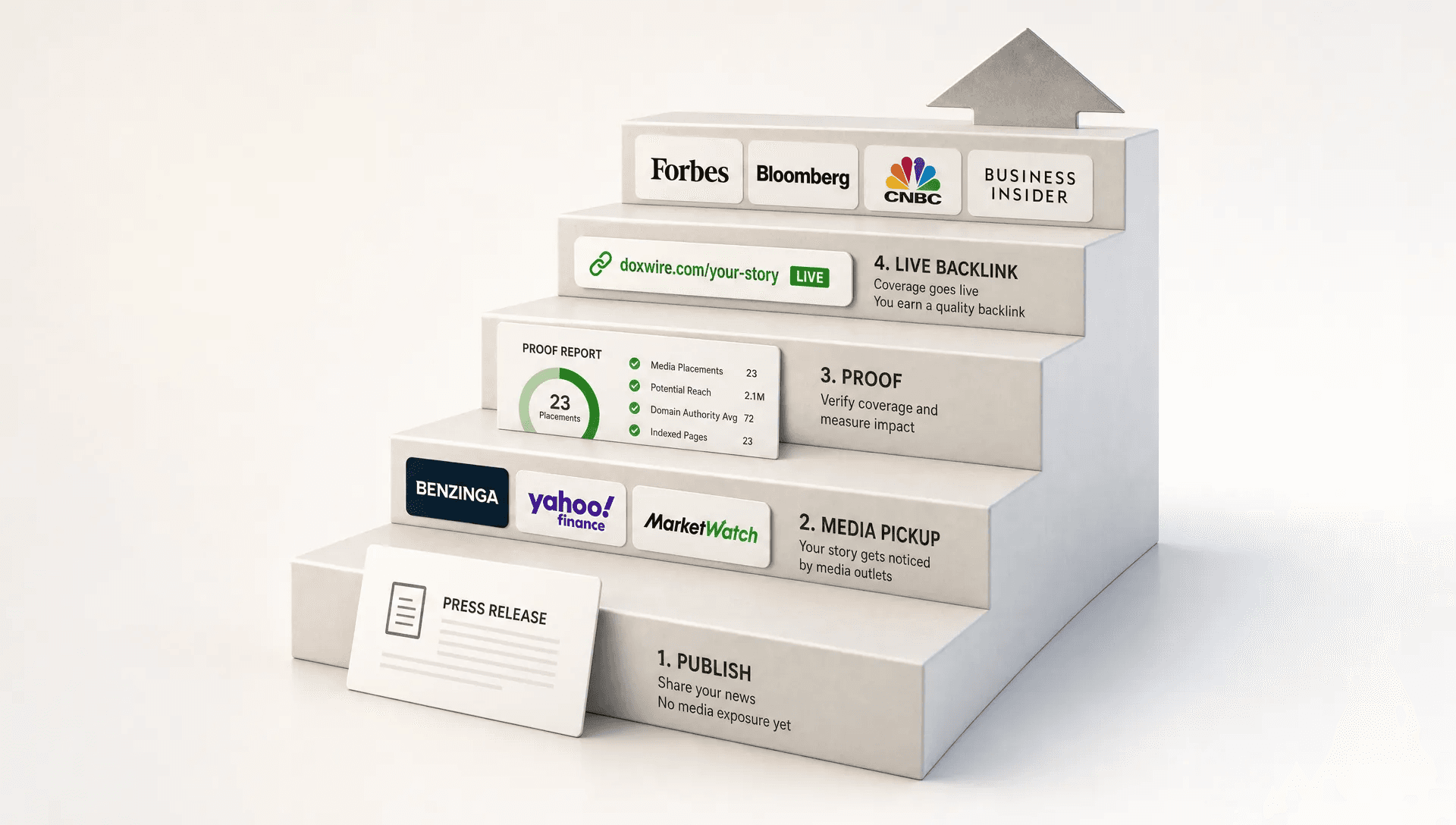
This is where distribution can help. Manual outreach is valuable, but it is also slow and unpredictable. Distribution gives you a way to place the announcement across relevant publications and create live media references that support broader PR, SEO, sales, and investor conversations.
The distinction is important: guaranteed press release placements are not the same as a journalist independently writing a feature after an interview. Both can be useful, but they serve different purposes. Earned editorial coverage builds third-party validation. Distributed placements create reach, discoverability, and public proof around a specific announcement.
Turn small mentions into bigger opportunities
The first mention is rarely the finish line. It is an asset.
Once you have coverage, use it. Add a tasteful “featured in” or “as seen in” section if the placement supports trust. Share the article with your email list, sales prospects, investors, partners, and employees. Post a short takeaway on LinkedIn instead of just dropping a link. Update your media kit so future writers can see previous coverage quickly.
Then use the mention to pitch the next opportunity. For example, if a trade publication covers your launch, you can pitch a podcast on the founder story behind it. If a local outlet covers your expansion, you can pitch a business newsletter on the trend it represents. If your press release is picked up across several outlets, you can reference that public announcement when offering commentary to writers covering your category.
This compounding effect also matters for discoverability. In 2026, buyers often encounter brands through search results, AI-generated answers, social posts, review sites, and media snippets long before they visit a homepage. Consistent media mentions can create more public context around who you are and what you do. For a deeper look at that shift, see MediaBoost’s article on how media coverage makes your startup visible to AI.
The goal is not to chase logos for vanity. The goal is to build a footprint that makes your brand easier to trust, cite, recommend, and remember.
A 30-day plan to get press when no one knows you
If you are starting from zero, avoid trying to do everything at once. Use the first month to create a focused, repeatable system.
| Timeline | Focus | Action |
|---|---|---|
| Days 1 to 5 | Clarify the angle | Identify one timely story your audience and the media both care about |
| Days 6 to 10 | Build proof | Create a media kit, gather data, write spokesperson bios, and prepare assets |
| Days 11 to 15 | Select outlets | Build a short list of local, niche, trade, podcast, and newsletter targets |
| Days 16 to 20 | Draft and refine | Write one press release and two pitch variations for different outlet types |
| Days 21 to 25 | Distribute and pitch | Send personalized outreach and use distribution if you have a real announcement |
| Days 26 to 30 | Repurpose and follow up | Share coverage, update your website, follow up once, and pitch the next angle |
This plan works because it avoids random activity. Instead of blasting hundreds of people with a generic announcement, you are building a press foundation: a credible story, proof to support it, relevant outlets, and a process for turning coverage into momentum.
Common reasons unknown brands get ignored
If your outreach is not working, the issue is usually fixable. Most failed pitches fall into a few patterns.
The first is lack of news value. A company milestone may matter internally, but it needs an external reason to matter to readers. Tie the milestone to a trend, problem, data point, or local impact.
The second is poor targeting. A great cybersecurity story sent to a general lifestyle editor is still a bad pitch. Match your angle to the writer’s beat.
The third is overpromotion. If every sentence sounds like website copy, rewrite it. Media language is factual, specific, and audience-centered.
The fourth is weak proof. Claims without evidence create risk for the writer. Add numbers, examples, named sources, customer insights, or documented milestones when possible.
The fifth is giving up too early. PR compounds over time. One unanswered pitch means very little. A pattern of unanswered pitches means you need to improve the angle, outlet list, or credibility assets.
Frequently Asked Questions
Can a brand with no previous coverage get press? Yes. Previous coverage helps, but it is not required. Unknown brands can get press by offering a timely angle, credible proof, and a source that is useful to the outlet’s audience.
What is the fastest way to get press coverage? The fastest path is usually a real announcement paired with press release distribution and targeted outreach to relevant niche or local outlets. Major editorial features often take longer because they depend on timing, fit, and journalist interest.
Should I pitch journalists or send a press release? Use both when the announcement is strong. A press release creates an official, shareable record of the news, while personalized pitches help you earn deeper coverage, interviews, or quotes.
How many media outlets should I pitch at first? Start with a focused list of 20 to 40 highly relevant contacts rather than hundreds of generic targets. Quality of fit usually matters more than volume, especially when your brand is still unknown.
What should I do after I get my first press mention? Share it, add it to your media kit, reference it in future pitches, use it in sales or investor conversations, and build a follow-up story. The first mention should make the second one easier.
Ready to build your first layer of media credibility?
Getting press coverage when no one knows your brand is not about luck. It is about packaging a real story, proving your credibility, choosing the right outlets, and making every mention work harder.
If you have a legitimate announcement and want a faster way to build visibility, MediaBoost can help with done-for-you press release distribution across 500+ media outlets, guaranteed live backlinks, editorial review, proof reports, industry-specific packages, and fast turnaround, often within 48 hours. Use it as a credibility layer, then keep building with targeted outreach, stronger stories, and consistent media momentum.