How to Write a Brand Press Release People Trust
A trusted brand press release does more than announce news. It gives readers clear claims, real proof and transparent context so journalists, customers and partners can believe the story.
Get featured on 500+ media outlets
Guaranteed placement, no PR experience needed.
Trust is the real product of a strong press release. Visibility helps, but a brand press release only earns attention when readers believe the announcement, understand why it matters and can verify the claims without doing detective work.
That matters even more in 2026. Journalists, customers, investors, partners and AI search systems all scan for signals of credibility: clear facts, named sources, specific outcomes, consistent language and publication context. A vague announcement filled with superlatives may get published, but it will not do much for brand trust.
A trustworthy brand press release is not a sales page with a dateline. It is a concise public record of something real, written in a way that makes it easy for a skeptical reader to say, “This sounds credible.”
Start With a Claim You Can Prove
Before writing the headline, decide what the release is truly announcing. The strongest angle is usually a concrete change in the business, not a broad statement about being “innovative” or “industry-leading.”
A trusted release begins with one central claim, then supports it with evidence. That claim might be a product launch, funding round, partnership, customer milestone, expansion, research finding, certification, leadership appointment or major company update. If the announcement does not create a clear change for customers, the market or the company, it may be better suited for a blog post or newsletter instead.
The test is simple: could a reasonable third party verify the main statement? If the answer is no, rewrite the angle until it rests on facts.
For example, “Company X launches a new customer support platform for independent retailers” is stronger than “Company X revolutionizes retail support.” The first statement tells readers what happened and who it helps. The second asks them to accept a conclusion without proof.
Use a Trust-First Press Release Structure
A trustworthy structure does not hide the important details. It puts the news, source and proof where readers expect to find them.
Most brand press releases should follow this order: a clear headline, a direct subheadline, a dateline, a lead paragraph, supporting facts, a credible quote, background context, a boilerplate and media contact details. If you need a refresher on the mechanics, MediaBoost has a separate guide to press release formatting rules every brand should follow.
The lead paragraph should answer the core questions quickly: who is announcing something, what changed, when it happened, where it applies and why it matters. Avoid making readers wait until paragraph four to understand the announcement.
A good lead might read like this:
“Acme Analytics today announced the launch of its new reporting platform for independent healthcare clinics, designed to help operations teams consolidate patient communication, scheduling and revenue data in one dashboard.”
That sentence is not flashy, but it gives the reader a usable foundation. From there, the release can explain the problem, who the product serves, what makes the update relevant and what proof supports the announcement.
Replace Hype With Specificity
Trust drops when a release leans on claims that sound impressive but say little. Phrases like “game-changing,” “best-in-class,” “next-generation” and “unmatched” are common because they are easy to write. They are also easy to ignore.
Specific language feels more credible because it reduces the burden on the reader. It shows the company knows exactly what changed and who benefits.
| Weak phrasing | More trustworthy phrasing |
|---|---|
| We are transforming the industry | We are launching a compliance workflow for regional accounting firms |
| Our platform is the best solution available | Our platform now supports same-day invoice reconciliation for Shopify merchants |
| We are proud to announce rapid growth | We added 1,200 paid customers between January and July 2026 |
| This partnership is a major milestone | The partnership gives customers access to integrated payroll reporting across both systems |
| Our solution saves time and money | Beta users reported reducing manual reporting from 6 hours to 2 hours per week |
The stronger examples work because they give the reader something to evaluate. They also create better material for journalists, search engines and sales teams.
If you do use performance data, define the context. A statistic without a sample size, time frame or comparison point can raise more questions than it answers. “Customers saved 40 percent of admin time” sounds compelling, but it needs support. Was that based on a survey, product usage data, a pilot group or a single customer story?
Make Quotes Sound Like Real People
Quotes are often the weakest part of a brand press release because they repeat the headline in corporate language. A quote should not say, “We are excited to announce this innovative solution.” That tells the reader almost nothing.
Use quotes to add judgment, context or a point of view that cannot be stated as a plain fact. The quote should explain why the announcement matters now, what problem the company is solving or what the next step means for customers.
A stronger quote might say:
“Independent clinics are under pressure to make faster operational decisions without adding headcount. We built this release around the reporting gaps our customers kept flagging in scheduling, billing and patient follow-up.”
That quote has a human source, a specific audience and a reason to care. It also sounds like something an executive, founder or product leader might actually say.
Use one or two quotes at most in a standard release. More than that can slow the story down unless the announcement includes multiple credible stakeholders, such as a partnership, acquisition or community initiative.
Substantiate Operational Claims
Many brand press releases ask readers to trust statements about quality, security, reliability, compliance, sustainability or customer impact. Those claims can be useful, but only when they are backed by evidence.
If the release says the company is improving safety, describe the process. If it says a product helps teams save time, explain what workflow changed. If it mentions compliance, identify the standard, certification or documented procedure involved. The goal is not to overload the reader with technical detail. It is to show that the claim has a foundation.
For example, a drone inspection company can make an operational credibility claim stronger by explaining that its work is planned, logged and documented through a drone operations management platform such as Dronedesk, rather than simply saying it has “robust safety processes.” The specific reference gives readers a clearer picture of how the company supports planning, risk assessment and flight records.
The same principle applies in almost every sector. A fintech company can reference audit controls. A health brand can reference clinical review processes. A logistics company can reference tracking data, delivery zones or service level benchmarks. Specific proof makes the announcement easier to believe.
Be Transparent About What Is New
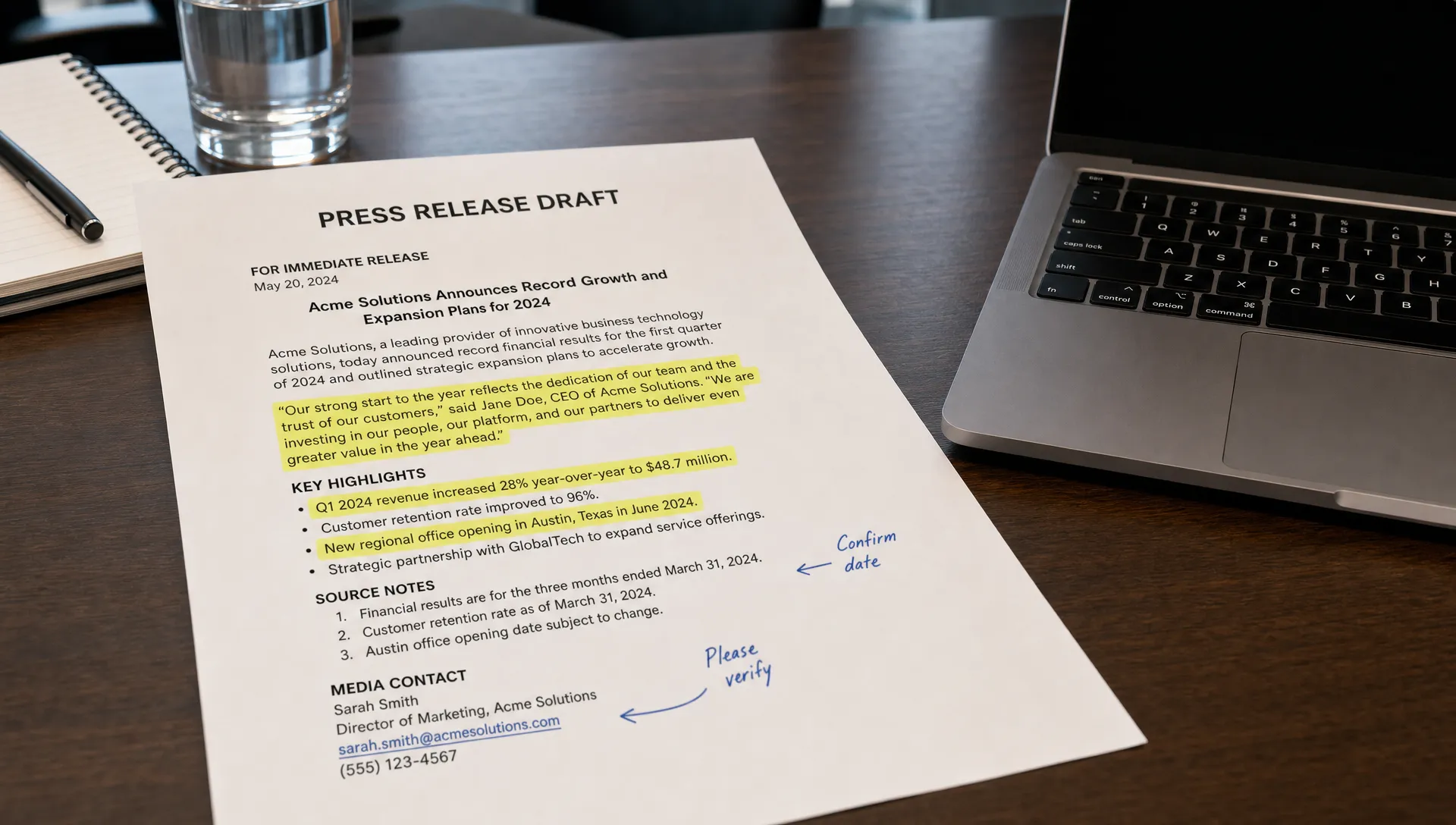
A trusted release makes a clear distinction between what is being announced now and what already existed. This is especially important for product updates, rebrands, partnerships and expansions.
If a product is already live, say so. If the launch is limited to a waitlist, beta group or region, say that too. If a partnership is a pilot rather than a full rollout, describe it accurately. Readers are more likely to trust a narrow, honest announcement than a broad one that later feels inflated.
Transparency also applies to timelines. Avoid implying that future plans have already happened. “The company plans to expand to Texas in Q4” is different from “The company expands to Texas.” The first is a forward-looking statement. The second is a completed action.
This distinction matters for legal, reputational and editorial reasons. A journalist may follow up. A customer may make a buying decision based on the release. An AI search result may summarize the announcement later. Clear language protects the brand from confusion.
Add Trust Signals Without Overloading the Release
A brand press release should include enough context to build confidence, but not every detail belongs in the body. Choose the proof points that best support the central claim.
Good trust signals include named customers or partners, measurable milestones, executive accountability, product screenshots or assets, certifications, third party reviews, analyst context, funding details, customer quotes, case study links and clear contact information.
Use only what is relevant. A release about a new executive hire does not need a long list of product features. A release about a product launch should not spend half its space recapping company history. Keep the story focused, then use the boilerplate and links for background.
The media contact section is also a trust signal. Include a real name, role, email address and company website when possible. A generic contact form can work for smaller brands, but human contact details tend to feel more accountable.
Write for Journalists, Customers and Search
A trustworthy press release serves several audiences at once. Journalists need a clean story angle and verifiable details. Customers want to know whether the announcement affects them. Search engines need clear entities, topics and context. AI answer engines increasingly rely on structured, consistent public information when summarizing brands.
That does not mean stuffing keywords into every paragraph. It means using the brand name, product names, executive names, industry terms and location details naturally. If the phrase “brand press release” fits once or twice, use it. If it sounds forced, do not.
The most search-friendly release is usually the clearest one. A descriptive headline, direct opening paragraph, relevant subheadings and consistent terminology help both humans and machines understand the announcement.
Distribution also affects trust. A release published only on an obscure page may not create much validation. Placement across relevant, reputable outlets gives the announcement more public context. If you are deciding where to publish, this MediaBoost guide on how to choose media outlets that build real brand trust explains how to weigh audience fit, credibility and editorial relevance.
Avoid the Most Common Trust Killers
Even a newsworthy announcement can lose credibility through small choices. The most common issues are vague claims, missing sources, overlong background sections, buried details, exaggerated quotes, unclear availability and unsupported comparisons.
Comparative claims deserve special care. If you say your product is faster, easier, cheaper or more accurate, make the comparison clear. Faster than what? Easier for whom? Cheaper under which pricing model? More accurate according to which test?
Also watch for borrowed credibility. Listing famous media logos, partner names or customer categories can help only when the relationship is real and presented accurately. If a logo implies an endorsement that does not exist, it can damage trust quickly.
For endorsements and testimonials, the Federal Trade Commission expects truthful representation and disclosure of material connections. Even when a press release is not an ad in the traditional sense, using customer praise, influencer comments or partner quotes responsibly protects the brand.
A Practical Trust Checklist Before You Publish
Before sending the release, review it as if you were a skeptical editor or buyer seeing the company for the first time.
- The headline states what happened without exaggeration
- The lead paragraph answers who, what, when, where and why it matters
- Every major claim has a source, example or supporting detail
- Quotes add context instead of repeating the announcement
- Availability, timing and scope are clear
- Names, titles, numbers and links have been checked
- The boilerplate is current and factual
- The media contact is easy to reach
- The release has a natural next step for readers
If your release fails one of these checks, fix it before distribution. Credibility is much easier to preserve than rebuild.
If you need a starting point for common announcement types, MediaBoost also offers press release templates for startups and small brands that can help you organize the first draft without losing the trust signals that matter.
Frequently Asked Questions
What makes a brand press release trustworthy? A trustworthy brand press release makes one clear announcement, supports it with verifiable facts, uses specific language, includes accountable quotes and avoids exaggerated claims that cannot be proven.
How long should a brand press release be? Most press releases work best between 400 and 800 words. Complex announcements can be longer, but clarity matters more than length. If a section does not support the news angle, cut it or move it to a background link.
Should a press release include data? Yes, if the data is relevant and can be explained. Include the time frame, source and context behind important numbers. Avoid using statistics that sound impressive but cannot be verified.
Can a small brand write a press release people trust? Yes. Small brands often build trust by being more specific. A clear customer problem, named founder, measurable milestone, local relevance or focused industry angle can be more credible than broad corporate language.
How many links should a press release include? Use only the links that help readers verify the announcement or take the next step. Common examples include the company website, product page, media kit, report, case study or booking page. Too many links can make the release feel promotional.
Turn a Trusted Press Release Into Visible Proof
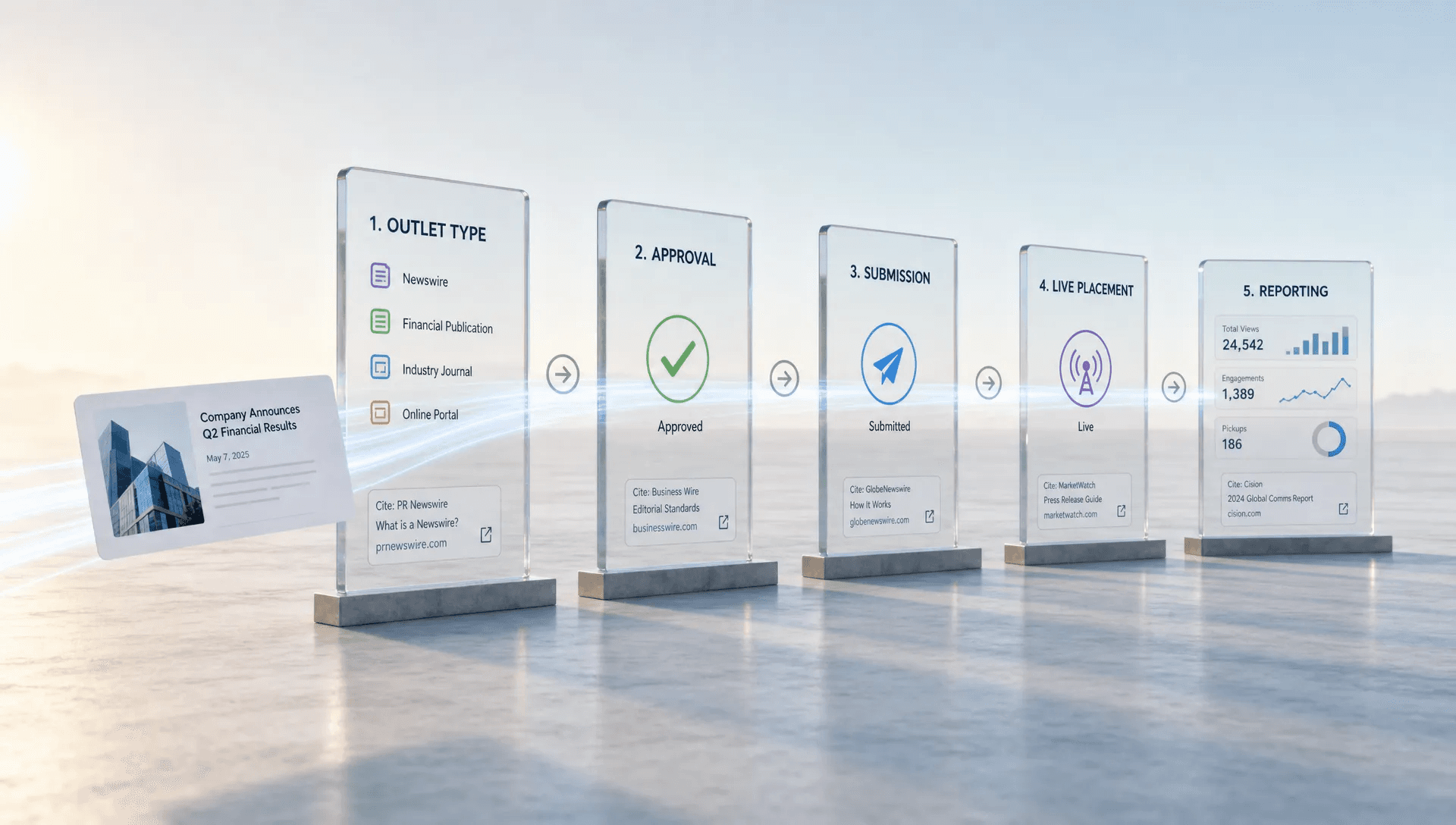
A credible release is only useful if the right people can find it. MediaBoost helps brands distribute press releases across 500+ media outlets with done-for-you submissions, live links, editorial review and proof reports. Packages can be tailored by industry, with turnaround often completed within 48 hours.
If you want your next brand press release to build credibility, search visibility and stronger public proof, explore MediaBoost and see how trusted placements can support your announcement.