Why Global Press Release Distribution Matters for Growth
Growth brands need more than one local mention. This guide explains how global press release distribution builds credibility, search visibility, partner trust, and reusable media proof across markets. Use it to decide when wider distribution is worth it.

Get featured on 500+ media outlets
Guaranteed placement, no PR experience needed.
Growth used to depend on who knew you in your home market. In 2026, that is no longer enough. Buyers compare brands across borders, investors research companies before taking a call, search engines evaluate public signals, and AI answer engines pull from the open web to understand which brands are credible.
That is why global press release distribution matters. It gives a brand a structured way to announce meaningful news across markets, build a public footprint, and turn one milestone into proof that can support sales, SEO, partnerships, hiring, and fundraising.
A press release will not replace product-market fit, customer experience, or a strong offer. But when it is used strategically, it can make growth easier by helping the right people discover, verify, and remember your brand.
The growth problem: credibility has to scale
Most companies can create visibility in one channel. They run paid ads, post on LinkedIn, send emails, sponsor newsletters, or pitch local journalists. Those channels can work well, but they often create fragmented attention. A prospect may see your ad without knowing whether your company is established. A partner may hear your name but struggle to validate it. A customer may search for you and find only your own website.
Growth becomes easier when your brand has third-party visibility. Not because a publication logo automatically convinces everyone, but because public coverage creates context. It shows that your announcement exists outside your own marketing claims.
This is especially important for companies entering new regions, launching a product in a competitive market, or selling to risk-aware buyers. Before people buy, invest, collaborate, or recommend, they look for signals that your company is real, active, and relevant.
Global distribution helps create those signals at scale.
What global press release distribution actually does
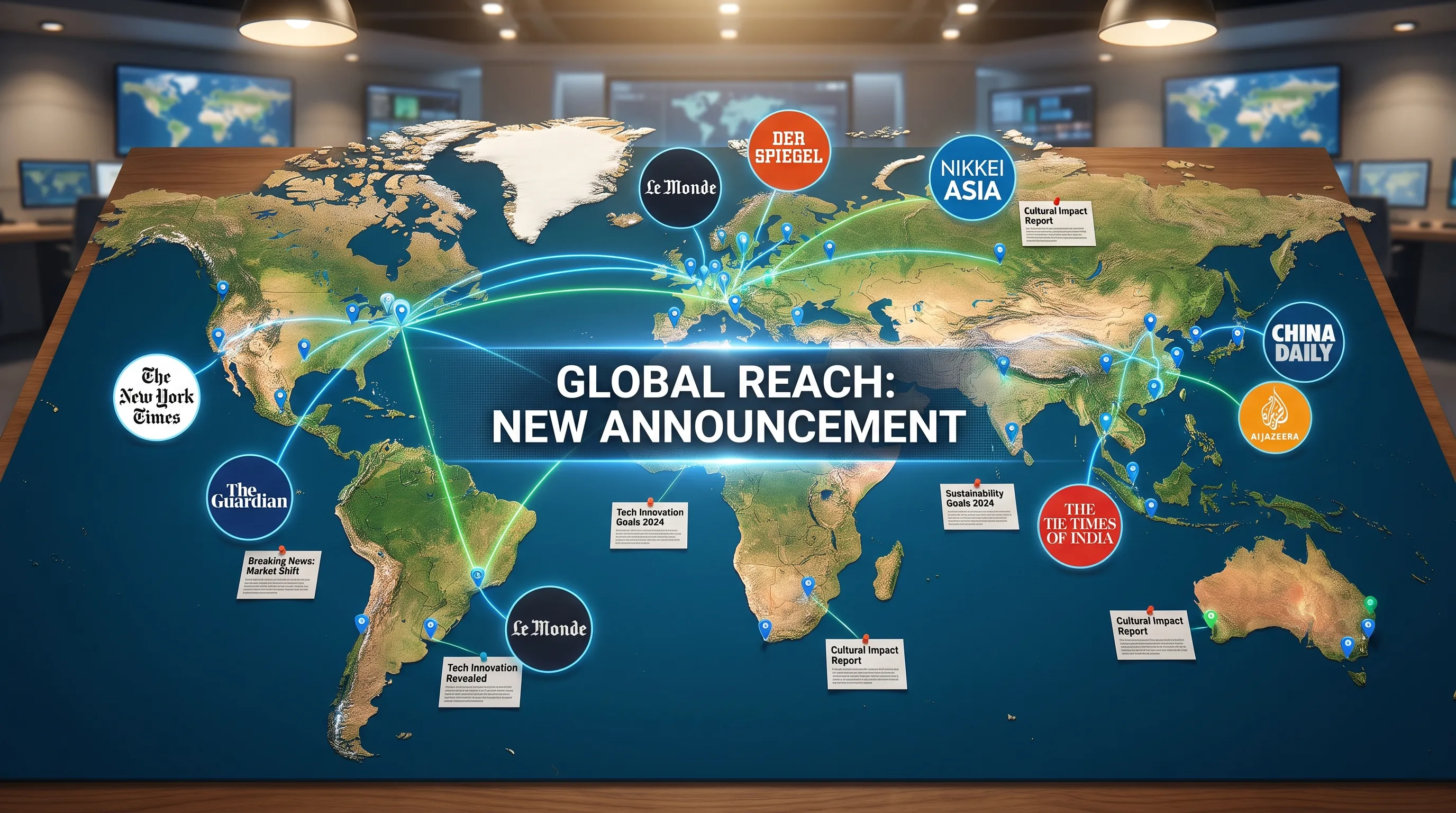
Global press release distribution is the process of sending a news announcement to media outlets, financial platforms, industry publications, and online news networks across multiple regions. The goal is not just to publish a release once. The goal is to create a broader media footprint around a newsworthy moment.
That footprint can include live article placements, indexed pages, backlinks, publication references, and proof reports that your team can reuse in sales and marketing. The best results come when the release has a clear angle, a relevant audience, and a distribution strategy that matches the brand’s growth goals.
A local press release might support community awareness. A national release might build credibility in one country. Global distribution is different because it positions the announcement for multiple markets at once.
That matters when your customers, partners, investors, or search demand are not limited to one geography.
Why global distribution supports modern growth
The value of press release distribution is often misunderstood. Some teams view it only as a backlink tactic. Others expect it to generate instant media interviews. Both views are too narrow.
A well-distributed release supports growth in several connected ways.
| Growth goal | How global distribution helps | What to prioritize |
|---|---|---|
| Brand credibility | Creates third-party references across recognized outlets | Strong headline, factual claims, clear company positioning |
| Search visibility | Adds indexed mentions and contextual backlinks that support discoverability | SEO-friendly release structure and relevant landing pages |
| Sales enablement | Gives teams proof links to share with prospects, partners, and investors | Proof reports, recognizable outlets, concise media assets |
| Market expansion | Introduces a company to audiences outside its home region | Region-aware messaging and industry-specific distribution |
| AI visibility | Adds public web signals that may help AI systems understand the brand entity | Consistent naming, clear descriptions, repeated trustworthy mentions |
The important point is that these benefits compound. One release may support a launch. Multiple well-timed releases can create a pattern of activity that makes your brand easier to find, verify, and explain.
Trust travels faster when it appears in more than one market
When a company is visible only in its own channels, audiences have to take its word for everything. When that same company appears across trusted media outlets, the brand gains a stronger public identity.
This is particularly useful for B2B companies, fintech brands, SaaS startups, agencies, consumer brands, e-commerce stores, crypto projects, and professional services firms that need to prove legitimacy quickly. A buyer in New York, London, Dubai, Singapore, or Toronto may not know your brand yet, but they can still evaluate your public presence.
A global release gives those audiences more context. It helps answer questions like:
- Is this company active and growing?
- Has it announced something substantial?
- Can I find third-party references beyond its own website?
- Does the company appear relevant to my market or industry?
That kind of trust is not built by volume alone. It comes from combining a credible announcement with consistent messaging and a distribution network that reaches publications your audience recognizes.
Search and AI discovery now depend on public signals
Search visibility has changed. Ranking is no longer just about publishing pages on your own site and waiting for traffic. Search engines evaluate brands, entities, topical relevance, and trust signals across the web. AI search and answer engines also rely on public information to understand who a company is, what it does, and why it matters.
A press release can help by creating structured, crawlable information about your brand. When distributed properly, it can reinforce your company name, product category, leadership, market, launch details, and positioning.
This does not mean every press release will rank for a competitive keyword. It also does not mean backlinks from syndicated coverage should be treated as a shortcut to SEO success. The better way to think about it is this: global distribution helps create discoverable proof around a real business event.
If you want the announcement itself to perform better in search, the writing matters. Clear headlines, concise summaries, relevant keywords, and supporting context all help. MediaBoost has a practical guide on how to write a press release that ranks on Google if you want to improve the SEO foundation before distribution.
Global press release distribution turns milestones into reusable assets
A major announcement should not disappear after one social post. If your company launches a product, expands internationally, closes a partnership, publishes research, opens a new location, or announces funding, that milestone can be repurposed across your growth engine.
A distributed press release can support:
- Sales emails that include media proof
- Investor updates with credible public references
- Landing pages that mention recent coverage
- Social posts that highlight publication placements
- Partner outreach that shows market momentum
- Founder profiles and speaker applications
This is where press release distribution becomes more than publicity. It becomes a credibility asset.
For example, event-led brands can benefit when their announcement has a visual or record-breaking angle. A campaign built around a champagne tower or record attempt, such as the world-record display work from Luuk Broos Events, has a story that can travel beyond the local venue when packaged for international media. The same principle applies to product launches, research reports, brand partnerships, and category-first announcements.
When a global release is worth it
Not every update deserves global distribution. A minor website redesign, a small internal hire, or a routine discount campaign may not carry enough news value. Growth-focused teams should reserve wider distribution for moments that can support a larger business objective.
Good candidates include product launches, funding announcements, executive appointments, strategic partnerships, major customer wins, international expansion, industry reports, award wins, event announcements, and new market entries.
The key question is simple: would a customer, partner, investor, journalist, or industry observer have a reason to care?
If the answer is yes, global distribution can help the announcement reach more of the people who matter. If the answer is no, the better move is to strengthen the story before spending budget.
What makes a global press release effective
Distribution is only as strong as the announcement being distributed. A weak release sent to hundreds of outlets is still a weak release. To create growth value, the release needs to be clear, relevant, and structured for both humans and search systems.
The strongest releases usually include a specific news hook, a concise explanation of why the announcement matters, a quote that adds insight rather than filler, supporting details, and a clear company boilerplate. They also avoid exaggerated claims, vague language, and unsupported promises.
Formatting matters more than many teams realize. Editors, distribution partners, and readers all need to understand the announcement quickly. Before submitting, check that your release follows standard structure and avoids common errors. This guide to press release formatting rules every brand should follow is a useful pre-distribution checklist.
Audience targeting matters too. A global network is valuable, but relevance still counts. A fintech release should not be treated the same way as an e-commerce release. A crypto announcement, a healthcare update, and a B2B SaaS launch all need different positioning and outlet priorities.
Quantity matters, but quality determines the outcome
It is tempting to judge distribution only by the number of outlets. More placements can create a larger footprint, but volume alone is not the goal. A campaign should also be judged by live links, publication relevance, indexing, proof quality, and whether the coverage can be used by the business afterward.
This is where many companies waste budget. They buy reach without considering the strength of the announcement, the credibility of the network, or how the coverage will support growth after publication. If you are comparing options, it is worth reviewing the common press release distribution mistakes that waste budget before choosing a provider.
A strong global distribution partner should help you answer practical questions:
- Which outlets or networks are relevant to this announcement?
- Will the placements include live links?
- How quickly will the release go live?
- Will I receive proof of publication?
- Is the package suitable for my industry?
- Does the release need editorial improvement before submission?
These details matter because the business value comes after publication. Your team needs links it can share, proof it can trust, and coverage that supports the next stage of growth.
How to measure the growth impact
Press release performance should be measured with realistic expectations. A global release is not the same as a paid ad campaign, so click-through rate is not the only metric. It often creates value through credibility, search footprint, and sales support, which can be harder to measure in a single dashboard.
Useful metrics include live placements, indexed pages, backlink quality, referral traffic, branded search lift, sales team usage, partner responses, and changes in how often your brand appears in search or AI-generated summaries.
You should also track qualitative outcomes. Did prospects mention seeing your announcement? Did investors respond more positively after receiving media proof? Did partners use the release in their own communications? Did your team gain better assets for outreach?
The most successful companies treat press release distribution as part of a broader growth system. They connect it to landing pages, sales sequences, social proof, founder branding, investor relations, and ongoing content strategy.
The MediaBoost approach to global visibility
MediaBoost helps brands turn announcements into media placements across 500+ trusted publications. The service is designed for companies that want guaranteed submissions, live backlinks, proof reports, editorial review, and industry-specific packages without managing every submission manually.
For growth teams, the appeal is speed and credibility. A campaign can often be completed quickly, sometimes within 48 hours, while giving the brand assets it can reuse across marketing, sales, and investor communications.
That does not mean every company should distribute every update globally. The best results come from choosing the right announcement, refining the message, and aligning the distribution package with the business goal. When those pieces are in place, global press release distribution can become a practical growth lever rather than a one-off PR expense.
Frequently Asked Questions
What is global press release distribution? Global press release distribution is the process of sending a news announcement to media outlets, news networks, and industry publications across multiple countries or regions. It helps brands create broader visibility and third-party references for important announcements.
Does global press release distribution help SEO? It can support SEO indirectly by creating indexed mentions, contextual backlinks, and stronger brand signals across the web. The best results happen when the release is newsworthy, well-written, and connected to a strong website or landing page.
Is global distribution better than local distribution? It depends on your goal. Local distribution is useful for community or regional announcements. Global distribution is better when you want to reach international customers, investors, partners, or search audiences.
How often should a company send press releases? Companies should send press releases when they have meaningful news. Quality matters more than frequency. A few strong announcements per year can outperform frequent releases with weak angles.
What should I prepare before distributing a press release? Prepare a clear news hook, accurate company details, approved quotes, supporting links, a media contact, and a landing page that explains the announcement. You should also decide how your team will reuse the coverage after it goes live.
Turn your next announcement into global proof
If your company has a real milestone to share, global distribution can help it reach more markets, build credibility, and create proof your team can use long after publication day.
MediaBoost helps brands distribute press releases across 500+ outlets with live links, editorial review, proof reports, and industry-specific packages. If your next launch, partnership, funding update, or expansion deserves more than a single post, global press release distribution can turn it into a growth asset.